
Engineered by Dingtian
H Beam Shot Blasting Machine Q69 | Roller Conveyor Type
H beam shot blasting machine with roller conv…
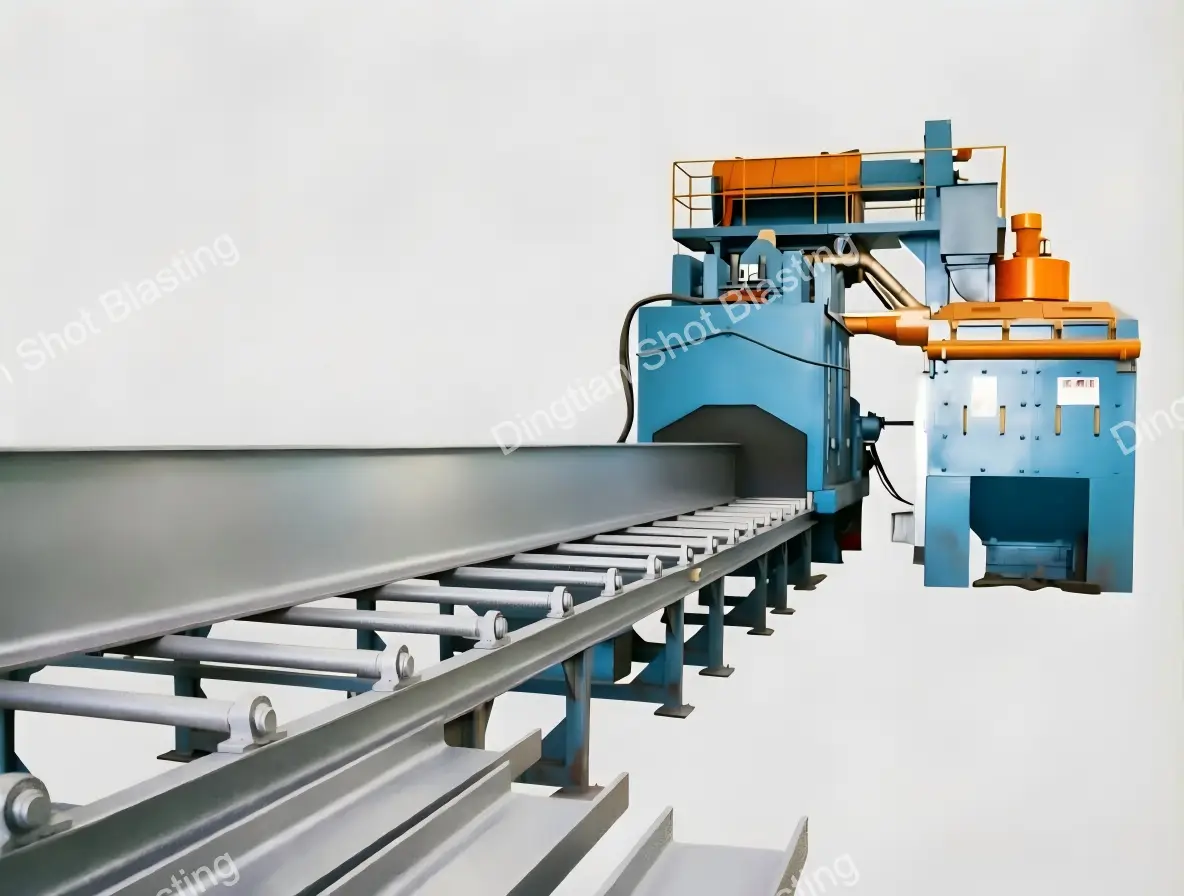
Request a QuoteAn H beam shot blasting machine is a through-feed roller conveyor system. It cleans long steel sections in one continuous pass. Sections roll horizontally into a fully enclosed blast chamber. Multi-angle blast wheels fire abrasive at the flanges, the web and the weld zones. They remove oxide scale, rust, weld slag and old primer. The steel leaves the chamber at a uniform cleanliness grade and a consistent anchor profile. It is then ready for protective coating, paint or powder coating.
There is no crane handling between load and unload. There is no turning of long members by hand. There is no idle gap between batches. That matters for a fabricator running H-beams, I-beams, channel steel and welded columns. It is the difference between a preparation step that waits on the floor and one that runs at line speed.
Buyers in different markets call the same machine by different names — roller conveyor shot blasting machine, structural steel shot blasting machine, tunnel type shot blasting machine, through feed shot blasting machine, wheel blast machine, beam blast line. This page covers all of them, because the machine you need is the machine your search terms describe.
1. What is an H beam shot blasting machine?
It is a continuous through-feed blast cleaning machine for structural steel sections. The workpiece moves on a powered roller conveyor. Loading, blasting and unloading happen at the same time, on different parts of one member. One pass is normally enough for open sections such as H-beams and I-beams. The web and both flange faces are exposed to the wheel pattern.
The machine does three jobs at once:
- Descaling — it removes mill scale formed during hot rolling. Mill scale is cathodic to steel, so leaving it under a coating drives undercutting and early coating failure.
- Rust and weld slag removal — it strips corrosion products, spatter and flux residue from weld seams. That happens before inspection or coating.
- Anchor profile creation — it leaves a controlled surface roughness. That gives the coating mechanical key. A smooth blasted surface holds less coating than a properly profiled one.
Standard result: Sa 2.5 to Sa 3.0 cleanliness per ISO 8501-1. Surface roughness is Ra 12.5 to 50 micron, adjustable through abrasive size, wheel speed and conveyor speed. SA 2.5 cleaning grade is what most structural steel coating specifications require. It is also what a steel service centre needs before applying a shop primer.
Why fabricators replace manual preparation with a roller conveyor machine
Manual chipping, wire brushing and handheld grinding cannot reach a reproducible cleanliness grade on a twelve metre beam. They also cannot hold a consistent profile across the flange, the web and the fillet. A through-feed machine repeats the same wheel pattern, abrasive flow and travel speed on every member. The coating specification is then met piece after piece, not by inspector luck.
2. What do overseas buyers call this machine?
The same equipment carries several established names, and buyers search by the name they already know. Every term below is in active use by equipment makers, B2B directories or structural steel shops. Strong text marks the terms buyers actually type.
| Term | Where it is used |
|---|---|
| H beam shot blasting machine / I beam shot blasting machine | Highest-volume generic search terms for this machine class, worldwide |
| Roller conveyor shot blasting machine | The standard industry term — Wheelabrator, Gostol TST, IST Surface, Qinggong, JX |
| Structural steel shot blasting machine | North American wording — BlastKing and structural fabrication shops |
| Steel structure shot blasting machine | Asian and Middle East tender wording; also used for steel construction workshops |
| Section steel shot blasting machine / H steel shot blasting machine | Asian and Middle East suppliers; direct translation of the Chinese term |
| Through feed shot blasting machine / pass-through shot blasting machine | Process-first wording, used when the buyer is specifying a line rather than a single machine |
| Tunnel type shot blasting machine | European wording — granalladopro and EU integrators |
| Roller table shot blast machine | Patent and technical literature wording |
| Wheel blast machine | Pangborn official product category wording |
| Beam blast line / beam line | North American structural steel shops and steel service centres |
| PeddiBlast / Ocean Blaster class | Trade names North American structural steel shops use for this machine type |
| Steel structure shot blasting line / continuous shot blasting line | Buyers specifying a full production line rather than one machine |
| H beam shot blasting and painting combined line | Buyers who want blasting and primer application in one pass |
| Automatic H section beam descaling machine | Descaling-first wording, common in rolling mill and service centre specifications |
| Heavy duty shot blasting machine for steel construction | Tender wording for large fabrication plants |
| Sa2.5 surface cleaning machine for structural steel | Specification-first wording, used when the coating standard drives the purchase |
| Q69 / QH69 series | Chinese model designation for roller conveyor through-feed machines |
Long-tail terms buyers search, grouped by intent
These come from equipment catalogue titles, B2B listing pages and real enquiry wording. The grouping tells you where a term belongs. That may be a heading, the body, a comparison table or a question.
| Intent group | Long-tail search terms |
|---|---|
| Machine type and structure | h beam shot blasting machine, roller conveyor shot blasting machine, roller conveyor type shot blast machine, continuous H beam shot blasting machine, steel beam shot blasting machine, through feed shot blasting machine, tunnel type blast cleaning machine, roller table shot blast machine, structural steel shot blasting machine, section steel shot blasting machine |
| Model and brand reference | Q69 shot blasting machine, QH69 roller conveyor blast line, PeddiBlast equivalent machine, Ocean Blaster class beam line, Wheelabrator roller conveyor type G equivalent, Pangborn wheel blast machine equivalent, Gostol TST P series equivalent |
| Workpiece and application | shot blasting machine for H beams and I beams, channel steel shot blasting machine, angle steel descaling machine, blast cleaning machine for steel columns and beams, welded steel structure shot blasting machine, box girder shot blasting machine, steel plate and profile blast line, steel service center equipment, transmission tower member shot blasting machine, bridge girder surface preparation equipment |
| Process and specification | SA 2.5 cleaning grade shot blasting machine, Sa 3 near white metal blast machine for structural steel, adjustable roller conveyor shot blasting machine, ISO 8501-1 surface preparation machine, efficiently descale H-beams, anchor profile blast machine for steel, oxide scale removal machine for hot rolled sections, structural steel shot blaster, automatic descaling and rust removal line |
Commercial and after-sales terms buyers search
| Intent group | Long-tail search terms |
|---|---|
| Purchasing intent | h beam shot blasting machine price, roller conveyor shot blasting machine for sale, h beam shot blasting machine manufacturer, structural steel shot blasting machine supplier China, OEM ODM beam blast line factory, customized roller conveyor shot blasting machine, shot blasting machine source factory in China, roller conveyor shot blasting machine quotation |
| Comparison and research | roller conveyor vs hanger type shot blasting machine, how to choose a shot blasting machine for H-beam and channel steel production lines, what is the pass-through speed of a continuous H-beam shot blasting machine, can a roller conveyor machine clean inside a box girder, shot blasting vs abrasive blasting for structural steel, what surface preparation grade is required before painting structural steel |
| Wear parts and spares | shot blasting machine wear parts, shot blasting machine blades, control cage, blast chamber wear liners, air wash separator, dust collector filter cartridge, roller conveyor blast machine spare parts, XCr23 alloy liner plates for beam blast line |
3. How does a roller conveyor shot blasting machine work?
The process is continuous and enclosed. Four stages run at the same time on different sections of the member.
| Stage | What happens | Why it matters to your output |
|---|---|---|
| Loading | The section is placed on the infeed roller conveyor and travels horizontally into the blast chamber through a rubber sealing curtain. | No crane lift into the chamber, no re-rigging, no waiting for the previous batch to leave. |
| Blasting | Blast wheels mounted above, below and to the sides fire steel abrasive at the flanges, the web and the weld zones. Wheel positions are laid out by 3D simulation before the machine is built, so the pattern covers the profile and minimises shadow zones. | One pass cleans an open section completely. Fillets and weld toes get coverage without repositioning the member. |
| Separation | The abrasive, dust and removed scale fall into the recovery system. An air wash separator returns reusable shot to the blast wheels and rejects fines and dust to the collector. | Closed-loop recovery keeps abrasive consumption down, which is the largest single running cost on a through-feed machine. |
| Blow-off and unloading | High-pressure air removes residual abrasive and dust from the top flange and the web before discharge. The section leaves the machine clean and dry. | Steel goes straight to primer or to the coating booth with no blow-down labour in between. |
What is the pass-through speed of a continuous H-beam shot blasting machine?
Conveyor speed on this machine family is normally 0.5 to 4 m/min, as an industry reference. High-capacity configurations run faster. The correct speed is not the fastest one. It is the speed at which your section reaches the specified grade and profile in one pass.
Three things set the speed. They are the thickness and tenacity of the mill scale, the required cleanliness grade, and the blast wheel count and power. Heavily rusted or thick-scaled sections need a slower pass or more wheel capacity. A section that only needs a light blast before shop primer can run faster. We set speed and wheel layout from your section list and coating specification. Not from a catalogue default.
The conveyor is inverter controlled on this machine family. Speed is therefore adjustable without changing gears or sprockets. That matters when your product mix shifts between light sections and heavy built-up beams in the same week.
4. Which sections and workpieces can it clean?
This is the classic blast cleaning machine for steel columns and beams. The machine is sized around your largest profile. The list below is what the design is built for, not a fixed limit.
- H-beams and I-beams — the ideal case. The web and both flange faces are exposed, so opposed wheel pairs reach them in one pass.
- Channel steel and angle steel — open sections, cleaned continuously alongside beams in the same production run.
- Welded beams, columns and built-up sections — weld slag and spatter removed before inspection or coating.
- Trusses and lattice members — long members that cannot be handled in a batch cabinet.
- Tower members — transmission tower and wind turbine tower sections. These often feed directly into a wind turbine tower shot blasting machine for shell work.
- Steel plate and flat bar — where a plate line is not justified. Sections and plate can then share one roller conveyor machine.
- Large welded structures — frames and assemblies that fit the chamber opening and lie flat on the rollers.
- Box girders and closed sections — possible, but with a caveat explained below.
Can it clean the inside of a box girder?
Not on a single through-feed pass. Blasting is a line-of-sight process. The interior faces of a closed section stay in shadow no matter how many wheels are mounted outside it. For enclosed box girders the practical options are:
- Add wheel angles aimed at the openings, and accept that the deep interior stays uncleaned.
- Run a second pass after the section is turned or opened.
- Blast the plates and profiles before assembly, then coat the interior with a stripe coat or a specified internal system.
- Use a hanger type shot blasting machine that can rotate the part, for members small enough to hang.
Telling you this before you order is cheaper than discovering it after commissioning. If closed sections dominate your mix, say so at enquiry stage. We will then recommend the right machine family, not simply the one you asked for.
5. Key features and engineering
| Feature | What it means for your production |
|---|---|
| Through-feed roller conveyor design | Loading, blasting and unloading run continuously in one pass. Built for long members and high-volume output, with no batch idle time. |
| 3D-simulated multi-angle blast wheels for full coverage | Wheel positions are modelled against your actual profile before build. Coverage reaches flanges, web and fillet areas from every direction, so shadow zones are minimised rather than discovered on site. |
| Wheels above and below the conveyor plane | Opposed wheel pairs reach the underside of the bottom flange and the top of the upper flange without turning the member over. |
| Adjustable roller conveyor width and speed | Conveyor width matches your section range; inverter speed control matches your coating line takt without mechanical changes. |
| XCr23 alloy wear plates for extended service life | Chamber liners, guards and wear plates are built for heavy continuous duty. Longer liner life means fewer chamber shutdowns. |
| High-efficiency abrasive separator | An air wash separator returns usable shot to the wheels and rejects fines. Clean abrasive gives a consistent profile and cuts consumption. |
| Closed-loop abrasive recovery | Automatic separation and reuse of shot lowers processing cost per tonne of steel, which is the number that decides your blast cost over a ten-year machine life. |
| Efficient pulse-jet dust collector, eco-friendly | An integrated cartridge dust collector captures fine dust and meets workshop emission requirements without taking extra floor space. |
| PLC touch-screen control | Wheel speed, conveyor speed, abrasive flow and blast sequence are set from one interface, with recipes stored per section type. |
| Compact, pitless design where the layout allows | A pitless configuration cuts civil works and installation cost, which matters on brownfield sites and retrofit projects. |
| Rubber sealing curtains at entry and exit | Curtains contain abrasive inside the chamber and keep dust out of the shop, while still letting long members pass through. |
| High-pressure blow-off at discharge | Residual abrasive and dust are removed from flange and web, so the section arrives at the coating station clean and dry. |
| Configured to your requirement | Conveyor width, blast-wheel count, motor power and infeed or outfeed length are matched to your sections and throughput rather than sold as a fixed catalogue machine. |
6. Technical parameters
Two values are fixed by the coating specification and are quoted on every machine. Everything else is sized from your section list. A beam line that suits a light-section shop is wrong for a heavy built-up girder plant.
| Parameter | Value or basis |
|---|---|
| Machine type | Through-feed roller conveyor shot blasting machine, fully enclosed blast chamber |
| Model designation | Q69 / QH69 series roller conveyor through-feed |
| Cleaning standard | Sa 2.5 to Sa 3.0 per ISO 8501-1 |
| Surface roughness | Ra 12.5 to 50 micron, adjustable by abrasive size, wheel speed and conveyor speed |
| Sections handled | H-beams, I-beams, channel steel, angle steel, welded beams, columns, trusses, tower members, plate, box girders |
| Standard model range | Q698, Q6912, Q6915, Q6920, Q6925, Q6930, Q6940 — the number after Q69 is the effective cleaning width in decimetres, so Q6920 handles sections up to 2000 mm wide |
| Effective cleaning width | 800 to 4000 mm across the seven standard models |
| Chamber opening (W x H) | 1000 x 400 mm up to 4200 x 800 mm, per model — see the table below |
| Workpiece length | 1200 to 18000 mm, depending on model and infeed / outfeed conveyor length |
| Maximum section size | 800 x 300 mm up to 3000 x 700 mm on standard models, and 4000 x 300 mm on Q6940 |
| Blast wheels and abrasive flow | 4 to 8 blast wheels, total abrasive flow 720 to 2880 kg/min; wheel layout confirmed by 3D simulation |
| Initial abrasive charge | 4000 to 11000 kg, per model |
| Dust extraction air volume | 17560 to 38000 m3/h, per model |
| Total installed power | 78.3 to 293.6 kW excluding the dust collector, per model |
| Conveyor speed | Inverter controlled; industry reference for this machine family is 0.5 to 4 m/min, extended on high-capacity configurations |
| Abrasive | Steel shot and steel grit, closed-loop recovery through an air wash separator |
| Dust collection | Integrated pulse-jet cartridge dust collector |
| Control | PLC with touch-screen interface |
| Optional downstream | Primer spraying, drying, infeed and outfeed conveyors, stacking devices, H beam shot blasting and painting combined line integration |
| Port of loading | Shanghai, China, UN/LOCODE CNSHA |
| Delivery lead time | 30 to 120 days, depending on configuration and order scope |
Model-by-model parameters for the Q69 roller conveyor series
The table below gives the published parameters for the Q69 through-feed series. The H-beam and section steel cleaning configuration is taken from this series. Values are per standard model, before any customisation to your section list.
| Parameter | Q698 | Q6912 | Q6915 | Q6920 | Q6925 | Q6930 | Q6940 |
|---|---|---|---|---|---|---|---|
| Effective cleaning width (mm) | 800 | 1200 | 1500 | 2000 | 2500 | 3000 | 4000 |
| Chamber opening W x H (mm) | 1000 x 400 | 1400 x 400 | 1700 x 400 | 2200 x 400 | 2700 x 800 | 3200 x 800 | 4200 x 400 |
| Workpiece length (mm) | 1200-12000 | 1200-16000 | 1200-12000 | 1200-12000 | 3000-12000 | 2400-12000 | 4500-18000 |
| Maximum section size (mm) | 800 x 300 | 1000 x 300 | 1500 x 300 | 2000 x 300 | 2500 x 700 | 3000 x 700 | 4000 x 300 |
| Roller conveyor speed (m/min) | 0.5-4 | 0.5-4 | 0.5-4 | 0.5-4 | 0.5-4 | 0.5-4 | 0.5-4 |
| Abrasive flow (kg/min) | 4 x 180 | 4 x 250 | 4 x 250 | 6 x 250 | 6 x 250 | 6 x 360 | 8 x 360 |
| Initial abrasive charge (kg) | 4000 | 4000 | 4000 | 4500 | 4500 | 8000 | 11000 |
| Dust extraction air volume (m3/h) | 22000 | 17560 | 19000 | 19550 | 27758 | 28050 | 38000 |
| Total power, excluding dust collector (kW) | 90 | 78.3 | 113.5 | 156.6 | 204.8 | 224.55 | 293.6 |
Which model fits which section?
| Your largest section | Model | Typical use |
|---|---|---|
| Up to 800 x 300 mm | Q698 | Light H-beams, channels and angles in a small fabrication shop |
| Up to 1000 x 300 mm | Q6912 | Standard structural sections, general fabrication |
| Up to 1500 x 300 mm | Q6915 | Medium beams and columns, bridge and tower members |
| Up to 2000 x 300 mm | Q6920 | The common choice for structural steel plants and service centres |
| Up to 2500 x 700 mm | Q6925 | Heavy built-up girders and large welded sections |
| Up to 3000 x 700 mm | Q6930 | Deep built-up girders, large bridge and offshore members |
| Up to 4000 x 300 mm | Q6940 | Very wide sections and long members up to 18000 mm |
| Beyond these limits | Custom | Chamber opening, roller rating and wheel layout built to your section |
Two cautions before you shortlist a model. First, Q6933 does not exist — the series runs Q698 to Q6940, and older quotations sometimes carry invented numbers. Second, the model number sets the width, not the height. A 3000 x 700 section needs Q6930; a 3000 mm wide section only 300 mm deep can run on Q6940. Both matter, because chamber height and roller rating are separate limits.
Send your largest section, your heaviest single piece and your daily tonnage. We will return the model, the wheel layout and the foundation loads rather than a catalogue guess.
7. Which industries use it?
- Structural steel fabrication — workshops and prefabrication plants cleaning beams and columns before shop primer or finish coating. This is the classic structural steel shot blasting machine application, and the highest-volume use of this machine family.
- Steel service centres and stockists — blast and prime plate and sections for resale. Steel service center equipment buyers need repeatability across mixed incoming stock. A roller conveyor line delivers that better than manual preparation.
- Bridge and infrastructure construction — girders, trusses and pile caps prepared before coating, often under a specified inspection regime.
- Shipbuilding and ship repair — hull structural sections and stiffener assemblies. These are frequently paired with a steel plate shot blasting production line, so plate and profiles run separately.
- Transmission towers and wind turbine towers — lattice members and tower sections. These sit upstream of a dedicated wind turbine tower shot blasting machine for shell and flange work.
- Construction and mining machinery — frames, booms and welded assemblies before paint.
- Container frame manufacturing — continuous long members at high takt.
- Offshore and marine construction — nodes, braces and secondary structure prepared for marine coating systems.
What surface preparation grade is required before painting structural steel?
Most protective coating systems on structural steel call for Sa 2.5 (Sa 2½) per ISO 8501-1. That means near-white metal. Mill scale, rust and old coating are removed, and only slight stains remain. Immersion service, offshore splash zones and high-build epoxy systems often specify Sa 3. That is blast-cleaned bare metal with a uniform metallic colour.
The grade is not a machine setting. It is the result of abrasive type and size, wheel speed, abrasive flow and conveyor speed working together. A machine that reaches Sa 2.5 on clean new sections may fall short on heavily pitted or thick-scaled stock at the same speed. That is why we specify from your incoming material condition. A buyer who only asks for a conveyor width usually gets the wrong wheel layout.
8. Roller conveyor, hanger type or turntable — which do you need?
This is the most common question from structural steel buyers, and answering it wrong is expensive. The decision turns on workpiece shape, length and handling method.
| Comparison | Roller conveyor shot blasting machine | Hanger type shot blasting machine | Turntable machine |
|---|---|---|---|
| Feeding method | Continuous through-feed on a roller conveyor | One workpiece suspended on a hook at a time | Part placed flat on a rotating table |
| Best for | Long sections, plate, high-volume production | Irregular or very heavy parts that cannot lie flat | Flat, thin-wall or disc-shaped parts |
| Crane handling | None inside the process — sections roll straight through | Required for every load | Required, but short lift |
| Cycle | Continuous, no batch idle time | Batch, one load per cycle | Batch or index, one part per cycle |
| Typical use | Structural steel production lines, service centres | Castings, forgings, mixed-geometry machined parts | Brake discs, flanges, valve bodies |
Flat, thin-wall or disc-shaped parts suit a turntable shot blasting machine. A wire mesh belt shot blasting machine also fits them. It handles small parts that would otherwise fall between the rollers. For medium batches of small, collision-tolerant parts, a tilted drum shot blasting machine costs less to run.
How to choose a shot blasting machine for H-beam and channel steel production lines?
Work through five questions in this order. Skipping to price first is the most common mistake.
- What is your largest section? Web height and flange width set the chamber opening and the roller width. Length sets the infeed and outfeed. One oversized beam forces a larger chamber on every member behind it.
- What cleanliness grade and profile does your coating specification require? Sa 2.5 and Sa 3 need different wheel capacity and different abrasive. The coating supplier’s data sheet is the source, not the machine catalogue.
- What is your daily tonnage or shift output? This decides wheel count and power. It also decides whether you need one machine or a line with buffer conveyors.
- What is your incoming material condition? Fresh rolled sections with light scale need far less capacity than stored, heavily rusted stock. A machine sized for the clean case fails on the dirty case.
- What comes before and after? Sawing, drilling, primer spraying, drying and stacking all change the layout. Deciding this after ordering means moving foundations.
Answer those five and the machine selects itself. Send us your section list, coating specification and daily output. We will return a configuration with the wheel layout and the foundation loads.
9. When is a roller conveyor machine the wrong choice?
Saying this plainly saves you a bad purchase. A through-feed roller conveyor machine is not the answer in four situations.
- Deep internal cavities. Blasting is line-of-sight. Enclosed box sections cannot be cleaned inside on a through-feed conveyor, whatever the wheel count.
- Short parts in mixed batches. A roller conveyor is built for continuous long members. Intermittent small batches suit a hanger, turntable or mesh belt machine better, and you will pay less per part.
- Very heavy single pieces. Load above the roller rating damages the conveyor and the drive. Check the load per linear metre before ordering, and tell us your heaviest piece.
- Parts that cannot lie flat or are unstable on rollers. Curved, round or tipping geometry needs suspension, not a roller table.
- Small parts that would fall between rollers. Anything shorter than the roller pitch needs a wire mesh belt shot blasting machine instead.
10. How does it compare with imported brands?
In manufacturing standard, blast-wheel life and finish consistency, this machine is comparable. The established designs come from Europe, America and Japan. The difference is commercial, not technical. Reference brands for this class are Wheelabrator (roller conveyor type G), Pangborn (wheel blast machines) and Sintokogio / Sinto. Gostol TST (P series), IST Surface, BlastKing and Rosler also build it.
| Item | EU / US / Japanese brands | Our machine |
|---|---|---|
| Cleaning grade and functional performance | Sa 2.5 to Sa 3.0 | Same — identical cleanliness and process capability |
| Wear part lead time | Weeks, import routing and OEM allocation queues | Days — produced in our own factory |
| Customisation | Limited, high engineering cost | OEM / ODM — conveyor width, wheel count and power matched to your sections |
| Technical response | Through a regional distributor | Direct from the engineers who built the machine |
On a through-feed machine the wear-part gap matters more than the purchase gap. Blades, control cages, impellers and chamber liners run continuously under heavy abrasive flow. A beam line in a busy fabrication plant consumes wear parts every month, not every year. Replacing them at imported prices over a ten-year life often costs more than the original outlay. Every day the machine waits for a liner is a day your coating line stands idle.
Which wear parts need replacing, and how fast can you supply them?
The consumable set on a roller conveyor machine is well defined. Keep these on the shelf and the line keeps running:
| Wear part | What wears it | Practical note |
|---|---|---|
| Shot blasting machine blades | Abrasive flow at high wheel speed | The fastest-moving consumable. Replace as a full wheel set, never one blade at a time, or the wheel goes out of balance. |
| Control cage | The abrasive stream itself | Sets the blast pattern. A worn cage scatters shot and drops the cleaning grade before anything else visibly fails. |
| Impeller / shot distributor wheel | Continuous abrasive feed | Uneven feed shows up as inconsistent coverage on the web. |
| Blast chamber wear liners | Direct impact in the hot zone | XCr23 alloy plates. Liners around the wheel openings wear fastest. |
| Air wash separator screen | Abrasive and scale flow | A blocked or torn screen sends fines back to the wheels and cuts the profile quality. |
| Dust collector filter cartridge | Fine dust loading | Rising differential pressure is the replacement signal. |
| Rubber sealing curtains | Abrasive cut and mechanical wear | Worn curtains leak abrasive onto the shop floor and let dust escape. |
| Roller conveyor rollers and bearings | Load and abrasive ingress | Sealed bearings matter more than roller wall thickness. |
All of these are produced and stocked in our own plant. Wear parts ship in days, not weeks. There is no import routing or OEM allocation queue between you and a replacement liner.
Note: Wheelabrator, Pangborn, Sintokogio (Sinto), DISA, Rosler, Gostol TST, IST Surface and BlastKing are trademarks of their respective owners. Brand names are referenced here only to identify comparable machine classes and spare part compatibility. Spare parts we supply are aftermarket, non-original replacement components. The cost ratios above are comparative estimates published by Jiangsu Dingtian. Ask us for a total-cost-of-ownership calculation on your configuration.
Costs and quotation
Buyers compare machines on purchase price. Plants that run them compare cost per tonne of steel cleaned. On a through-feed line the second number is dominated by three items: abrasive consumption, wear part replacement and downtime.
A working air wash separator is the control point for all three. It does two jobs at once. It returns usable shot to the wheels and removes fines, dust and broken abrasive. Fines left in the mix cushion the blast and drop the cleaning rate. The operator then slows the conveyor. Throughput falls and cost per tonne rises. That chain is invisible on a purchase order and obvious on a monthly production report.
The practical rules:
- Match abrasive size to the profile you need. Coarse grit cuts scale fast. It leaves a deep profile that a thin coating cannot cover. Fine shot gives a shallow profile and slower cleaning. Most structural steel work sits between the two.
- Keep the separator adjusted. Air wash separators are tuned, not fitted and forgotten. Check the air flow setting when the abrasive mix changes.
- Watch the dust collector differential pressure. A loaded filter reduces separation efficiency, which returns fines to the wheels.
- Replace blades as a set. Mixed wear on one wheel unbalances it and loads the bearings.
- Measure cost per tonne, not per hour. Hourly cost hides the throughput loss from a tired separator.
12. What are the commercial and delivery terms?
| Term | Our position |
|---|---|
| Port of loading | Shanghai, China, UN/LOCODE CNSHA |
| Delivery lead time | 30 to 120 days, depending on configuration and order scope |
| Wear part lead time | Days, not weeks — made and stocked in our own plant |
| Scope of supply | Machine, blast wheels, separator, bucket elevator, dust collector, PLC control, infeed and outfeed conveyor as specified |
| Customisation | OEM / ODM — built to your section list, throughput and downstream process |
| Installation support | Turnkey solution from foundation design to on-site commissioning, with operator training |
| Documentation | Foundation drawing, general arrangement drawing, electrical diagram, parts list, operation and maintenance manual |
| After-sales | 24/7 technical support and spare parts supply |
| Pricing basis | Factory-direct pricing from Jiangsu, China |
| Export markets | Widely exported to Turkey, Latin America, the GCC, Russia, Southeast Asia, Africa and Eastern Europe |
What is the delivery time, and which port do you ship from?
Delivery lead time is 30 to 120 days, depending on configuration and order scope. A standard configuration with a stock wheel layout ships at the short end. A full line takes longer. That means primer spraying, drying, infeed and outfeed conveyors, stacking devices and PLC data output. Such a line is built and run-tested as one system, not assembled from a catalogue machine.
We confirm the delivery date in writing at quotation stage. Shipments leave from Shanghai, China, UN/LOCODE CNSHA. If your forwarder prefers another Chinese port, tell us at order stage. We then arrange inland transport to it.
What information do you need to quote this machine?
Five items are enough to start. Missing any one means we either guess or ask. Guessing produces a machine that does not fit your shop.
- Section list — the H-beams, I-beams, channels, angles and built-up members you run. Give web height, flange width and maximum length.
- Heaviest single piece and load per linear metre — this sizes the rollers, the drive and the foundation.
- Required cleanliness grade and surface profile — from your coating specification. Ideally name the coating system too.
- Incoming material condition — fresh rolled with light mill scale, or stored and heavily rusted.
- Throughput — daily tonnage, shift pattern, or metres per shift.
Useful extras: your existing line layout drawing, and what comes upstream and downstream. Also available floor space, pit depth, local voltage and frequency, and your dust emission requirement.
13. Frequently asked questions
What is an H beam shot blasting machine used for?
It cleans long steel sections continuously. They travel horizontally through an enclosed blast chamber. H-beams, I-beams, channel steel and angle steel enter at one end. They leave clean at the other, at Sa 2.5 to Sa 3.0 with a controlled anchor profile. That makes it the standard choice for structural steel production lines, steel service centres and bridge fabrication shops.
What do overseas buyers call this machine?
Several names are in active use for the same machine. They are h beam shot blasting machine, roller conveyor shot blasting machine and structural steel shot blasting machine. Also section steel or H steel shot blasting machine, through feed shot blasting machine, tunnel type shot blasting machine, roller table shot blast machine, wheel blast machine and beam blast line. In North America the PeddiBlast and Ocean Blaster trade names refer to this class too. The Chinese model designation is Q69 or QH69 series.
What is the difference between an H beam shot blasting machine and a structural steel shot blasting machine?
Nothing in function. They are the same machine class. “H beam shot blasting machine” names the most common workpiece. “Structural steel shot blasting machine” names the industry. “Section steel” and “H steel” shot blasting machine are direct translations used by Asian suppliers. All describe a roller conveyor through-feed machine that cleans long open-section members.
How does a roller conveyor shot blasting machine work?
The section travels on a powered roller conveyor into an enclosed chamber. Blast wheels mounted above, below and to the sides fire steel abrasive at the flanges, web and weld zones. Spent abrasive, dust and removed scale fall into the recovery system. An air wash separator there returns usable shot to the wheels. High-pressure air blows off residue before the section leaves, ready for coating.
Which sections can this machine clean?
H-beams, I-beams, channel steel, angle steel and welded beams. Also columns, trusses, tower members, steel plate, flat bar and large welded structures. Open sections are the ideal case, because the web and both flange faces are exposed. Heavy H-beams, built-up girders and box sections need a configuration sized to your largest profile.
Can it clean the inside of a box girder?
Not on a single through-feed pass. Blasting is a line-of-sight process, so the interior faces of a closed section stay in shadow. Enclosed box girders need one of four answers. Add extra wheel angles aimed at the openings. Run a second pass after turning. Blast the plates before assembly. Or use a hanger type machine that can rotate the part.
What surface preparation grade does it reach?
Sa 2.5 to Sa 3.0 per ISO 8501-1, with surface roughness Ra 12.5 to 50 micron. Sa 2.5 is what most structural steel coating specifications require. The grade comes from balancing abrasive size, wheel speed, abrasive flow and conveyor speed. We therefore set it from your incoming material condition, not from a menu.
What abrasive does an H beam shot blasting machine use?
Steel shot and steel grit, recovered and reused in a closed loop. Grit cuts mill scale fast and leaves a deeper profile. Shot gives a more rounded, shallower profile and faster coverage. Most structural steel work uses a mixed operating abrasive that builds up naturally in service. The right mix depends on your coating system. We therefore specify it with the machine, rather than leaving it to the shop floor.
Can the abrasive be reused?
Yes. The air wash separator screens the abrasive and dust mixture. It returns usable shot automatically to the blast wheels. You only top up the media consumed during operation. Keeping the separator correctly adjusted is the single most effective control. It holds abrasive consumption down and keeps the cleaning rate consistent.
Roller conveyor or hanger type shot blasting machine — which do I need?
A roller conveyor feeds workpieces continuously. It suits long sections, plate and high-volume production, with no crane handling inside the process. A hanger machine takes one suspended workpiece at a time. It suits irregular, heavy or non-flat parts such as castings, forgings and mixed-geometry fabrications. If most of your volume is beams and columns, choose the roller conveyor. If most of it is awkward single pieces, choose the hanger.
What is the pass-through speed of a continuous H-beam shot blasting machine?
The industry reference range for this machine family is 0.5 to 4 m/min. High-capacity configurations run faster. The conveyor is inverter controlled, so speed is adjustable without mechanical changes. The correct speed is the one at which your section reaches the specified grade and profile in a single pass. Heavy scale or a Sa 3 requirement slows it down. Light scale before shop primer allows a faster pass.
How to choose a shot blasting machine for H-beam and channel steel production lines?
Work through five questions in order. Your largest section. Your required cleanliness grade and profile. Your daily tonnage or shift output. Your incoming material condition. And what runs upstream and downstream. Those five answers set chamber size, roller rating, wheel count and power, and the layout. Choosing on price first is the most common cause of a machine that cannot hold specification.
Can the machine be customised for our workshop?
Yes. Conveyor width, blast wheel count, motor power and chamber length are matched to your section sizes. So are the infeed and outfeed conveyors. We also integrate primer spraying, drying, stacking devices and PLC data output where your line requires them. We supply the foundation drawing, so your civil works match the machine rather than the other way round.
Costs and quotation
Price follows maximum workpiece dimensions and conveyor width. Then wheel number and power, required throughput and dust collector configuration. Any primer spraying, drying, infeed or outfeed lines add to it. Send your section list, heaviest piece, required grade and daily output. We will return a roller conveyor shot blasting machine price quotation with the configuration behind it.
Costs and quotation
Contact us for a quotation based on the machine configuration, production capacity, and project requirements.
Which wear parts need replacing, and how fast can you supply them?
Blades, control cages, impellers and blast chamber wear liners. Also air wash separator screens, dust collector filter cartridges, rubber sealing curtains, and conveyor rollers and bearings. All are produced and stocked in our own plant. They ship in days rather than weeks, with no import routing or OEM allocation queue. Replace blades as a full wheel set to keep the wheel balanced.
What is the delivery time, and which port do you ship from?
Delivery lead time is 30 to 120 days, depending on configuration and order scope. We confirm the date in writing at quotation stage. A standard configuration ships at the short end. A full line with primer spraying, drying and stacking takes longer. Shipments leave from Shanghai, China, UN/LOCODE CNSHA. If your forwarder prefers another Chinese port, we arrange inland transport to it.
What information do you need to quote this machine?
Five items. Your section list, with web height, flange width and maximum length. Your heaviest single piece and load per linear metre. The required cleanliness grade and surface profile, from your coating specification. Your incoming material condition. And your throughput, as daily tonnage or metres per shift. Add a layout drawing, available floor space and pit depth, local voltage and frequency, and your dust emission requirement. The quotation is then faster and more accurate.
When is a roller conveyor machine the wrong choice?
In five situations. Deep internal cavities that blasting cannot reach. Short parts in mixed intermittent batches. Single pieces heavier than the roller rating. Parts that cannot lie flat on rollers. And parts shorter than the roller pitch, which would fall between them. In those cases a hanger type, turntable, tumble belt or wire mesh belt machine is the correct choice. It will also cost you less per part to run.
What surface preparation grade is required before painting structural steel?
Most protective coating systems on structural steel specify Sa 2.5 per ISO 8501-1. That is near-white metal with only slight stains remaining. Immersion service, offshore splash zones and high-build epoxy systems often specify Sa 3. The coating supplier’s data sheet is the authority. The machine must hold that grade on your actual incoming condition, not on clean test pieces.
14. Talk to an engineer about your configuration
This machine is built to order. The useful conversation is therefore about your sections, your coating specification and your throughput. Not about a catalogue model. Send your section list, heaviest piece, required cleanliness grade and daily output. We will return a configuration with the wheel layout, the foundation loads and the delivery date in writing.
You will get a named engineer, not a sales queue. If a roller conveyor machine is the wrong choice for your product mix, we will tell you. We will then point you to the machine that is right. That may be a hanger type shot blasting machine or a wire mesh belt shot blasting machine. It may be a turntable shot blasting machine, or a steel plate pretreatment line where plate volume justifies a dedicated line.
We supply turnkey solutions from foundation design through to on-site commissioning. Afterwards you get 24/7 technical support and spare parts supply. Equipment is exported to Turkey, Latin America, the GCC, Russia, Southeast Asia, Africa and Eastern Europe.
Jiangsu Dingtian Rust Removal and Coating Equipment Co., Ltd.
Email: dtcx@dt-shotblasting.com
WhatsApp / WeChat: +86 158 9516 5618
WeChat ID: cxj999888
Website: https://dt-shotblasting.com/
Location: Jiangsu, China
Watch our machines running on-site
LinkedIn | Instagram | Facebook | youtube.com/@ChinaDingtianShotBlasting
Related pages: structural steel surface preparation equipment, steel structure shot blasting line, shot blasting machine wear parts and shot blasting machine source factory in China.
Model Comparison
Compare available models and technical parameters.
| Parameter | Engineered Configuration |
|---|---|
| Cleaning standard | Sa 2.5–Sa 3 |
| Surface roughness | Ra 12.5–50 μm |
| Workpiece | H-beams, box girders and large steel structures |
| Conveyor | Continuous roller conveyor |
| Blast coverage | 360° full coverage |
Reviews
Customer reviews & ratings
Product inquiry
Reviews
There are no reviews yet.