
Engineered by Dingtian
Q76 Trolley-Type Shot Blasting Machine | Heavy Casting Cleaner up to 80 Tons
Trolley type shot blasting machine (bogie typ…
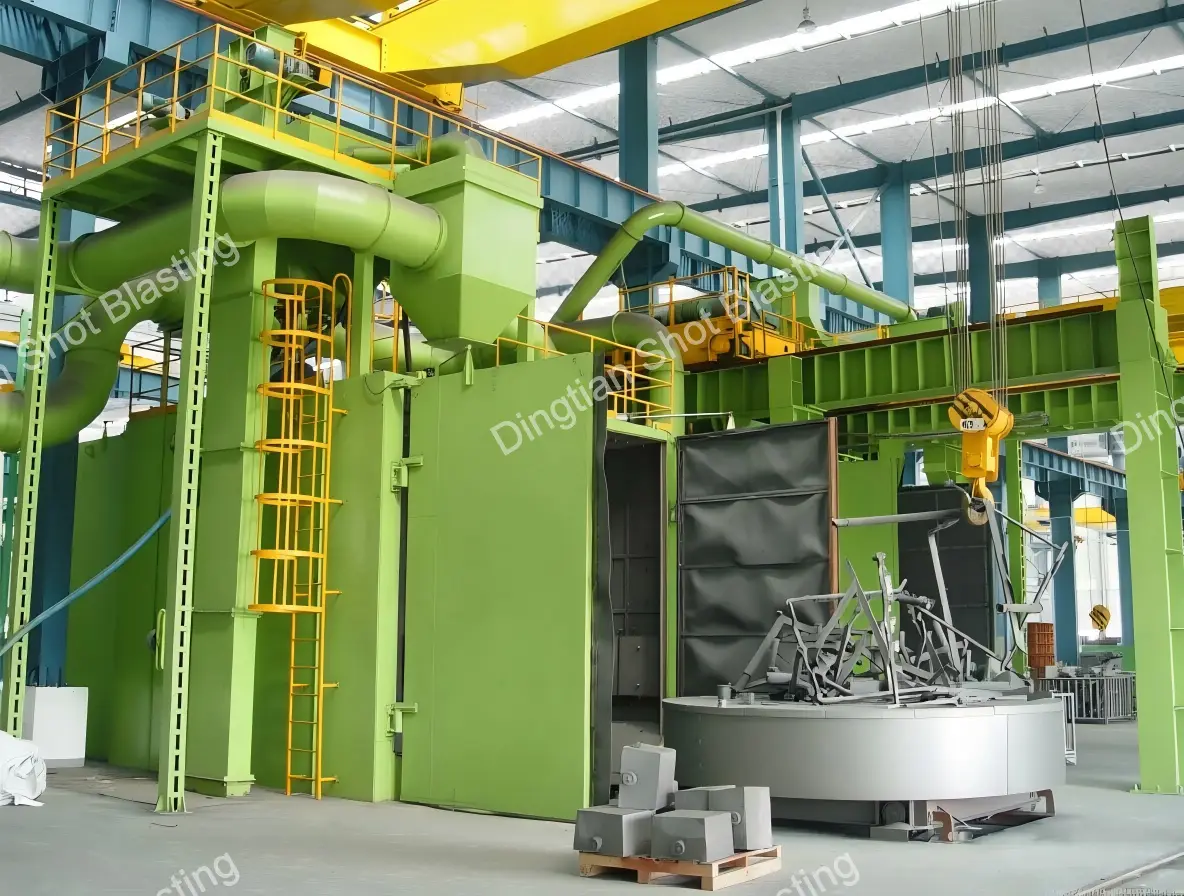
Request a QuoteA trolley type shot blasting machine (also called a bogie type shot blasting machine) works on one simple principle. The workpiece travels on the trolley; the blast wheels stay fixed. Parts ride a rail-mounted flat car into the sealed chamber. Blast wheels fire from multiple angles. Parts never turn over and never strike one another. It is the standard solution for large, heavy, collision-sensitive work.
What do overseas buyers call this machine?
The same machine is sold under different names in different markets. Knowing the local name helps you compare quotations correctly. The table below lists the names buyers actually type into Google, grouped by region and by the reference brands that popularised them.
| Market / reference | Name buyers search |
|---|---|
| North America (Pangborn class) | bogie work car blast machine |
| Europe (Gostol TST class, Slovenia) | bogie table shot blasting machine, bogie shot blasting machine |
| Italy (Sirsi class, railway sector) | shot blasting machine for wagons and railway vehicles |
| China export makers (KEEJOO, Antai, Qinggong, Kaitech class) | trolley type shot blasting machine, trolley car type shot blasting machine, rotary trolley bogie type shot blasting machine |
| Catalogues and B2B platforms | heavy duty trolley shot blasting machine, bogie blast machine, rail mounted trolley shot blasting machine |
Model codes are a second search entry point. The Q76 series is the common Chinese code for the bogie type trolley machine, and the Q36 series covers smaller trolley and turntable models; typical sizes run Q7610, Q7620, Q7630 up to Q76100 and Q76200. International reference designs include the bogie work car blast machine from Pangborn class builders, rated from 5 up to 200 tons, and the bogie table machine Type KOM from Gostol TST class builders. Brand and model names are referenced for naming and comparison purposes only and are the property of their respective owners.
How Does a Trolley Type Shot Blasting Machine Work?
The cycle runs in four stages.
1. Loading
An overhead crane places the workpiece on the trolley. There is no rotating hook or turntable bearing to limit the weight, so very heavy parts load directly onto the flat car.
2. Sealed blasting
The door closes. Blast wheels on the roof and side walls fire simultaneously from multiple angles. On some models the trolley traverses or reciprocates so the whole surface passes through the shot pattern.
3. Abrasive recycling
A screw conveyor collects spent shot, a bucket elevator lifts it, and a separator returns usable abrasive to the wheels while fines and dust are rejected.
4. Unloading
A dust collector keeps emissions compliant, the door opens, and the trolley rolls out for crane unloading.
How is the machine configured?
The standard Q76 engineered configuration is built around a programmable load trolley and full PLC control. The key published features are:
| Item | Configuration |
|---|---|
| Material handling | Programmable load trolley (motor-driven flat car on rails) |
| Control | PLC touch screen |
| Cleaning process | Programmable traverse and blasting cycles |
| Blast wheel layout | Fixed wheels on chamber roof and side walls, multi-angle coverage |
| Abrasive recovery | Screw conveyor, bucket elevator and separator, closed loop |
| Dust collection | Cartridge or bag dust collector for compliant emission |
| Workpiece | Large castings, forgings and welded assemblies |
Which Parts Is a Trolley Type Machine Best For?
This heavy duty trolley shot blasting machine wins on high load capacity and zero part-on-part contact:
| Part Category | Typical Workpieces |
|---|---|
| Very large and heavy parts | A shot blasting machine for heavy castings, forgings and welded structures — several tonnes to tens of tonnes per piece |
| Long structural components | A shot blasting machine for large steel structures: shafts, beams, columns, frames, mould bases — several metres long |
| Delicate large parts | Engine blocks, gearbox housings, wind turbine hubs — zero impact damage |
| High-mix, low-volume production | One load per trolley cycle |
Which Factories Use Trolley Type Shot Blasting Machines?
Heavy machinery plants, construction machinery makers, wind and nuclear equipment builders, shipyards, railway plants and large foundries. Typical loads: excavator structures, turbine hubs, hull sections, railway wagons and bogies, and forged blanks.
Which Parts Should NOT Go on a Trolley Type Machine?
The wrong machine costs more than none. We recommend another model for these workloads:
| Workload Type | Better Machine |
|---|---|
| High-volume small parts (bolts, nuts, small gears) | Tilted drum shot blasting machine or rubber-belt tumble blaster |
| Flat, thin-wall small parts | Turntable shot blasting machine |
| Continuous high-speed production — trolley cycles are intermittent | Through-feed roller conveyor shot blasting machine |
| Deep-cavity and blind-hole parts | Hanger type shot blasting machine |
How Does the Price Compare with Wheelabrator, Pangborn and SINTO?
Buyers benchmark us against Wheelabrator (Germany), Pangborn (USA) and SINTO (Japan). As a Wheelabrator alternative shot blasting machine supplier:
| Item | Premium Western and Japanese Brands | Our Machine |
|---|---|---|
| Initial investment (CAPEX) | 100% (benchmark) | About 1/3 |
| Cleaning grade and performance | SA 2.5 to SA 3 | Same |
| Wear parts: blades, liners, cages, impellers | 100% (benchmark) | About 1/10 |
| Spare-part lead time | Weeks to months, imported | Factory-direct, short |
| Customisation | Limited, high engineering cost | OEM / ODM — chamber, trolley rating, rail gauge, wheel layout |
Does the saving add up? Yes, and it compounds. Blades, liners and cages wear continuously. Low consumable pricing saves more over five years than the machine price gap.
Note: Wheelabrator, Pangborn and SINTO are registered trademarks of their respective owners. Brand names are referenced for comparison purposes only. Spare parts supplied are aftermarket, non-original replacement components.
Do You Offer OEM / ODM and Aftermarket Spare Parts?
We are an OEM ODM shot blasting machine manufacturer and a shot blasting machine source factory in China, not a trading company. As a large casting shot blasting machine builder, we engineer every chamber and trolley around your parts.
- OEM: built to your specification, under your brand.
- ODM: full design from your samples or drawings.
- Aftermarket wear parts: Pangborn compatible spare parts — blades, liners, cages and impellers for Wheelabrator, Pangborn and SINTO class blast wheels.
Frequently Asked Questions
What is a trolley type shot blasting machine?
The workpiece rides a rail-mounted trolley into a sealed chamber. Fixed blast wheels fire from multiple angles. The part is never tumbled. Buyers also call it a bogie blast machine or a bogie work car blast machine.
Is a bogie work car blast machine the same thing?
In practice, yes. Bogie work car is the name Pangborn class machines use in North America, and bogie table is the Gostol TST class name in Europe. Trolley type, bogie type, bogie car and rail mounted trolley all describe the same principle: the part sits on a wheeled flat car that runs on rails into a fixed blast chamber. When you compare quotations, check the load rating and chamber size, not the name.
What does the electric trolley do, and does the part rotate?
The trolley is motor-driven and programmable under PLC control. It carries the part into the chamber and can traverse or reciprocate during blasting so the whole surface passes through the shot pattern. On a standard trolley machine the part does not spin. Where a rotating surface is needed, some models add a turntable or rotary bogie on the trolley so the part turns while it is blasted.
What is the difference between a trolley type and a turntable machine?
A turntable is limited to about 2,500 mm diameter and a few tonnes. A trolley machine has no rotating bearing under the part. It takes workpieces several metres long and tens of tonnes heavy.
What is the difference between a trolley type and a hanger type machine?
A hanger machine suspends parts from hooks. A trolley machine supports parts from below, for work too heavy or too large to hang.
How heavy a part can it handle?
Several tonnes up to tens of tonnes per piece. Load capacity is custom-engineered around your heaviest part, with no fixed upper limit. Send your maximum unit weight and we size the trolley rating and rail accordingly.
How long a part can it take?
Several metres. Shafts, beams, columns, frames and mould bases are core applications.
Is trolley type shot blasting a continuous process?
No. It is an intermittent batch process: load, blast, unload. It suits high-mix, low-volume heavy work. For continuous high-speed production of smaller parts, a through-feed roller conveyor machine is more economical.
Can it blast railway wagons, bogies and ship sections?
Yes. These are standard applications. Railway wagons, bogies and couplers, hull sections and large welded assemblies all sit on the trolley and pass through the fixed wheel pattern. For very long rail vehicles, builders in Italy supply turbine machines sized specifically for wagons and railway vehicles, and we engineer the chamber length and wheel layout to match.
What cleaning grade does it achieve?
SA 2.5 to SA 3 per ISO 8501-1 — mill scale, rust, sand and weld slag removed to bare metal with a uniform anchor profile.
Is it really comparable to Wheelabrator, Pangborn or SINTO equipment?
In cleaning grade and construction standard, yes. The difference is commercial: about one third of the initial investment, with wear parts at about one tenth of brand pricing.
Can you supply spare parts for existing European, American or Japanese machines?
Yes. Aftermarket blades, liners, cages and impellers fit major blast-wheel designs, at about one tenth of brand pricing.
Get a Quotation
Send your part name, material, maximum weight and dimensions, daily volume and cleaning grade. We size the chamber and trolley accordingly. If a trolley machine is not the economical choice, we say which is. Request a trolley type shot blasting machine price quotation.
Jiangsu Dingtian Derusting & Painting Equipment Co., Ltd.
Email: dtcx@dt-shotblasting.com | WhatsApp: +86 158 9516 5618 | WeChat: cxj999888
Location: Jiangsu, China
Watch Our Machines Running On-Site
See more models working in real customer plants:
LinkedIn: LinkedIn
Instagram: Instagram
Facebook: Facebook
YouTube: YouTube
Related configuration and application pages: shot blasting machine spare parts.
Ready to specify this machine? Send drawings, material and dimensions through the inquiry form below. Our engineers confirm model and abrasive specification before you order.
Model Comparison
Compare available models and technical parameters.
| Parameter | Q76 Engineered Configuration |
|---|---|
| Maximum load | Up to 20 t |
| Workpiece | Large castings, forgings and welded assemblies |
| Material handling | Programmable load trolley |
| Control | PLC touch screen |
| Cleaning process | Programmable traverse and blasting cycles |
Reviews
Customer reviews & ratings
Product inquiry
Reviews
There are no reviews yet.