
Engineered by Dingtian
Monorail Overhead Conveyor Shot Blasting Machine
Overhead monorail shot blasting machine for c…
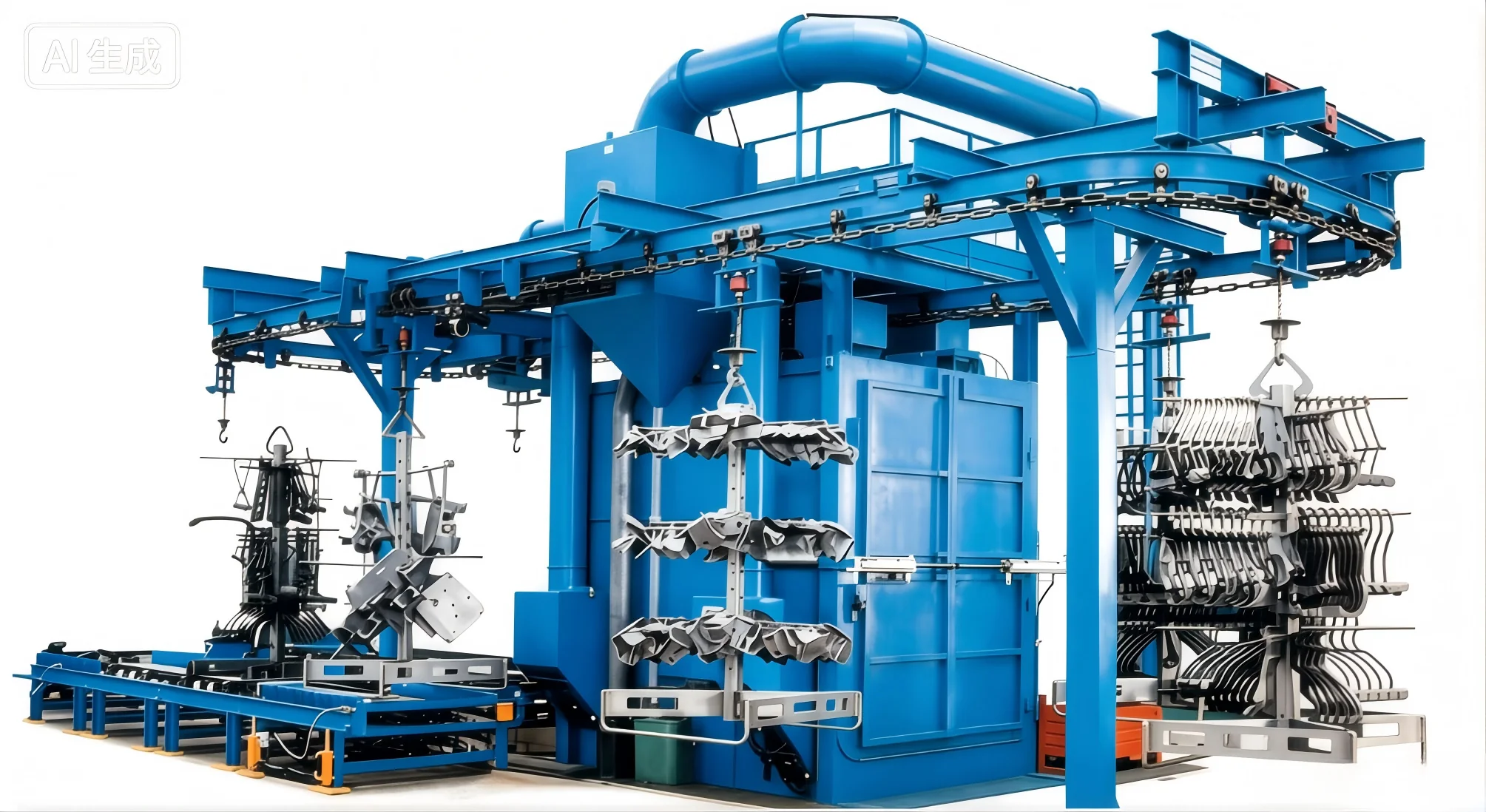
Request a QuoteAn overhead conveyor through-feed shot blasting machine is also called a continuous hanger type shot blasting machine. It combines hanger type and through-feed blasting. An overhead chain conveyor delivers continuous in-line production. Buyers also search for an overhead rail shot blasting machine, a monorail shot blasting machine or a spinner hanger blast machine, and all of these names describe the same family of equipment.
It is also the mandatory first stage of a powder coating and painting line. Pretreatment quality decides coating adhesion and service life. If derusting is inadequate, even the best paint fails early. See the powder coating and painting production line for the downstream process.
What do overseas buyers call this machine?
The same machine is sold under different names in different markets. Knowing the local name helps you compare quotations and specifications correctly. The table below lists the names buyers actually type into Google, grouped by region and by the reference brands that popularised them.
| Market / reference | Name buyers search |
|---|---|
| North America & Europe (Rosler, Pangborn class) | spinner hanger blast machine, overhead monorail blast machine |
| Europe (Gostol TST, Turbotecnica, IST class) | overhead rail shot blasting machine, overhead conveyor blast machine |
| India (Precicut, Krishna, Abrablast class) | closed loop continuous hanger type shot blasting machine |
| China export makers (Antai, JX, QGMA class) | continuous hanger type, hanging chain conveyor shot blasting machine |
| Catalogues (DirectIndustry, DISA class) | overhead conveyor shot blasting machine, pass through monorail shot blasting machine |
| Trade listings (B2B platforms) | overhead rail continuous blast machine, tunnel overhead conveyor type shot blasting machine |
Model codes are a second search entry point. Chinese makers use the Q38 series for continuous through-feed, the Q48 series for indexing (step) and the Q58 series for power and free; common sizes are Q383, Q485 and Q4810. International reference codes include the Wheelabrator HB and DHB overhead monorail, the Rosler RHB spinner hanger, the Gostol TST VKP and the Turbotecnica TC. Brand and model names are referenced for naming and comparison purposes only and are the property of their respective owners.
How does an overhead conveyor shot blasting machine work?
The process runs in four stages.
1. Loading and conveying
Workpieces hang on fixtures attached to the overhead chain conveyor. The chain carries them into the sealed blast chamber at preset speed.
2. Multi-angle shot blasting
A rotating device spins the workpiece. Turbines on the chamber top and sides run at 2000–3000 r/min. They throw shot of 0.2–2.0 mm at 60–80 m/s from multiple angles. Impact strips mill scale, rust, weld slag and sand. A uniform roughness profile forms.
3. Shot recirculation and dust collection
Spent shot falls to a screw conveyor. A bucket elevator lifts it to a full-curtain air-wash separator. Usable shot recirculates; fines are rejected. A pulse-jet dust collector holds emission below 20 mg/m³.
4. Unloading
Parts leave the chamber on the chain. High-pressure air blows off residual shot. A PLC control system coordinates the whole process.
Which conveyor running mode should I choose?
The running mode sets the line takt. It is the first decision in selection.
| Mode | How it runs | Best for |
|---|---|---|
| Continuous | Constant-speed pass-through | High-volume production with a fixed takt |
| Indexing (step) | Advances intermittently by a set pitch | Positional rotary blasting; balances efficiency and quality |
| Power and free | Loading stations and blast zone stop independently | Multi-product small and medium batches |
For multi-product, low-volume plants, specify a power and free overhead conveyor shot blasting machine. For single-product high-volume runs, continuous mode gives the highest output and lowest investment.
What are the technical parameters?
Three standard models cover most hanging workpieces. All figures below are published design values for the corresponding configuration; the exact layout is confirmed against your workpiece before order.
| Parameter | Q383 / Q483 | Q385 / Q485 | Q4810 |
|---|---|---|---|
| Cleaning workpiece size (mm) | Φ800 × 1200 | Φ1000 × 1500 | Φ1000 × 2500 |
| Number of work positions | 2 | 2 | 2 |
| Blast wheel quantity | 4 | 4 | 6 |
| Blasting capacity (kg/min) | 4 × 250 | 4 × 250 | 6 × 250 |
| Blast wheel power (kW) | 4 × 15 | 4 × 15 | 6 × 15 |
| Maximum hanger load (kg) | 300 | 500 | 1000 |
| Productivity (hangers/h) | 30–60 | 30–60 | 40–60 |
| Cleaning room size (mm) | 7680 × 2000 × 2900 | 7680 × 2000 × 2900 | 7680 × 2000 × 3800 |
| Total air volume (m³/h) | 17000 | 19000 | 19000 |
| Total power, excluding dust collector (kW) | 73.15 | 73.15 | 114.72 |
Which workpieces is it suitable for?
Its core advantage is hung conveying plus continuous operation. This hanging chain type shot blasting machine suits complex medium and small workpieces. They must need multi-face cleaning and hang safely in batches.
| Industry | Typical workpieces |
|---|---|
| Automotive | Engine blocks, cylinder heads, gearbox housings, clutch plates, wheel hubs, chassis parts |
| Construction and agricultural machinery | Axle housings, gearboxes, valve bodies, excavator bucket parts, tiller blades |
| Castings and forgings | Motor housings, gears, pump housings, hardware tool bodies |
| Welded fabrications | Frames, welded boxes, guardrails, window frames, bogie components |
| Appliance components | Compressor shells, counterweights, refrigerator frames |
| Other hangable parts | Motorcycle housings, valves, diesel engine components |
Which workpieces is it NOT suitable for?
Selection also requires knowing the limits:
| Unsuitable workpiece | Better machine type |
|---|---|
| Cannot be hung — long sections and flat plate | roller conveyor through-feed shot blasting machine |
| Small bulk parts — bolts, nuts, small gears | Tumble belt shot blasting machine |
| Thin-walled parts — under 1.2 mm wall | Lower shot speed and size, or compressed-air abrasive blasting |
| High-appearance precision parts | Decorative compressed-air abrasive blasting or polishing |
| Deep blind holes | Add a nozzle touch-up blasting station |
| Overweight parts — standard hooks carry 300–1000 kg, custom to 5000 kg | Bogie type or hanger type shot blasting machine |
Costs and quotation
Contact us for a quotation based on the machine configuration, production capacity, and project requirements.
Note: Wheelabrator, Pangborn and SINTO are registered trademarks of their respective owners. Brand names are referenced for comparison purposes only. Spare parts supplied are aftermarket, non-original replacement components.
Overhead conveyor shot blasting machine buyer FAQ
What is the difference between an overhead conveyor and a hanger type shot blasting machine?
A hanger type machine works intermittently: one hook blasts inside while the other loads outside. It suits large heavy single parts. This overhead monorail shot blasting machine works continuously. Many workpieces pass through in sequence without stopping. Output is far higher, and it suits batch production of medium and small parts.
Is a spinner hanger blast machine the same thing?
In practice, yes. Spinner hanger is the name Rosler and Pangborn class machines use in North America and Europe. It stresses that the hook rotates the part (spins) while it hangs. An overhead conveyor machine adds continuous pass-through conveying. When you see spinner hanger, overhead monorail, overhead rail and continuous hanger type in a catalogue, they describe the same hung, rotating, multi-angle blast principle.
How many workpieces can it process per hour?
Published productivity for the standard models is 30–60 hangers per hour (Q383/Q483 and Q385/Q485) and 40–60 hangers per hour (Q4810). The actual rate depends on chain speed, hanger pitch, workpiece size and the target cleanliness grade. Send workpiece name, dimensions, weight and daily output and we calculate the takt for your conditions.
What is the maximum load per hook?
Standard models carry 300–1000 kg per hook (300 kg on Q383/Q483, 500 kg on Q385/Q485, 1000 kg on Q4810). Some customized models reach 5000 kg. Exceeding the limit causes chain deformation or drive slip. Accurate unit weight must be supplied at selection.
What does a power and free conveyor mean?
Power and free is a conveyor design where the driven (power) rail and the load-carrying (free) rail are separate. Trolleys can stop and accumulate at loading stations while the blast zone keeps running. It lets you load and unload independently of the blasting takt, which suits mixed products and small to medium batches. Continuous and indexing modes use a single driven chain instead.
What dust emission level does it achieve?
With the standard pulse-jet cartridge dust collector, emission stays below 20 mg/m³. That is better than industrial limits in most countries.
What shot is used, and is consumption high?
Shot is recovered and recirculated, so loss comes mainly from broken fines. Cast steel shot or wire cut shot at 0.2–2.0 mm is normal. For aluminium and thin walls, use smaller shot and reduce turbine speed.
Which wear parts need replacing?
Turbine blades, control cages, impellers, chamber liners and sealing curtains. Blades and cages are replaced most often. Dingtian supplies the full wear part range long term.
Can it clean complex inner surfaces and blind holes?
The rotating hook plus multi-angle turbine layout reaches most faces of a hung part. Deep blind holes and fully enclosed cavities are the exception, because shot travels in straight lines and cannot turn a corner. For those features add a nozzle touch-up blasting station after the main chamber. Tell us the depth and diameter of any internal cavity at the quotation stage so we can position the turbines correctly.
Can it be integrated with a coating line?
Yes — this is its most common application. The discharge end connects directly to the powder or paint booth and curing oven. Blast, coating and curing run on one shared overhead chain. Request an overhead conveyor shot blasting machine price with your line layout.
About Jiangsu Dingtian
Jiangsu Dingtian Derusting & Painting Equipment Co., Ltd. is a China surface treatment equipment source factory. We build shot blasting machines, abrasive blasting rooms and coating lines. OEM / ODM customization and overseas installation guidance are available.
Contact
Send workpiece name, dimensions, weight, daily output and whether a coating line follows. You get a free model recommendation and quotation.
Email: dtcx@dt-shotblasting.com | WhatsApp / WeChat: +86 158 9516 5618 | WeChat ID: cxj999888
More models and on-site working videos: LinkedIn | Instagram | Facebook | YouTube
Ready to specify this machine? Send drawings, material and dimensions through the inquiry form below. Our engineers confirm the model, blast wheel layout and abrasive specification before you order.
Model Comparison
Compare available models and technical parameters.
| Parameter | Q383 / Q483 | Q385 / Q485 | Q4810 |
|---|---|---|---|
| Cleaning workpiece size (mm) | Φ800×1200 | Φ1000×1500 | Φ1000×2500 |
| Number of work positions | 2 | 2 | 2 |
| Blast wheel quantity | 4 | 4 | 6 |
| Blasting capacity (kg/min) | 4×250 | 4×250 | 6×250 |
| Blast wheel power (kW) | 4×15 | 4×15 | 6×15 |
| Maximum hanger load (kg) | 300 | 500 | 1000 |
| Productivity (hangers/h) | 30–60 | 30–60 | 40–60 |
| Cleaning room size (mm) | 7680×2000×2900 | 7680×2000×2900 | 7680×2000×3800 |
| Total air volume (m³/h) | 17000 | 19000 | 19000 |
| Total power, excluding dust collector (kW) | 73.15 | 73.15 | 114.72 |
Reviews
Customer reviews & ratings
Product inquiry
Reviews
There are no reviews yet.