
Engineered by Dingtian
Shop Primer Line Q69 | Steel Plate Pretreatment Line
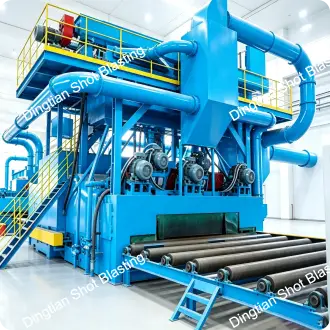
Roller conveyor shot blasting machine for ste…
Request a QuoteThe Q69 series steel plate pretreatment line is a fully automatic continuous system. Steel plate and structural sections ride on one motorised roller conveyor through preheating, shot blasting, primer spraying, drying and coding in a single pass. The line cleans to Sa 2.5 per ISO 8501-1 and holds a stable Rz 30-75 um anchor profile. It keeps residual soluble salt below 20 mg/m2 and applies a weldable shop primer at 15-25 um dry film.
Buyers also search for this equipment as a shop primer line, a steel plate preservation line or a blast and prime line. It is also sold as a roller conveyor shot blasting machine based plate profile shot blasting painting drying line. Seven standard models cover effective cleaning widths from 800 mm to 4000 mm. Customised builds reach 5 m width and 150 mm plate thickness. Core build quality is comparable to leading German, American and Japanese brands. Contact us for a quotation based on the machine configuration, production capacity, and project requirements.
1. What is a steel plate pretreatment line?
It is the standard first process in shipbuilding, offshore engineering and heavy steel structure fabrication. Raw plate arrives from the mill covered in mill scale, rust, oil and soluble salt contamination. Left untreated, that surface ruins every coating applied over it. The line removes all of it mechanically, then immediately seals the clean steel with a weldable primer before flash rust can form.
One operator runs the whole process under PLC control. Loading, blasting, dust extraction, priming, drying and unloading are interlocked and synchronised, so there is no manual transfer between stations and no handling damage.
| What the line delivers | Why it matters to the buyer |
|---|---|
| Sa 2.5 cleanliness to ISO 8501-1 | The grade specified for coating adhesion in class rules and PSPC-compliant builds |
| Stable Rz 30-75 um anchor profile | Primer grips mechanically instead of sitting on a polished surface |
| Soluble salt below 20 mg/m2 | Inside IMO PSPC limits; prevents osmotic blistering and underfilm corrosion |
| Weldable shop primer 15-25 um | Primed plate goes straight to cutting and welding with no burn-back rework |
| Residual stress relief | Thin plate and high-strength steel stay flat through welding and assembly |
| Automatic QR coding | Full traceability through nesting, cutting and block assembly |
2. What do overseas buyers call this line?
The same equipment carries different names in different markets, and buyers usually search only the name used in their own region. Knowing the term used in your market helps you compare quotations correctly. It also stops you buying a plate-only machine when you actually need a steel plate and profile shot blasting pretreatment line.
2.1 Line names
| Term | Where it is used |
|---|---|
| Shop primer line | International shipyards and coating specifications; the most widely understood term worldwide |
| Steel plate pretreatment line | Asia, tender documents and project specifications |
| Steel plate preservation line | Europe – Rosler, Gostol TST, GEC Blasting and most EU shot blast equipment suppliers |
| Blast and prime line | North America – plate mills and steel service centres |
| Shot blasting and painting line / shot blasting painting drying line | General trade name; dominant wording on B2B marketplaces |
| Shot blasting and priming line | India, Middle East, Southeast Asia |
| Pre-construction primer line / prefabrication primer line | Coating specifications, class rules, NACE and AMPP papers |
| Steel plate descaling line / mill scale removal line | Buyers searching by the problem rather than the machine |
| Marine steel surface treatment production line | Offshore and naval programme documentation |
2.2 Machine-type names for the blasting section
| Term | Where it is used |
|---|---|
| Roller conveyor shot blasting machine / roller conveyor shot blast machine | The standard industry term for the blasting section |
| Through feed shot blasting machine | Continuous in-line processing of long, flat or section material |
| Pass-through shot blasting machine / tunnel type shot blasting machine | Trade catalogues covering enclosed tunnel blast chambers |
| Sheet and profile shot blasting machine | European and Turkish suppliers covering plate plus sections |
| Steel plate shot blasting machine / section steel shot blasting machine | The highest-volume generic search terms for this machine class |
| Structural steel shot blasting machine | North American wording |
| Roller table type shot blasting machine | Alternative wording for the same roller conveyor principle |
2.3 Model codes buyers search
The Chinese Q69 series is the dominant designation on export listings for roller conveyor type plate blasting and priming line equipment. Buyers who already know a machine search the size code directly: Q698, Q6912, Q6915, Q6920, Q6925, Q6930 and Q6940. The digits follow the effective cleaning width in decimetres, so Q6920 covers 2000 mm and Q6940 covers 4000 mm. Brand and model names are referenced for naming and comparison purposes only and are the property of their respective owners.
In China this line is also known as the shipyard pretreatment line, but that wording is a domestic trade habit rather than an international term. Overseas procurement documents use shop primer line or steel plate pretreatment line.
3. What is the complete process flow?
Seven integrated stations run in sequence on a single synchronised roller conveyor:
- Automatic transverse loading (optional) – plate fed from the mill crane or vacuum lifter
- Flame preheating (optional) – removes moisture and condensation, drives off drawing oils, begins stress relief
- High-intensity shot blasting – mill scale, rust, oil and contaminants removed to Sa 2.5
- Uniform shop primer coating – weldable inorganic zinc silicate applied at controlled dry film thickness
- Hot air drying – constant-temperature chamber with adjustable drying curves
- Automatic coding (optional) – text, symbols and QR codes for downstream traceability
- Automatic transverse unloading
Optional stations are why one automatic steel plate pretreatment line for shipyard use can serve several production flows. Flame preheating matters in cold or humid climates where condensation would otherwise cause flash rust before priming. Automatic marking prints part numbers and QR codes that survive nesting, cutting and block assembly.
The line can also be supplied as a through feed shot blasting machine without the coating stages if you already operate a paint shop, or as a complete shop primer spraying line with blast cleaning.
4. Which Q69 model fits my plate width?
Seven standard models cover effective cleaning widths from 800 mm to 4000 mm. Each model processes both steel plate and section steel on the same conveyor, with no changeover.
| Parameter | Q698 | Q6912 | Q6915 | Q6920 | Q6925 | Q6930 | Q6940 |
|---|---|---|---|---|---|---|---|
| Effective cleaning width (mm) | 800 | 1200 | 1500 | 2000 | 2500 | 3000 | 4000 |
| Room feed-in size (mm) | 1000×400 | 1400×400 | 1700×400 | 2200×400 | 2700×800 | 3200×800 | 4200×400 |
| Workpiece length (mm) | 1200-12000 | 1200-16000 | 1200-12000 | 1200-12000 | 3000-12000 | 2400-12000 | 4500-18000 |
| Roller conveyor speed (m/min) | 0.5-4 | 0.5-4 | 0.5-4 | 0.5-4 | 0.5-4 | 0.5-4 | 0.5-4 |
| Steel plate thickness (mm) | 3-60 | 3-60 | 1.5-60 | 3-60 | 3-60 | 3-110 | 4.5-100 |
| Section steel specification (mm) | 800×300 | 1000×300 | 1500×300 | 2000×300 | 2500×700 | 3000×700 | 4000×300 |
| Shot blasting quantity (kg/min) | 4×180 | 4×250 | 4×250 | 6×250 | 6×250 | 6×360 | 8×360 |
| Initial abrasive load (kg) | 4000 | 4000 | 4000 | 4500 | 4500 | 8000 | 11000 |
| Roll-brush height adjustment (mm) | 200 | 200 | 350 | 450 | 600 | 850 | 900 |
| Air capacity (m3/h) | 22000 | 17560 | 19000 | 19550 | 27758 | 28050 | 38000 |
| Total power, excl. dust collector (kW) | 90 | 78.3 | 113.5 | 156.6 | 204.8 | 224.55 | 293.6 |
Customised configurations are available up to 5 m effective plate width and 150 mm plate thickness, with 4 to 10 blast wheels selected according to required throughput and cleaning grade. High-throughput builds extend conveyor speed to 6.5 m/min.
4.1 Which model to shortlist
| Your requirement | Model to shortlist |
|---|---|
| Thin plate work from 1.5 mm, container and light structural steel | Q6915 – the only standard model rated down to 1.5 mm |
| General shipbuilding and steel structure | Q6920 (2000 mm) |
| Larger hull blocks and heavy plate | Q6925 to Q6930 (2500-3000 mm, sections to 3000×700 mm) |
| Very wide plate and offshore structures | Q6940 (4000 mm, workpiece length to 18000 mm) |
| Plate wider than 4 m or thicker than 110 mm | Custom build to 5 m width and 150 mm thickness |
Send your widest plate, your largest profile section and your required daily tonnage and we name the model before you order.
5. What surface quality does the line guarantee?
These indicators hold across all Q69 models and are the figures written into the technical agreement.
| Indicator | Achieved value | Governing standard |
|---|---|---|
| Surface cleanliness | Sa 2.5, near-white metal blast cleaning | ISO 8501-1 |
| Surface roughness | Rz 30-75 um, adjustable within the band | ISO 8503 / IMO PSPC |
| Residual soluble salt | Below 20 mg/m2 | ISO 8502-6 Bresle method / IMO PSPC |
| Shop primer dry film | 15-25 um, typical 15-20 um | Owner coating specification |
| Dust emission | Below 10 mg/m3 | Local emission limits |
| Total hydrocarbon (VOC) | Below 10 mg/m3 | Zeolite rotary wheel concentrator plus RTO |
Stability matters more than the nominal value. Because abrasive mix, wheel speed, conveyor speed and blast distance are all closed-loop controlled, the line holds the same Rz value from the first plate of a shift to the last. That is what class surveyors and coating inspectors verify with replica tape and digital roughness testers during PSPC-compliant builds.
The roughness band is adjustable to match epoxy, inorganic zinc silicate, zinc-rich and polyurethane heavy-duty anti-corrosion coating systems.
6. Does one line handle both steel plate and section steel?
Yes, and this is the defining feature of the plate-and-profile combined design. Most steel intake is mixed: plate arrives with bulb flat, angles and channels in the same delivery. The same roller conveyor and blast chamber handle both without changeover, which is what separates a sheet and profile shot blasting machine from a plate-only machine.
| Material fed to the line | Typical use after pretreatment |
|---|---|
| Steel plate – hull plating, deck plate, bulkhead plate | Nesting and cutting for hull blocks |
| Bulb flat and flat bar | Stiffeners, longitudinal frames |
| Angles, channels, I-beams, H-beams | Frames, brackets, structural assemblies |
| Small fabricated sections | Sub-assemblies before welding |
Blast wheel count and orientation are set to cover flat faces plus profile webs and flanges in one pass. Standard section coverage runs to 3000×700 mm on Q6930 and 4000×300 mm on Q6940. Send us your widest plate and your largest profile section and we confirm the wheel layout before you order.
For heavy fabricated assemblies rather than flat plate and standard profiles, see our bogie hearth shot blasting machine or H beam shot blasting machine instead.
7. How does the anti-pitting roller design protect the blasted surface?
This is the defect that ordinary pretreatment lines cannot avoid, and the reason buyers reject plate after a competitor line has run it.
On a standard conveyor, steel shot collects at the contact point between roller and plate. As the plate moves, that trapped abrasive is pressed into the freshly blasted surface, leaving pitting marks, indentation defects and roller-print patterns. The damage is invisible under primer until the coating fails early.
The Q69 line is equipped with specially optimised anti-extrusion rollers and protective auxiliary devices. The roller and shielding geometry prevents shot accumulation at the contact point, which eliminates roller-induced pitting during continuous mass production. Surface defect rate drops and uniformity improves across both plate and section steel.
Roll-brush height adjustment from 200 mm to 900 mm across the model range lets the same protection work on thin container plate and heavy offshore plate alike.
8. Which shop primer does the line apply?
The standard configuration is a pre-construction primer line: weldable inorganic zinc silicate at 15-25 um dry film, with a typical target of 15-20 um.
- Weldable. Primed plate goes straight to cutting and welding with no need to strip the primer first, so no burn-back rework at the seams.
- Corrosion protection in storage. Protects plate for months in the yard before assembly.
- Compatible with later coating. Accepts the full paint system applied at block stage.
- Multi-layer customisation. For heavy-duty anti-corrosion projects the system supports multi-layer film thickness adjustment to the project coating specification.
The intelligent variable-speed spraying system controls dry film thickness precisely. Spray guns are driven by the PLC against measured plate width, so primer is not wasted on overspray beyond the plate edge. That matters on narrow profile runs where a fixed-width booth wastes most of its paint.
9. What dust and VOC treatment systems are included?
Modern steel pretreatment must balance throughput against emission permits. Traditional equipment fails on both particulate dust and VOC exhaust. The Q69 line treats both.
| System | How it works | Result |
|---|---|---|
| Cartridge dust collector | Multi-stage filtration with pulse-jet automatic cleaning; intercepts particulate from blasting and abrasive recycling | Dust emission below 10 mg/m3 |
| Zeolite rotary wheel concentrator plus RTO | The rotary wheel gathers large-volume, low-concentration VOC exhaust into a small high-concentration combustible stream. That stream enters the regenerative thermal oxidiser, where ceramic regenerators recycle combustion heat for autothermal operation | Total hydrocarbon below 10 mg/m3, with lower natural gas consumption |
| Air wash separator | Full-flow separation removes fines cleanly so good abrasive is not lost with the dust | Lower abrasive consumption and stable blast pattern |
Overspray from the primer booth is captured before it reaches the exhaust. Both emission figures are set to your local regulations so the line can be permitted in the destination country – tell us which country and we configure to that standard. Applicable frameworks include EU IED and BAT conclusions and US EPA MACT; we do not publish fixed limit values because the correct figure depends on your national permit.
10. Does the line relieve residual stress in hot-rolled plate?
Yes. Hot-rolled plate carries uneven residual stress from rolling and cutting. Released unevenly during welding, that stress causes warping, twisting and distortion that ruins assembly accuracy.
The Q69 line releases it in a controlled way. Flame preheating raises the plate temperature and drives off moisture, then continuous shot blasting delivers high-velocity projectile impact distributed uniformly across the entire surface. Because the bombardment is symmetrical on both faces and across the full width, uneven internal stress is released in all directions simultaneously.
For thin-plate work in the 1.5-6 mm range and for high-strength naval-grade steel, this is often the single most valuable function of the line. Dimensional stability is protected through welding and painting, and post-processing deformation defects are avoided.
11. Which shipyards run this line?
The shipbuilding shop primer line has completed verified industrial service at three of the most demanding shipbuilding enterprises in China, all members of China State Shipbuilding Corporation (CSSC):
| Shipyard | Location and profile |
|---|---|
| Guangzhou Shipyard International Co., Ltd. (GSI) | Longxue Island base, Nansha, Guangzhou. One of the largest shipbuilders in South China and the first listed shipbuilding company in China |
| CSSC Huangpu Wenchong Shipbuilding Co., Ltd. | Guangzhou, Guangdong. Major CSSC base for naval vessels, special engineering ships and offshore engineering |
| Hudong-Zhonghua Shipbuilding (Group) Co., Ltd. | Shanghai, with bases on Changxing and Chongming islands. Known as the cradle of Chinese frigates and landing ships, and a leading builder of large LNG carriers |
Plate and section steel processed on these lines has been used on:
- Very large ocean-going bulk carriers (VLOC and Capesize class), including 300,000 DWT ore carriers
- Container ships from feeder to ultra-large classes
- Luxury cruise ferries (Ro-Pax) built for Italian shipowners
- Large dredgers
- Offshore drilling platforms and marine engineering structures
- Naval programmes – Type 052 missile destroyers, Type 054 missile frigates, Type 075 amphibious assault ships (landing helicopter docks) and Zubr-class air-cushion landing craft, all built to applicable military standards
Across commercial, offshore and naval programmes, every measured process indicator met or exceeded the client acceptance targets: cleanliness grade, roughness band, soluble salt residue, primer film uniformity, surface defect rate and emission limits. Naval and offshore programmes apply the tightest incoming-inspection regimes in the industry, so a line that has passed those audits is effectively pre-qualified against the most demanding specifications available.
Costs and quotation
Contact us for a quotation based on the machine configuration, production capacity, and project requirements.
12.1 Quality benchmark
Contact us for a quotation based on the machine configuration, production capacity, and project requirements.
13. How does PLC control and MES integration work?
The whole line runs on PLC touch-screen control. Loading, shot blasting, dust extraction, priming, drying and unloading are interlocked and synchronised, so one operator monitors the entire process.
An MES system is supplied as standard and can be networked into your plant scheduling system for:
- Real-time order tracking
- Process data logging
- Quality traceability
- Output reporting
For class-surveyed work, logged process data supports coating inspection records without extra manual paperwork. That is a real saving when a surveyor asks for blast and primer records on one specific plate batch.
14. How to choose the right configuration?
Six numbers decide the whole line. Send them and we return a specification, layout drawing and firm quotation:
- Maximum plate width and thickness range – sets blast chamber size, roller spec and wheel layout
- Section steel profile – confirm the room feed-in opening covers your H-beams, channels and bulb flats
- Required throughput in t/h or plates per shift – sets blast wheel count (4 to 10), shot flow and conveyor speed
- Shop primer specification – zinc silicate or epoxy, DFT target, number of layers, weldable or not
- Local emission limits – sets dust collector and rotary wheel plus RTO configuration for permitting
- Workshop layout – sets line length, loading direction and optional transverse transfer
We are an OEM ODM shot blasting machine manufacturer and a shot blasting machine source factory in China. The configuration is built to your numbers rather than picked from a fixed catalogue. Supply is turnkey: design, manufacturing, installation and commissioning, operator training, 24/7 technical support and spare parts supply. All Q69 lines are made in China, direct from the Jiangsu factory, with no trading-company markup and global shipping available.
15. Frequently asked questions
What is a shop primer line in shipbuilding?
It is a continuous automated line that blast-cleans steel plate and sections to Sa 2.5, then immediately applies a weldable shop primer and dries it. Shipyards call it a shop primer line because the primer is applied in the fabrication shop before cutting and assembly, not on the finished vessel. The primer protects steel during months of yard storage and survives welding without burn-back rework.
What is the difference between a pretreatment line, a preservation line and a blast and prime line?
Nothing in function – they are the same equipment under different regional names. Pretreatment line is the Asian and specification-document term. Preservation line is the European term used by suppliers such as Rosler, Gostol TST and GEC Blasting. Blast and prime line is the North American term. All three describe a roller conveyor shot blasting machine linked to a primer booth and a drying chamber.
What is the difference between a roller conveyor shot blasting machine and a pretreatment line?
The roller conveyor shot blasting machine is the blasting section only – it cleans the steel to Sa 2.5 and nothing more. A pretreatment line adds the primer booth, drying chamber, dust collection, VOC treatment and optional loading, coding and unloading stations around that machine. We can supply either: a standalone through feed shot blasting machine if you already have a paint shop, or the full shot blasting and priming line.
What soluble salt level does the Q69 line achieve?
Residual soluble salt is stably controlled below 20 mg/m2, verified per the ISO 8502-6 Bresle method. That is comfortably inside the IMO PSPC performance standard, which allows up to 50 mg/m2. Salt left on the surface is the main cause of osmotic blistering and underfilm corrosion, so this figure matters more than the cleanliness grade for long coating life.
What surface roughness range can the line hold?
A stable anchor profile of Rz 30-75 um, adjustable within that band to match epoxy, inorganic zinc silicate, zinc-rich and polyurethane heavy-duty anti-corrosion coating systems. Because abrasive mix, wheel speed, conveyor speed and blast distance are closed-loop controlled, the same Rz value holds from the first plate of a shift to the last.
Can one line process both steel plate and section steel?
Yes. The plate-and-profile combined design lets the same roller conveyor and blast chamber handle plates from 1.5 mm to 150 mm thick and sections up to 4000×300 mm on Q6940 or 3000×700 mm on Q6930, with no changeover. Blast wheel orientation is set so webs and flanges are cleaned in the same pass as the flat faces.
Which Q69 model should a shipyard choose?
Match effective cleaning width to your widest plate: Q6915 for thin plate from 1.5 mm, Q6920 for general shipbuilding and steel structure, Q6925 to Q6930 for larger hull blocks and heavy plate, Q6940 for very wide plate and offshore structures. Custom builds reach 5 m width and 150 mm thickness. Send your plate width, length, thickness and required daily tonnage for an exact quotation.
What is the difference between a roller conveyor pretreatment line and a batch blast room?
A batch room processes one piece at a time and needs manual loading, manual primer application and manual marking. A roller conveyor pretreatment line is continuous and integrated – blasting, priming, drying and coding happen in one automated pass at 0.5 to 6.5 m/min. For any yard consuming more than a few hundred tonnes of plate per month, the through-feed line delivers far higher output per operator and much better consistency.
Does the line need flame preheating?
It is optional, and worth specifying in cold or humid climates. Preheating drives off moisture and condensation that would otherwise cause flash rust between blasting and priming, and it removes drawing oils. It also starts the residual stress relief process that the symmetrical shot impact then completes. Yards in dry, temperature-controlled shops often omit it.
Costs and quotation
There is no single price for a plate profile shot blasting painting drying line. Cost follows maximum plate width, thickness range, blast wheel count, primer system, drying length, the rotary wheel plus RTO package, and the optional stations you specify. Send those six items and we return a line specification, layout drawing, firm quotation and a wear-part price list so you can compare real running cost against a planned imported line.
Can Chinese-made pretreatment lines match Wheelabrator or Pangborn quality?
Contact us for a quotation based on the machine configuration, production capacity, and project requirements.
Who manufactures the Q69 pretreatment line?
Jiangsu Dingtian Rust Removal and Coating Equipment Co., Ltd., a Chinese manufacturer providing one-stop service from design and manufacturing through installation, commissioning and after-sales support. The process technologies and equipment solutions are independently developed and iterated in house. Made in China, direct from the Jiangsu factory.
16. Talk to an engineer about your line
Send your maximum plate width, plate thickness range, section steel profile, required daily tonnage, shop primer specification, local emission limits and workshop layout. We will configure the line, provide a detailed quotation and a wear-part price list, and confirm the blast wheel layout before you order. Free blast testing is available on your actual plate samples.
Jiangsu Dingtian Rust Removal and Coating Equipment Co., Ltd.
Email: dtcx@dt-shotblasting.com
WhatsApp / WeChat: +86 158 9516 5618
Website: https://dt-shotblasting.com/
Location: Jiangsu, China
All brand names mentioned are the property of their respective owners and are used for reference and comparison purposes only.
Watch our machines running on-site
Model Comparison
Compare available models and technical parameters.
| Parameter | Q698 | Q6912 | Q6915 | Q6920 | Q6925 | Q6930 | Q6940 |
|---|---|---|---|---|---|---|---|
| Effective cleaning width (mm) | 800 | 1200 | 1500 | 2000 | 2500 | 3000 | 4000 |
| Room feed-in size (mm) | 1000×400 | 1400×400 | 1700×400 | 2200×400 | 2700×800 | 3200×800 | 4200×400 |
| Cleaning workpiece length (mm) | 1200–12000 | 1200–16000 | 1200–12000 | 1200–12000 | 3000–12000 | 2400–12000 | 4500–18000 |
| Wheel conveyor speed (m/min) | 0.5–4 | 0.5–4 | 0.5–4 | 0.5–4 | 0.5–4 | 0.5–4 | 0.5–4 |
| Steel sheet thickness (mm) | 3–60 | 3–60 | 1.5–60 | 3–60 | 3–60 | 3–110 | 4.5–100 |
| Section steel specification (mm) | 800×300 | 1000×300 | 1500×300 | 2000×300 | 2500×700 | 3000×700 | 4000×300 |
| Shot blasting quantity (kg/min) | 4×180 | 4×250 | 4×250 | 6×250 | 6×250 | 6×360 | 8×360 |
| Initial abrasive load (kg) | 4000 | 4000 | 4000 | 4500 | 4500 | 8000 | 11000 |
| Roll-brush height adjustment (mm) | 200 | 200 | 350 | 450 | 600 | 850 | 900 |
| Air capacity (m³/h) | 22000 | 17560 | 19000 | 19550 | 27758 | 28050 | 38000 |
| Exterior size (mm) | 25017×4500×9015 | 12180×4250×7095 | 15200×5370×6797 | 30650×6850×9095 | 31200×8070×7500 | 44042×6385×7758 | 45000×7830×11117 |
| Total power, excluding dust collector (kW) | 90 | 78.3 | 113.5 | 156.6 | 204.8 | 224.55 | 293.6 |
Reviews
Customer reviews & ratings
1 review for Shop Primer Line Q69 | Steel Plate Pretreatment Line
Product inquiry
Victor Chen –
Great pre-sales communication and top-notch after-sales service!..with 24/7 technical support.