
Engineered by Dingtian
Automatic Abrasive Blasting Room for Large Workpieces
Automatic abrasive blasting room for oversize…
Request a QuoteNot to be confused with a shot blasting machine. A blasting room uses compressed
air and a nozzle to project abrasive at the workpiece, and is used for oversize
components that cannot be loaded into a machine chamber. A shot blasting machine
throws abrasive from a rotating wheel and suits repeatable, batch production.
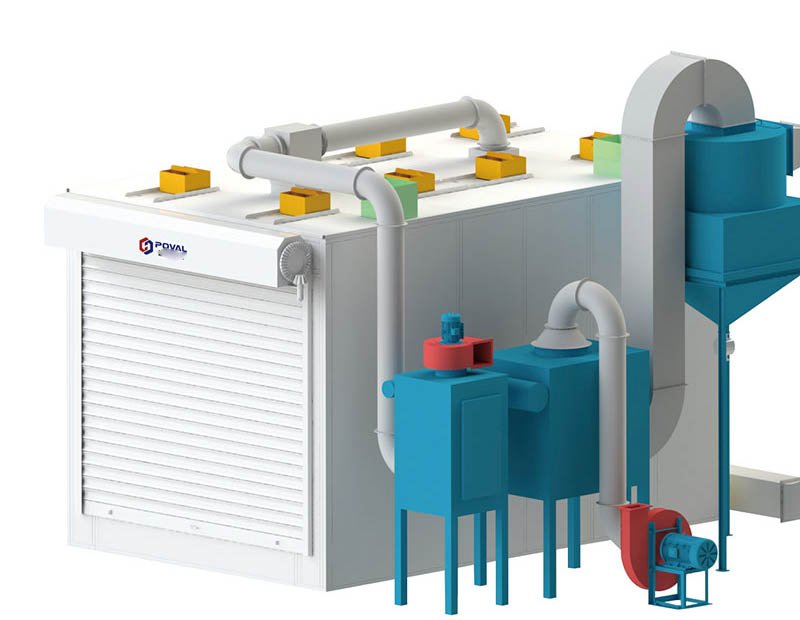
An abrasive blasting room is dedicated surface preparation equipment for oversized and heavy metal workpieces. Buyers also search it as an abrasive blasting room, blasting room, abrasive blasting room or abrasive blasting chamber. It handles parts too large for a standard wheel blasting machine. Typical workpieces: steel structures, container bodies, storage tanks, vessels, castings, forgings and welded fabrications.
For buyers researching an abrasive blasting room manufacturer in China, one specification matters most. It is not the room size. It is the abrasive recovery system. That system decides foundation cost, downtime and abrasive consumption.
What is an abrasive blasting room used for?
In real plant conditions, an automatic abrasive recovery abrasive blasting room performs three main surface treatment functions:
- Surface cleaning: it removes rust, mill scale, weld spatter and old paint. It achieves Sa2.5 or Sa3 cleanliness per ISO 8501-1;
- Surface profiling: abrasive impact creates a uniform anchor profile to support coating adhesion;
- Decorative finishing and deburring: it produces a uniform roughness (anchor profile). That prepares parts for painting, zinc spraying or anti-corrosion work.
Applications cover bridge steel members, wind turbine towers, pressure vessels and ship hull blocks. Also mining equipment and large castings. Such a abrasive blasting booth is common in bridge, tower and shipyard fabrication. These projects need a custom engineered blast room sized around the maximum workpiece. Crane travel and turning space are added. A blast room for steel structure job follows the same rule.
How does an abrasive blasting room work?
The room is driven by compressed air. Media — steel shot, steel grit, quartz sand, silicon carbide, brown corundum or glass beads — is pressurized in the blast pot. It travels through the hose to a high-velocity nozzle, accelerated to 60–120 m/s onto the workpiece.
The abrasive stream removes contaminants by impact and cutting. It also leaves a uniform anchor profile on the base metal. A complete industrial blast room also includes a cartridge or bag filter dust collector. Add the recovery and separator system, lighting and a control panel. Operators wear a blast suit, helmet and air-fed breathing system.
The abrasive recovery system decides operating cost and failure rate. Yet procurement teams underestimate it most. With an automatic abrasive recovery system, media is collected, lifted, separated and recirculated automatically. Abrasive consumption drops sharply and manual sweeping ends.
The 4 abrasive recovery systems for abrasive blasting rooms — comparison table
| Recovery system | Working principle | Foundation pit required? | Best suited for |
|---|---|---|---|
| Mechanical screw (auger) recovery | Rotating helical blades push abrasive to a collection point, then a bucket elevator lifts it to the separator | Yes — typically a 2.5–3.5 m deep pit | High-volume continuous production; large conveying capacity and high efficiency |
| Belt conveyor recovery | A belt conveyor transports abrasive to a central point, then a bucket elevator lifts it for separation | Yes — pit or raised foundation needed | Medium and large blast rooms; simple, reliable structure with low blockage risk |
| Scraper (drag conveyor) recovery | Mechanical scrapers on the floor push abrasive to the collection point, then a bucket elevator lifts it to the separator | No deep pit — shallow foundation only (0.5–2.5 m) | Heavy oversized workpieces, steel bridge structures; durable, efficient and tolerant of foreign objects |
| Pneumatic recovery (honeycomb floor) | Fan vacuum pulls abrasive through a honeycomb floor and conveys it pneumatically to the grit-dust separator | No — or an extremely shallow foundation only | Small and medium blast rooms; very low failure rate and minimal maintenance, but higher energy consumption |
1. Screw conveyor recovery blast room
Screw recovery gives the highest conveying capacity. It suits steel structure plants and container factories on multiple shifts. Such a mechanical recovery blast room has one drawback: civil work. Pits run 2.5–3.5 m deep. That is a problem where groundwater is high.
2. Belt conveyor recovery blast room
Belt recovery is simple, with few failure points and low blockage risk. Maintenance stays cheap. It is mainstream for medium and large blast rooms. But it still needs a pit or a raised foundation.
3. Scraper recovery blast room
A scraper recovery abrasive blasting room pushes abrasive along a shallow trench with wear-resistant scrapers. Load capacity and durability are excellent. It tolerates rod stubs, bolts and offcuts dropped in the room. That makes it preferred for bridge fabrication, long chambers and heavy crane work.
4. Pneumatic (honeycomb floor) recovery blast room
A pneumatic abrasive recovery blast room pulls abrasive through a honeycomb floor by fan vacuum. This honeycomb floor blast room needs essentially no pit. Installation is fast and civil cost is low. Few moving parts mean a low failure rate, ideal for rented or space-limited sites. The trade-off is higher fan energy and slightly more abrasive loss.
How to choose the right abrasive recovery system — selection guide
- Screw or belt recovery: highest efficiency for continuous large-batch production, but a deep pit and high civil cost;
- Scraper recovery: rugged under heavy loads and long chambers, on a shallow foundation;
- Pneumatic recovery: no pit, fast installation and low infrastructure cost, with slightly higher abrasive consumption.
Fix three items together: chamber size versus workpiece, foundation conditions and daily blasting hours. The recovery method then follows. For budget planning, request an abrasive blasting room price estimate with your workpiece data.
About Jiangsu Dingtian — China abrasive blasting room manufacturer
Jiangsu Dingtian Derusting & Painting Equipment Co., Ltd. is a direct-from-factory surface treatment manufacturer in China. We design, produce and export abrasive blasting rooms, shot blasting machines and painting production lines. OEM / ODM engineering, overseas installation guidance and long-term wear part supply are included. Equivalent configurations need about one third of the imported investment.
Frequently asked questions about abrasive blasting rooms
What is the difference between an abrasive blasting room and a shot blasting machine?
A shot blasting machine throws abrasive with high-speed rotating wheels. It suits small and medium standard parts in automated batches. An abrasive blasting room drives a blasting nozzle with compressed air, manually or semi-automatically. It suits oversized, overweight or complex workpieces that cannot enter a machine.
How deep a pit does an abrasive blasting room need?
Screw and belt recovery normally need a 2.5–3.5 m pit. Scraper recovery needs a 0.5–2.5 m shallow foundation. Pneumatic honeycomb-floor recovery needs no pit, or an extremely shallow one.
Which abrasive recovery system has the lowest failure rate?
Pneumatic recovery fails least and needs the least routine maintenance. It has the fewest moving mechanical parts. Scraper recovery is most durable under heavy loads. It also handles rooms where foreign objects frequently enter.
What abrasive media is used in an abrasive blasting room?
Steel shot and steel grit give high cleaning efficiency and many recirculation cycles. Quartz sand, silicon carbide, brown corundum and glass beads also work. Glass beads suit decorative finishing. The media choice sets roughness and blast cleanliness grade.
What blast cleanliness grade can an abrasive blasting room achieve?
With suitable abrasive and process parameters, the room reliably reaches Sa2.5 (near-white metal). Sa3 (white metal) is also achievable. Surface roughness is typically controlled at Rz 40–75 μm.
What affects abrasive blasting room price?
Price follows chamber dimensions and recovery system type. Dust collector air volume and cartridge count matter too. So do blast pot and nozzle count, electrical configuration and crane inclusion. Send maximum workpiece size and daily hours for an exact quotation.
Do you supply abrasive blasting rooms for export with installation support?
Yes. We export blast rooms worldwide with a container-optimized modular design. You receive English manuals and electrical drawings. Installation support is on-site or video-guided. Nozzles, hoses, blast pots and filter cartridges stay stocked.
Related configuration and application pages: LinkedIn, Instagram, Facebook and YouTube.
More machine types and sourcing information: dtcx@dt-shotblasting.com.
Ready to specify this machine? Send workpiece drawings, material and maximum dimensions through the inquiry form below. Add your required hourly output. Our engineers confirm the model, nozzle layout and abrasive specification before you order.
Model Comparison
Compare available models and technical parameters.
| Parameter | Engineered Abrasive Blasting Room Configuration |
|---|---|
| Applications | Large castings, forgings, welded structures and marine components |
| Process | Scale and rust removal; surface strengthening |
| Core systems | Blast chamber, abrasive recovery, ventilation and dust collection |
| Controls | Integrated lighting and electrical control |
| Configuration | Customized to workpiece size, handling and throughput |
Reviews
Customer reviews & ratings
Product inquiry
Reviews
There are no reviews yet.