
Engineered by Dingtian
Industrial Powder Coating and Painting Line
Industrial powder coating and painting line i…
Request a QuoteAn industrial powder coating and painting line is an integrated, automated surface finishing system for metal workpieces. Buyers also search it as a powder coating production line, electrostatic spray painting line or liquid paint spraying line. It serves steel structures, machinery, appliance housings, automotive parts, enclosures and pipe fittings. Electrostatic or air spray forms a uniform, dense, corrosion-resistant film. That improves appearance, rust protection and service life.
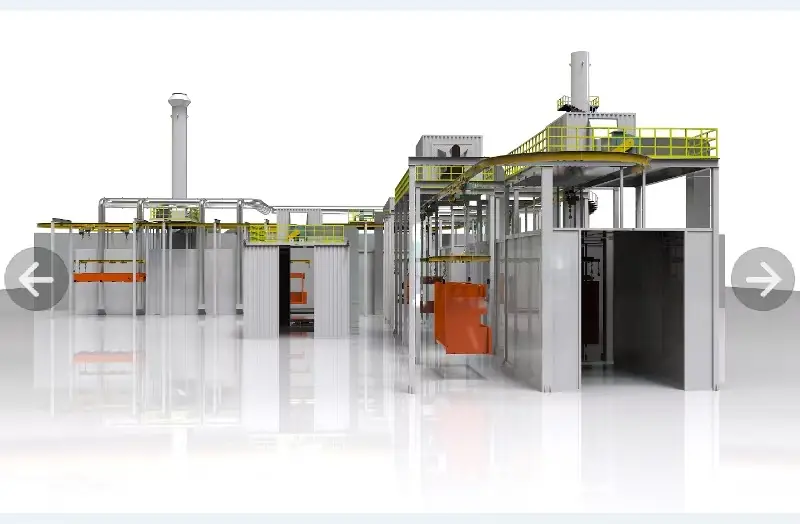
The hero image on this page is a 3D layout of a complete CNC machine bed production line. Jiangsu Dingtian designed and manufactured it for Jiangsu Jinfangyuan CNC Machine Tool Co., Ltd. That company is a wholly-owned subsidiary of TRUMPF (Germany).
Dingtian supplies the full surface treatment chain — shot blasting machines, abrasive blasting rooms and coating lines. Pretreatment through curing and unload is delivered as one turnkey powder coating line project.
What is a powder coating and painting line used for?
Coating lines serve three purposes, and one line typically covers all three:
- Protective coating — rust and corrosion prevention with a barrier against moisture. Typical for outdoor steel structures, construction machinery, bridge members, valves, tanks and wind towers.
- Decorative coating — wide colours, gloss levels and textures (sandy, hammered, wrinkled). Typical for appliance housings, metal furniture, enclosures and hardware.
- Functional coating — high-temperature resistance, conductivity, insulation, fire or antibacterial properties. Typical for electrical equipment and automotive functional parts.
How does an electrostatic powder coating line work?
The core technology is electrostatic spraying. The gun applies 60–100 kV high-voltage static charge. That charges the powder or paint particles. The grounded workpiece forms the opposing pole of the electric field. Charged particles deposit evenly on the surface. They reach recesses, weld seams and edges that air spraying cannot cover.
The coated workpiece then enters a curing oven, normally at 180–220 °C. Powder melts, flows out and cross-links into a hard, dense film. Liquid paint cures as the solvent evaporates and the film hardens under heat.
What is the difference between powder coating and liquid painting?
Choose powder coating for environmental compliance, film thickness, durability and low-cost volume production. Choose liquid painting for fine appearance, very thin films, or heat-sensitive and oversized on-site workpieces. Both options fit the same electrostatic powder coating line frame. The spray stage can be upgraded later without rebuilding the conveyor or oven.
| Comparison item | Powder coating | Liquid painting |
|---|---|---|
| Coating form | Solid powder, solvent-free | Liquid, solvent-borne or water-borne |
| Film thickness | 50–150 μm in a single pass | 15–40 μm per coat, built up in layers |
| Environmental impact | Zero VOC emission; overspray powder is recovered and reused | VOC emission; requires exhaust treatment |
| Appearance quality | Thicker film; can build up on sharp edges | Thinner, finer finish; better levelling |
| Suitable workpieces | Metal parts that withstand 180–220 °C | Complex shapes, precision appearance parts, heat-sensitive parts, oversized on-site structures |
| Colour changeover | Requires booth cleaning; slower | Fast; suits multi-colour short runs |
What are the four steps of the coating line process flow?
The line runs on an overhead conveyor or floor track conveyor. This conveyorized powder coating line links every stage automatically. The standard process has four steps.
Step 1 — Shot blasting pretreatment
Workpieces first enter the blasting stage. High-velocity steel shot removes rust, mill scale, weld slag and oil. It creates a uniform anchor profile for coating adhesion. This is the single most critical stage for coating quality. Poor pretreatment causes premature failure regardless of paint quality. So a powder coating plant with pretreatment starts at the blast stage. Pretreatment equipment is covered in the shot blasting machine and abrasive blasting room ranges.
Step 2 — Powder coating or liquid painting
Pretreated workpieces move into the spray zone. The coating method follows product requirements:
- Powder coating — electrostatically deposited powder, 50–150 μm in one pass, zero VOC. Overspray is recovered and reused by the powder recovery system.
- Liquid painting — better flow and levelling for fine appearance or complex shapes. Suits multi-coat systems with primer, topcoat and clearcoat.
Step 3 — Drying and curing
Coated workpieces enter the curing oven. Powder cures at 180–220 °C for 10–30 minutes, melting and cross-linking. Liquid paint forms its film through heated drying. A tunnel curing oven holds temperature deviation within ±5 °C. Colour, gloss and hardness then stay consistent across a whole batch.
Step 4 — Unload and inspection
Cured workpieces pass a cooling zone down to ambient temperature. Then come appearance, film thickness and adhesion (cross-cut) inspections. Accepted parts are packed and warehoused.
Which environmental systems must a coating line include?
Two systems are standard on any compliant line: industrial dust collection and VOCs exhaust treatment. Without them the line cannot pass environmental assessment approval.
Industrial dust collection system
- Powder lines use two-stage recovery — cyclone plus cartridge filtration. Powder recovery reaches ≥95%, sharply cutting raw material waste.
- Paint lines use a water curtain booth or dry filter for overspray, plus a pulse-jet bag dust collector. Particulate emission stays at ≤10 mg/m³.
VOCs exhaust treatment system
| Exhaust condition | Recommended process | Purification efficiency |
|---|---|---|
| Medium to low concentration | Activated carbon adsorption + catalytic oxidation (CO / RCO) | ≥95% |
| High volume, low concentration | Zeolite rotor concentrator + regenerative thermal oxidizer (RTO) | ≥99%, heat recovery ≥95% |
Coating line buyer FAQ
How much more does a powder coating line cost than a paint line?
A powder line costs more upfront. It adds a powder recovery system and curing oven. But powder is recovered and reused, with no solvent consumption. Sludge disposal costs are far lower. So cost per coated part drops significantly over time. For stable volume production, the difference is usually recovered within 1–2 years. For a budget figure, request a powder coating line price estimate with your workpiece data.
Which heating method should the curing oven use?
The five common options are electric, natural gas, LPG, biomass pellet and thermal oil. Overseas buyers most often choose natural gas or electric. That depends on local energy prices and emission rules. Dingtian designs the oven body and combustion system around your site energy conditions. See the curing oven configurations for powder coating lines for standard gas-fired and electric layouts.
Should I choose an overhead conveyor or a floor track conveyor?
An overhead conveyor suits small to medium parts in high-volume takt production. It also saves floor space. A floor track conveyor — including power-and-free types — suits heavy, oversized parts. Those need station dwell time, routing and far higher loads. The decision follows workpiece weight, dimensions and building height.
Can the coating line be customized to my factory dimensions?
Yes. Every Dingtian coating line is engineered to order. We take maximum workpiece dimensions, unit weight, shifts and output target. We also take building length, width, height and existing utilities. Then we produce a 3D layout proposal first, followed by the equipment list and quotation.
How is installation and commissioning handled for export projects?
Equipment is packed in numbered modules sized for standard containers. Detailed installation drawings and video guidance are included. Engineers can travel overseas to supervise installation, commissioning and operator training. Lines have been exported to Southeast Asia, the Middle East, South America, Africa and Eastern Europe.
How is coating quality inspected and accepted?
Standard acceptance items are appearance, film thickness and adhesion. Appearance means no runs, orange peel, craters or particles. Film thickness is checked with a magnetic gauge within the design range. Adhesion follows GB/T 9286 or ISO 2409 cross-cut test, grade 0–1 accepted. Pencil hardness and impact resistance complete the list. Inspection can follow customer, ISO or ASTM standards.
Is colour changeover difficult on a powder line?
Changing colour requires cleaning the booth, recovery system and guns. That normally takes 30–60 minutes. If you run many colours in small batches, specify a quick-change powder booth. It uses large cyclone recovery with interchangeable cartridges. Otherwise choose a liquid paint line.
About Jiangsu Dingtian
Jiangsu Dingtian Derusting & Painting Equipment Co., Ltd. is a source factory integrating R&D, manufacturing, sales and service. Products: automatic powder coating line systems, shot blasting machines, abrasive blasting rooms, dust collectors and VOCs treatment equipment. All are listed on the surface treatment equipment factory website. Non-standard customization, turnkey line delivery and overseas installation guidance are available per workpiece and capacity requirements.
Contact and Technical Support
Send workpiece drawings, dimensions, weight and daily output to receive a free line layout proposal and quotation:
Email: dtcx@dt-shotblasting.com | WhatsApp / WeChat: +86 158 9516 5618 | WeChat ID: cxj999888
More machine working videos are available on our social media channels:
LinkedIn | Instagram | Facebook | YouTube
Related configuration and application pages: curing oven configurations for powder coating lines.
Ready to specify this machine? Send your workpiece drawings, material and maximum dimensions. Add your required hourly output. Use the inquiry form below. Our engineers will confirm the model and coating specification before you order.
Model Comparison
Compare available models and technical parameters.
| Parameter | Engineered Coating-Line Configuration |
|---|---|
| Process stages | Conveying, spraying, flash-off and drying |
| Paint application | Automatic or manual; selected for the coating system |
| Environmental systems | Ventilation, filtration and optional VOC treatment |
| Integration | Stand-alone booth or complete pretreatment and coating line |
| Configuration | Customized to workpiece, throughput and coating specification |
Reviews
Customer reviews & ratings
Product inquiry
Reviews
There are no reviews yet.