
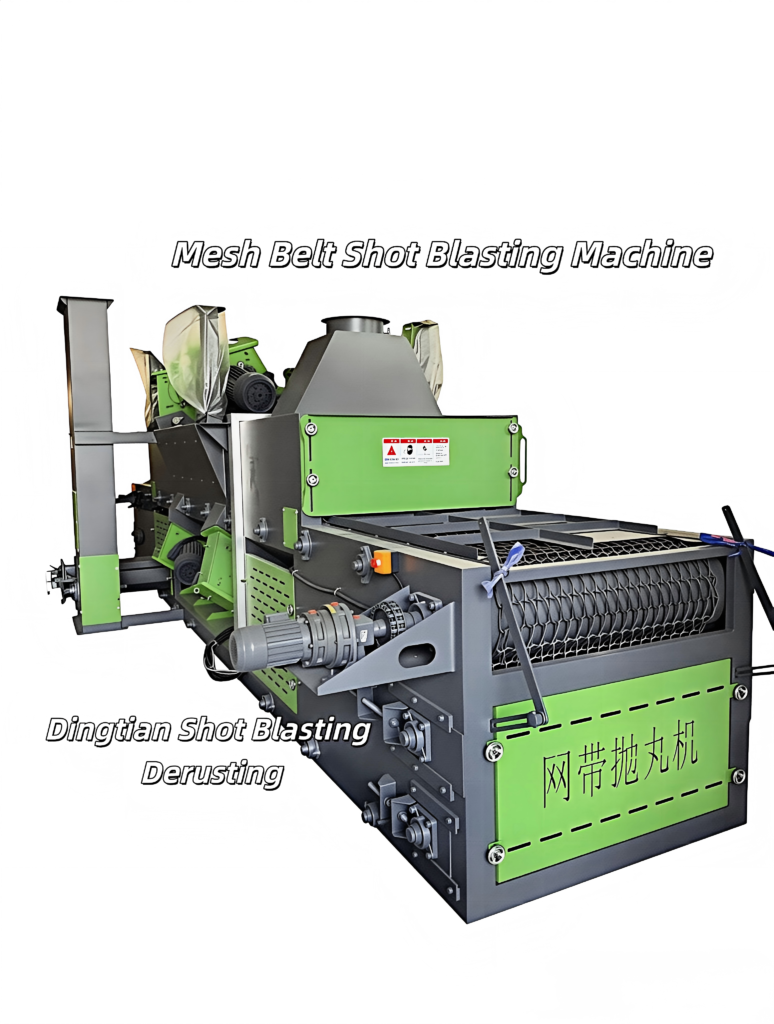
A wire mesh belt shot blasting machine carries workpieces flat on a woven metal belt through an enclosed blast chamber. Blast wheels throw abrasive at 70–80 m/s. The stream strips oxide scale, rust, moulding sand, welding slag and burrs in one pass. Cleanliness reaches Sa 2.5 to Sa 3.0 per ISO 8501-1.
Parts never tumble and never strike one another. That makes this the standard choice for fragile work. Typical parts: aluminium die castings, brake discs, thin-wall housings, fasteners and precision components.
| Key Metric | Value |
|---|---|
| Chamber liner and wear part material | Mn13 / ZGMn13 Mn13 work-hardening alloy |
| Abrasive velocity | 70–80 m/s |
| Cleanliness per ISO 8501-1 | Sa 2.5 – Sa 3.0 |
| Belt speed | 0.5–4 m/min, inverter controlled |
| Blast wheels | 4–12 units, set to workpiece width |
| Dust emission | ≤ 30 mg/m³ |
What Does Mn13 Mean for Wire-Belt Service Life?
Mn13 is the Chinese designation for a work-hardening austenitic wear alloy, standardised as ZGMn13 under GB/T 5680. Its defining property is work hardening. As-cast hardness is HB 200–250. Under impact from abrasive and workpieces the surface layer hardens to HB 450–550, while the core stays tough.
This is why a Mn13 wear liner resists abrasion instead of cracking. In our chamber the liners last 3 to 5 times longer than ordinary steel plate. The same steel class is used worldwide for crusher liners, rail frogs and heavy duty conveyor parts.
| Standard | Equivalent Designation | Where Buyers Recognise It |
|---|---|---|
| China GB/T 5680 | Mn13 / ZGMn13 | Asia, Middle East, Africa, South America |
| USA ASTM A128 | Hadfield work-hardening alloy | North America |
| Europe EN | X120Mn12 (material 1.3401) | Germany and the EU |
| Trade name | Mn13 work-hardening alloy | All markets |
Water toughening treatment is applied before machining. After roughly 40–80 running hours the hardened layer fully develops and wear resistance rises sharply. That run-in period is normal, not a defect. Buyers in North America searching for a Mn13 belt blast machine are looking for exactly this material class.
How Does a Wire Mesh Belt Shot Blasting Machine Work?
Workpieces lie flat on the belt and pass through the chamber at an inverter controlled speed of 0.5–4 m/min. Four to twelve blast wheels strike the parts in a single pass. The wheels sit in opposed pairs above and below the belt, angled to cover flat faces, sides and shallow cavities.
Spent abrasive falls through the mesh openings. A screw conveyor and bucket elevator lift it to a full flow air wash separator, which removes dust, fines and fractured media. Clean abrasive returns to circulation. A cartridge or bag dust collector holds the chamber under negative pressure, so nothing escapes. Emission stays at or below 30 mg/m³. Cleaned parts exit through an optional blow-off station.
This is a pass-through or through-feed process. European buyers call it a continuous flow machine. North American buyers call it a continuous pass-through blast machine. German catalogues list it as a wire belt blast machine. It is the same equipment under four names.
Why buyers choose it over tumble blasting
- Zero part-to-part contact. A tumble blaster collides parts thousands of times per cycle. A continuous mesh belt shot blasting machine holds every part exactly where it was loaded.
- No damage to threads or edges. Bolts, tapped holes and machined sealing faces keep their geometry.
- No thin-wall distortion. The belt supports parts fully across its width instead of lifting and dropping them.
- Both faces in one pass. Abrasive falls through the open mesh, so the underside is blasted at the same time. No re-fixturing and no manual flipping.
- Genuinely continuous output. Loading and unloading run while the machine blasts, so it links straight into a die casting cell, a machining centre or a painting and coating line.
- Compressed surface layer. Impact leaves residual compressive stress, which raises fatigue strength as well as coating adhesion.
Which Parts and Industries Suit This Machine?
A through-feed conveyor shot blasting machine suits flat, thin or shallow parts laid in a single layer. It is strongest for fragile, threaded or cosmetically critical parts in high volume.
| Industry | Typical Workpieces |
|---|---|
| Foundry and casting | Small and medium steel and iron castings — desanding, oxide scale removal, deburring |
| Automotive and new energy vehicles | Aluminium die cast motor housings, EV battery pack trays, gearbox housings, brake discs and drums, wheel hubs, suspension springs, bearing rings |
| Forging and hand tools | Wrenches, pliers and other forged tools — scale removal before machining |
| Fasteners and powder metallurgy | Screws, bolts, nuts, washers, retaining rings, sintered PM parts — the flat belt protects thread crests |
| 3C electronics and electrical | Aluminium mid-frames, heat sinks, stamped enclosures, motor end caps, radiator and filter profiles |
| Steel structure | Plate, profiles and weldments needing pretreatment before coating |
| Aerospace and medical | Aluminium structural components, surgical instrument parts, hygienic grade hardware |
Three of these sectors drive most of our enquiries. Aluminium and zinc die casting plants need a mesh belt shot blasting machine for aluminium die castings, because tumbling would round off the edges of soft alloy. Brake component makers specify a brake disc shot blasting machine to hold flatness on the friction face. Fastener producers look for a bolt and nut shot blasting machine that cleans threads without flattening the crests.
Foundries processing delicate shells ask for a thin-wall casting shot blasting machine. Electronics plants running extruded or die cast heatsinks need a heat sink shot blasting machine that leaves no witness marks on visible faces. Where iron embedding must be avoided entirely, we fit a stainless steel wire mesh belt shot blasting machine with non-ferrous media.
Technical Parameters
| Parameter | Specification |
|---|---|
| Workpiece size range | width 800–3000 mm × height 50–800 mm |
| Belt speed | 0.5–4 m/min, inverter controlled |
| Number of blast wheels | 4–12 units, set to workpiece width |
| Single wheel power | 11 / 15 / 18.5 / 22 kW standard; 7.5–30 kW range available |
| Impeller diameter | Ø360–Ø420 mm |
| Abrasive diameter | Ø0.5–Ø1.5 mm, steel shot and grit mix |
| Abrasive velocity | 70–80 m/s |
| Dust extraction air volume | 8000–30000 m³/h |
| Dust emission concentration | ≤ 30 mg/m³ |
| Noise level | ≤ 85 dB(A), double sealed chamber |
| Total installed power | approx. 60–200 kW depending on configuration |
| Cleaning grade | Sa 2.5–Sa 3.0 per ISO 8501-1 |
| Control system | PLC plus touch screen, manual / auto switch, fault alarm |
Belt material is specified to the workpiece. High strength stainless steel mesh is the default. A Mn13 alloy mesh belt shot blasting machine version uses a woven Mn13 belt for maximum wear life on heavy abrasive duty. Stainless mesh is preferred for aluminium, brass and food grade work, where iron contamination must be avoided.
Hourly output is quoted per project rather than as a fixed catalogue number. It depends on part size, belt width, loading density and the required Sa grade. Send your part data and we will calculate the real figure for your line.
When Is a Mesh Belt Machine the Wrong Choice?
- Deep cavities and blind holes. Blasting is a line of sight process, so the stream cannot reach the bottom of a deep cavity. Use a hanger type, turntable or robotic blast room instead.
- Very heavy single pieces. Load above the belt rating stretches or breaks the mesh. The governing limit is load per square metre of belt, not total weight.
- Rugged bulk parts. If the part tolerates impact, a rubber crawler or tilting drum tumble blaster cleans it at lower cost.
- Long profiles. Plate, pipe, H-beam and section steel belong on a roller conveyor through-feed machine.
- Very thin aluminium. Sheet below about 1.2 mm can deform under concentrated impact, even on a flat belt.
- High mix, low volume. This machine is built for continuous running. Intermittent mixed batches suit a hanger or turntable machine better.
- Aluminium dust risk. Non-ferrous processing needs an explosion protected dust collector. Specify it at enquiry stage.
How Do You Keep the Machine Running?
| Interval | Maintenance Action |
|---|---|
| Every shift | Check blast wheel running sound, belt tension and dust collector pressure differential |
| Weekly | Grease blast wheel bearings, elevator shaft and gearbox |
| Monthly | Inspect blades and liners for wear; replace parts past the limit |
| Quarterly | Clean or replace dust collector cartridges; clean and tighten electrical panels |
| Annually | Full strip-down inspection; replace worn screws and elevator belts |
Belt tension is the most common cause of unplanned stoppage. Check it every shift. A slack belt tracks sideways and wears at the edges long before the mesh itself fails.
How Do You Select the Right Model?
- Small parts in high volume — choose the mesh belt type. Parts lie flat and pass continuously, which gives the highest throughput.
- Irregular or impact sensitive parts — choose a roller conveyor or overhead chain through-feed type to cut part-to-part friction.
- Heavy parts with thick scale — increase wheel count or single wheel power, rather than slowing the belt.
- Aluminium and non-ferrous alloys — fit an explosion protected dust collector and use isolated or stainless media.
- Line integration — specify infeed and outfeed conveyors, part presence sensors, blow-off station and PLC data output.
Specify four numbers: maximum part size, load per square metre of belt, required hourly throughput and target cleaning grade. Belt width, wheel count, wheel power, media size and collector capacity all follow from these.
Wear Part Compatibility with Wheelabrator, Pangborn and Sintokogio Machines
Wear parts are where suppliers differ most, and where a vague answer costs money later. Blades, control cages, impellers and chamber liners are consumables, and over ten years their cost usually exceeds what you paid for the machine.
We manufacture compatible wear parts for Wheelabrator, Pangborn and Sintokogio machine series to the original dimensions, fitted by drawing or sample. The parts are cast in our own foundry, so the alloy grade, the liner thickness and the lead time are under our control rather than dependent on an outside supplier.
Wheelabrator, Pangborn and Sintokogio are trademarks of their respective owners. Compatibility references describe fit and function only, and do not imply any affiliation with or endorsement by those companies.
Frequently Asked Questions
What is the difference between a mesh belt and a tumble shot blasting machine?
A tumble cleaner rotates parts against one another, so it leaves impact marks. It suits rugged bulk parts where cosmetics do not matter. A mesh belt cleaner conveys parts flat and still, and blasts top and bottom at the same time with zero part-to-part contact. It suits fragile, precision, threaded or thin-wall parts. If a part cannot tolerate a single dent, choose the mesh belt machine.
What is Mn13 steel, and is it the same as Hadfield work-hardening alloy?
Mn13 is the Chinese GB/T 5680 designation, written ZGMn13, for a work-hardening austenitic wear alloy. It corresponds to ASTM A128 in the USA, where it is called Hadfield work-hardening alloy, and to X120Mn12 (material 1.3401) in Europe. All three are the same work hardening class. Its value here is that the surface hardens under abrasive impact while the core stays tough, so liners and belts resist wear instead of stretching or cracking.
What surface cleanliness and profile can it achieve?
Sa 2.5 to Sa 3.0 measured per ISO 8501-1, given enough wheel power, correct media and a lower belt speed. Surface profile is controlled by media size and dwell time, so a repeatable anchor pattern keeps batch to batch consistency for painting or powder coating.
Can this machine blast aluminium and magnesium die castings?
Yes. It is one of the most common applications. Use non-ferrous media such as stainless shot, cut wire or dedicated aluminium media. Keep the abrasive circuit isolated or thoroughly cleaned, so iron does not embed and cause later corrosion staining. Reduce belt speed and wheel power compared with steel work, so soft alloy edges do not round off. Fit an explosion protected dust collector for aluminium fines.
What is the maximum part size and weight?
Standard frames cover workpieces 800–3000 mm wide and 50–800 mm high. The governing limit is load per square metre of belt rather than total weight. A light part spread over a large area behaves very differently from a dense casting of the same mass. Send a drawing and we will confirm the belt rating for your parts.
How fast is the belt, and can the speed be changed?
Belt speed runs from 0.5 to 4 m/min under inverter control. Slower speed means longer dwell time, heavier scale removal and a coarser profile. Faster speed means higher throughput on light cleaning duty. The operator sets it from the touch screen for each part family.
Are spare parts expensive or slow to supply?
Can it run on an automated production line?
Yes. This is its main structural advantage. Infeed and outfeed conveyors, part detection sensors, blow-off stations, load and unload robots and PLC communication let the blaster run as one station inside a die casting cell, a machining line, or a pretreatment line ahead of painting, powder coating, plating or bonding.
Get a Quotation — Free Shot Blast Test on Your Parts
Send us your part drawing, material, maximum dimensions, weight and required hourly output. Before you order we confirm belt width, wheel count and media specification, and we report the Sa grade achieved on your sample parts.
Submit your inquiry through the form below, or contact Jiangsu Dingtian Derusting & Painting Equipment Co., Ltd. directly.
- Email: dtcx@dt-shotblasting.com
- WhatsApp: +86 15895165618 | WeChat: cxj999888
- Location: Jiangsu, China
Watch More Shot Blasting Machine Models Running On-Site
To see more shot blasting machine models working in real customer plants, please visit the following channels:
- LinkedIn: LinkedIn
- YouTube: youtube.com/@ChinaDingtianShotBlasting
- Instagram: Instagram
- Facebook: Facebook
- Facebook Company Page: Facebook
Trademark notice: Wheelabrator, Pangborn, SINTO / Sintokogio, Rösler and Gostol are registered trademarks of their respective owners. They are mentioned here for comparison and reference only. Jiangsu Dingtian Derusting & Painting Equipment Co., Ltd. is an independent manufacturer and is not affiliated with, endorsed by, or a supplier of original parts to those brands. Wear parts we supply are aftermarket, non-original components.