
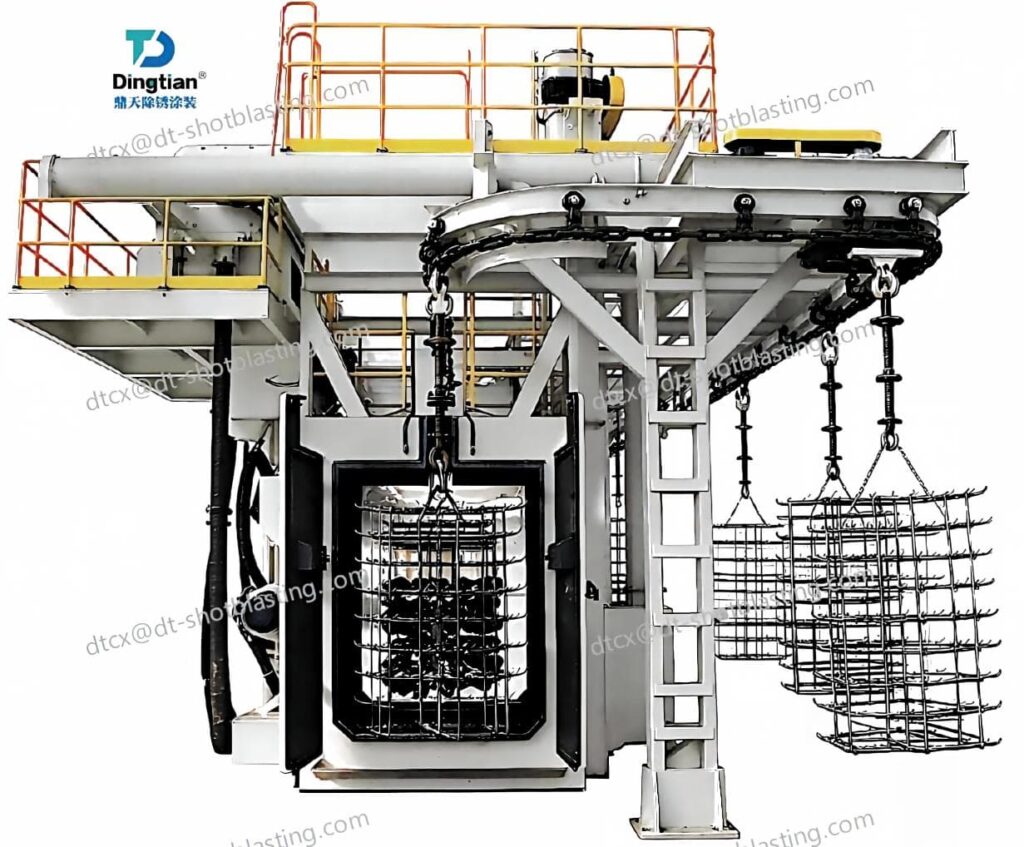
Why the conveyor mode decides everything else about the machine
In foundries, forge shops and metal fabrication plants, high-volume surface preparation of hung workpieces is rarely a stand-alone operation. It sits between welding or casting upstream and coating downstream, and the way parts move through the blast chamber determines how well the whole line runs. This is a shot blasting machine selection question before it is a purchasing question.
An overhead monorail blast machine carries each workpiece on a hook. The hook travels along an overhead rail into an enclosed blast chamber, where centrifugal wheels throw abrasive at the part. The workpiece hangs free rather than resting on a roller table or tumbling in a barrel. That is what lets this machine family handle three-dimensional welded assemblies, castings and forgings. Any other method would damage them or clean them badly.
What most buyers do not realise before they order is that this machine family comes in two fundamentally different operating modes. The difference is not a minor configuration option. It changes the sealing principle. It changes the number and placement of blast wheels, and the installed power. It decides whether a manual touch-up station is physically possible at all. It also decides whether the machine can synchronise with a coating line.
The two modes are:
- Indexing mode — the workpiece enters the chamber, the chamber closes, the part is blasted while stationary, then the chamber opens and the part moves out. Known in Chinese practice as the step-through configuration.
- Continuous feed mode — the chamber has no doors. Workpieces pass through without stopping, and the wheels run continuously.
Both are built on the same frame, the same abrasive recycling circuit and the same spinner hanger blast machine principle. Everything below explains what actually changes between them, and how to decide which one your plant needs.
What is an indexing spinner hanger blast machine?
The indexing machine works on a stop-and-blast cycle. The hook carries the workpiece into the chamber along the overhead rail. Once inside, pneumatically operated doors at both ends of the chamber close, forming a fully sealed enclosure. The blast wheels start, the hook rotates the workpiece, and the part is cleaned while it stands still. When the cycle ends, the exit door opens and the hook carries the part out to the next operation.
This arrangement has one decisive advantage: sealing integrity. Blasting happens inside a fully closed chamber, so abrasive cannot escape into the plant. That protects the surrounding floor, keeps abrasive consumption predictable, and above all keeps personnel out of the line of fire. For plants with mixed traffic around the machine, or with strict housekeeping requirements, the closed-chamber design is the safer baseline.
A second advantage follows from the same design. Because the part is stationary during blasting, the wheels have as much time as the cycle allows to work on every surface. The dwell time is a controlled variable, not a consequence of conveyor speed. That is what makes the indexing mode tolerant of difficult geometries.
The whole indexing cycle is automatic, not operator-driven
A point that is frequently misunderstood, and worth stating plainly: the stop, blast, release and step sequence of an indexing machine is not controlled by an operator. It is executed entirely by the PLC programme, using photoelectric position sensing for feedback and pneumatic actuators for the chamber doors.
The sequence runs as follows:
- Hook position is detected. Photoelectric sensors at the load-in point, at the chamber entrance and at the discharge point report hook presence to the PLC. The controller knows where every hook is on the rail at all times, so the conveyor is never stepped by guesswork.
- The conveyor indexes and stops. The PLC starts the monorail drive, and cuts it the moment the sensor confirms a hook has reached the blasting position. The stop is sensor-triggered, which is what puts the workpiece in the same place to the same tolerance on every cycle.
- The chamber doors close. Pneumatic cylinders drive both doors shut. Position switches on each cylinder confirm the doors are physically closed and latched before the PLC will proceed.
- The interlock permits blasting. This is the safety-critical step. Four conditions must all be confirmed before the PLC will start the blast wheels. The door-closed signal must be present. The hook rotation drive must be running. The abrasive recycling circuit must be running. The dust collector must be confirmed operating. If any one is missing, the cycle holds.
- The blast cycle runs to a set time. Wheels start, abrasive flow is metered, and the hook rotates the workpiece. Cycle time is a PLC parameter, so it can be set per part family and recalled from a stored programme rather than judged by an operator.
- Wheels stop, then a drain delay runs. The wheels are stopped before the doors open, and the PLC holds a short delay so that abrasive carried up by the wheels falls back into the recovery hopper. Opening the doors while abrasive is still in flight is what causes shot to spill onto the plant floor.
- The doors open and the conveyor steps again. Only after the drain delay does the PLC command the exit door open. It then waits for position confirmation. Finally it restarts the monorail drive to index the next hook into position.
Three consequences of this being fully automatic:
- Cycle time is repeatable. Every workpiece receives the same dwell, so cleanliness grade is consistent hook to hook. Manual control cannot hold that, and inconsistent grade is what causes coating rejection.
- The mode can actually track a coating line. The synchronisation described later in this article only works because the PLC can hold, release and re-time the cycle against a signal from downstream equipment. An operator pressing buttons cannot do this reliably through an eight-hour shift.
- The interlock is enforced, not procedural. Door-closed and dust-collector-running conditions are checked by the controller on every cycle. On a manually sequenced machine those checks depend on the operator remembering.
The operator’s role on an indexing machine is loading and unloading workpieces. The operator also monitors the touch-screen for cycle status and fault messages, and refills abrasive. The operator does not drive the blast cycle. Where the plant wants recipe control for different part families, cycle time, wheel speed and abrasive flow are stored as named programmes on the HMI.
The continuous machine is automated in the same sense but with fewer discrete steps. The PLC holds conveyor speed under inverter control. It keeps the wheels running whenever parts are in the chamber, and it monitors curtain-zone and dust-collection status. There are no doors to interlock. That is why it has no equivalent stop-and-hold point.
The indexing configuration is offered across our Q48 range. Some pieces are too heavy to hang at all. For those, the alternative is a trolley type shot blasting machine. The workpiece then rides on a rail car instead of a hook.
What do overseas buyers call these two modes?
The naming varies considerably between markets and between manufacturers, and this is a genuine source of confusion in international procurement. A buyer searching for the right machine will encounter several terms for the same equipment. The table below maps the common designations.
| Mode | Terms used by European manufacturers | Terms used in North America | Terms used on B2B platforms |
|---|---|---|---|
| Indexing / stop-and-blast | spinner hanger blast batch machine; indexing monorail blast machine | overhead monorail blast machine with rotating hook; single-rail batch blaster | hanger type shot blasting machine; hook type shot blast machine; Y-track hanger blast machine |
| Continuous feed / pass-through | continuous feed spinner hanger blast machine; continuous monorail blast machine | overhead monorail blast machine, closed loop; power and free blast cleaning system | continuous hanger type shot blast machine; hanging chain conveyor shot blasting machine; tunnel overhead conveyor type shot blasting machine |
| Accumulation / index-and-hold | power and free conveyor blast machine | power and free overhead conveyor blast system | accumulation type hanger shot blasting machine |
Two manufacturer references are worth naming because they define the vocabulary the rest of the market follows. Rösler publishes the RHBD spinner hanger range. The batch machine is the base configuration, and the RHBD-K suffix denotes the continuous feed version. The company describes its RHBD-T continuous machine as essentially a spinner hanger blast batch machine with two doors to allow the linear flow of parts. That is precisely the distinction this article draws.
Wheelabrator uses the HB designation for its overhead monorail machine with a rotating hook on a Y-track rail. The DHB designation covers its high-throughput closed-loop system, built on power and free conveyor technology. Note carefully that in the DHB description, power and free refers to the conveyor subsystem, not to the machine as a whole. This is a common misreading in specifications. A power and free conveyor is one way to move hooks, and it can serve indexing, continuous or accumulation blasting.
If you are comparing quotations from different countries, the first thing to establish is which of these modes each supplier is actually offering. Two machines with near-identical model numbers and price can differ completely here.
Which international builders set the terminology for this machine family?
Most buyers do not start their search from a machine category. They start from a brand name. Brand names are what appear in second-hand machinery listings. They appear in engineering specifications written by outside consultants, in tender documents, and in the maintenance records of plants that already run one of these machines. Knowing which designation belongs to which builder makes an international quotation comparable. So does knowing which operating mode that designation implies.
| Builder | Origin | Their designation for this machine family | Operating mode implied |
|---|---|---|---|
| Wheelabrator | United Kingdom and Germany | HB Overhead Monorail machine with rotating hook and Y-track rail; DHB Overhead Monorail for high-throughput closed-loop processing; TITAN blast wheels | HB — indexing and batch on a single rail; DHB — continuous, closed loop |
| Norican Group | Denmark and Germany | Parent group holding Wheelabrator and DISA; operates a manufacturing centre in Changzhou, China, dating from 1997 | Group rather than a single machine type |
| Rösler Oberflächentechnik | Germany, Untermerzbach | RHBD spinner hanger blast machine; RHBD-K continuous feed; RHBD-T continuous with two doors for linear part flow; RMBC and RMBD tumble belt; RSAB for plastics | RHBD — indexing and batch; RHBD-K and RHBD-T — continuous feed |
| Pangborn | United States, Hagerstown, Maryland | Hanger hook blast machine, where the hook rotates and dwells at multiple positions under the wheel pattern; barrel blast machine in the GN series; bogie work car blast machine | Hanger hook — indexing with multi-position dwell |
| DISA | Denmark | Foundry-oriented blast cleaning range within the Norican Group; the DISA name appears widely in foundry specifications and in second-hand foundry equipment listings | Multiple configurations across the foundry range |
| Sintokogio (Sinto) | Japan, Nagoya | Broad blast cleaning and moulding range; established a manufacturing plant in Qingdao, China, in 1996, so Sinto designations are familiar to buyers across Asia and the Middle East | Multiple configurations across the range |
| AGTOS | Germany, Emsdetten | Tumble belt, wire belt and hanger blast machines; frequently named in European specifications for continuous through-feed cleaning | Batch and continuous configurations |
| Gostol TST | Slovenia | Type VKP overhead rail shot blasting machine; Type KOM bogie machine; KTP wire belt; P series preservation lines | VKP — overhead rail hanger cleaning |
| Turbotecnica | Italy | TC series overhead conveyor blast machine, in mono-rail and bi-rail layouts; automatic pass-through turbine shot blaster | TC — mono-rail batch or bi-rail continuous |
| OMSG (Officine Meccaniche San Giorgio) | Italy | CWB wire belt machines; Lauco roller conveyor blast machines; SG350 blast wheel | Continuous through-feed configurations |
| Tosca | Italy | Monorail and continuous hook shot blasting machines | Both indexing and continuous |
| BlastKing | India, with North American distribution | HB hanger type shot blaster range, specified by maximum cluster height and cluster weight; Type C pass-through tunnel machines | HB — hanger batch; Type C — continuous tunnel |
| CM Spa | Italy | MX series monorail shot blasting machines; M1250 hanger model with automatic hanger advancement; ST series blast cleaning machine for wire, bar, rod and tube | MX — monorail batch and pass-through |
| Viking Blast & Wash Systems | United States, Kansas | MR6016 monorail blast system with a blast zone 60 in. tall by 16 in. wide; structural steel and heavy fabrication blast machines | Monorail pass-through |
| Roto Blast Engineering | United States | Monorail shot blasting machines where parts hang on an overhead rail and are carried through the blast chamber into the next process | Monorail continuous |
| Kaltenbach | Germany | Structural steel shot blasting and preservation systems; scalable blast systems designed to integrate with existing fabrication equipment | Continuous through-feed for sections and plate |
| Guyson | United Kingdom | Blast cabinets and automated abrasive blasting systems; NC-10 CNC shot peening system; robotic blast installations | Cabinet and robotic rather than monorail |
| Blastman Robotics | Finland | Robotic abrasive blast cleaning for wind turbine towers, large fabrications and heavy plate, using compressed-air delivery rather than centrifugal wheels | Robotic compressed-air, not wheel blasting |
| BlastOne | Australia | Wheel blast machine systems for surface preparation, descaling, shot peening and rust removal; tumble blast, plate and structural sections; blast and paint facilities | Both wheel and compressed-air configurations |
| Airblast | United Kingdom and Netherlands | Wheel blast machines and bespoke cabinets; internal pipe-blasting nozzle ranges for tube and pipework | Cabinet, wheel and pipe internal cleaning |
| CYM Materiales | Argentina | Centrifugal wheel and compressed air blast machines; pipe and spool blast wheel machines; industrial dust collection and shot peening | Wheel and compressed-air, pipe and spool focus |
| Selmers | Netherlands | Pipe blasting and coating lines with internal blast wheel systems; high performance blast wheels for line pipe | Continuous pipe internal and external |
Three points follow from this table, and they are the ones that actually decide a purchase.
First, the same letter code does not mean the same machine. Wheelabrator’s HB and BlastKing’s HB both denote hanger machines, but they are unrelated product lines with different chamber geometry and wheel arrangements. A specification that says simply “HB type” is ambiguous until the builder is named.
Second, the suffix carries the operating mode. For Rösler, the plain RHBD is the batch machine and the K suffix makes it continuous feed. For Wheelabrator, the change from HB to DHB is the change from a single-rail hook machine to a closed-loop power and free system. Buyers who compare a plain RHBD quotation against an RHBD-K quotation are comparing two different machines, and the price difference is not a discount.
Third, brand names travel with the equipment long after purchase. A plant running a Rösler, a Wheelabrator or a Sintokogio machine will specify replacements and expansions by that name, and its maintenance staff will order consumables against it. That is why the terminology matters commercially and not only technically.
Questions buyers ask when they search by brand name
When a plant expands or replaces an existing machine, the enquiry rarely starts from a generic machine category. It starts from the name already on the equipment. In every case the answer follows the same route: establish the operating mode, the wheel count and placement, the chamber length and the installed power.
- Is a Wheelabrator HB overhead monorail machine the same thing as a Wheelabrator DHB? No — the HB is a single-rail hook machine with a rotating hook, the DHB is a closed-loop high-throughput system on power and free conveyor technology.
- What is the difference between a Rösler RHBD and a Rösler RHBD-K? The plain RHBD is the batch machine; the K suffix denotes the continuous feed version.
- What does the K suffix mean on an Rösler RHBD-K spinner hanger blast machine? Continuous feed rather than batch operation.
- Is a Pangborn hanger hook blast machine an indexing machine? Yes — the hook rotates and dwells at multiple positions under the wheel pattern, which is an indexing arrangement rather than a pass-through one.
- What is a Pangborn GN series barrel blast machine used for? Batch tumbling of smaller robust parts, using the GN capacity code; it is not a monorail machine.
- Does a DISA blast machine handle hung castings? DISA equipment is foundry-oriented and spans several configurations; the operating mode has to be established from the specific machine, not from the brand.
- What does a Sintokogio or Sinto designation mean in a foundry specification? It identifies the builder rather than the machine type, and Sintokogio designations are widely encountered across Asia and the Middle East following the Qingdao plant established in 1996.
- Is an AGTOS hanger blast machine continuous or batch? AGTOS supplies both; the quotation has to state which.
- What is a Gostol TST VKP overhead rail shot blasting machine? A hanger-type machine on an overhead rail, from the Slovenian builder also known for its KOM bogie machines and KTP wire belt machines.
- What does the Turbotecnica TC series cover? Overhead conveyor blast machines in mono-rail and bi-rail layouts, and automatic pass-through turbine shot blasters.
- What is an OMSG CWB machine? A wire belt blast machine from the Italian builder also known for Lauco roller conveyor machines and the SG350 blast wheel.
- Is a CM Spa MX monorail machine the same as an overhead conveyor blast machine? Same family — monorail hook transport through a blast chamber, with the M1250 offered with automatic hanger advancement.
- What is a Viking Blast MR6016? A monorail blast system with a blast zone 60 in. tall by 16 in. wide, from the United States builder serving structural steel and heavy fabrication.
- Is BlastKing HB the same designation as Wheelabrator HB? No. The same letter code is used by unrelated product lines with different chamber geometry and wheel arrangements.
- Can a Blastman robot do what a monorail blast machine does? Different process entirely — Blastman uses compressed-air robotic abrasive blast cleaning for wind turbine towers and large fabrications, not centrifugal wheel blasting of hung parts.
- Are BlastOne wheel blast machines and Airblast wheel blast machines comparable to a Chinese monorail machine? Comparable in category; the specification questions above still have to be answered model by model.
- What about Kaltenbach for structural sections? Kaltenbach systems are aimed at structural steel and are designed to integrate with existing fabrication equipment, usually as continuous through-feed rather than hung-part cleaning.
- Does Guyson make monorail blast machines? Guyson’s range is built around blast cabinets, automated abrasive blasting systems and CNC shot peening rather than overhead monorail hung-part cleaning.
- Are CYM Materiales and Selmers relevant to pipe work? Yes — both supply pipe and spool blast wheel systems, which is a different machine family from the monorail hanger machines discussed here.
- What is Norican? The group holding Wheelabrator and DISA, with a manufacturing centre in Changzhou, China, dating from 1997.
How do our machines relate to these designations?
Jiangsu Dingtian builds this machine family as an independent Chinese manufacturer. Our Q48 indexing range is comparable in function to the Rösler RHBD batch machine and to the Wheelabrator HB overhead monorail. Our Q38 continuous feed range is comparable to the Rösler RHBD-K, and in closed-loop service to the Wheelabrator DHB. Our Q58 accumulation range corresponds to machines built on power and free conveyor technology.
The designations above are used here for one purpose only: to help a buyer translate a specification written around another builder’s catalogue into the terms that decide the purchase. Where a plant already runs one of these machines, the same five questions apply. Which operating mode? How many blast wheels, and on which sides? What chamber length? What installed power? Is a manual touch-up station required?
Consumable designations also differ between builders, for blades, liners, control cages and impellers, even where the underlying part is dimensionally interchangeable. Our article on cross brand shot blasting wear parts maps those across manufacturers. That is normally the fastest way to establish whether an existing machine can be serviced from an alternative source.
Why must the hook rotate in both modes?
Hook rotation is not an optional extra. It is the mechanism that makes complete surface coverage possible, and it applies to both modes.
Blast wheels throw abrasive in a fixed, directional pattern. A wheel mounted on one side of the chamber cannot reach the far side of a workpiece. It cannot reach the underside of a flange or the inside of a recess. If the hook were fixed, those surfaces would stay in the blast shadow for the entire cycle. They would come out with mill scale, weld spatter or foundry sand still on them.
Rotating the hook sweeps every surface through the abrasive pattern. That is how the machine achieves full-perimeter coverage without needing wheels at every possible angle.
In the indexing mode, rotation is straightforward. The part is stationary in space, so a constant rotation speed gives even exposure over the whole dwell time.
In the continuous feed mode, the requirement is stricter. The hook must rotate steadily and without interruption for the entire time the part is inside the chamber, because there is no second chance. Any hesitation while the part passes the wheels leaves an unblasted band that no downstream operation will fix. This is why the drive on a continuous machine is specified for constant torque through the full traverse. It is also why rotation failure is treated as a stop-the-line fault rather than a quality nuisance.
The Wheelabrator HB description makes the same point from the other direction. It combines a rotating hook mechanism with a Y-track overhead rail specifically to achieve full surface coverage. The Y-track is what allows the hook to spin freely while the trolley changes direction.
Why is the indexing mode the standard choice in front of a powder coating line?
This is the single most useful insight in the whole comparison, and it is the reason indexing machines dominate one particular application.
Blast cleaning is normally followed immediately by coating. The coating stage is not a smooth continuous process. It is a sequence of discrete steps, each with its own natural cycle time: loading parts onto hangers, pre-treatment, powder application, curing in an oven, cooling, and unloading. Batch ovens and batch spray booths in particular work in loads, not in a stream. Colour changes force the line to stop and purge. Manual loading stations set the pace for everything behind them.
An indexing blast machine has exactly the same rhythm. Its cycle is enter — stop — blast — exit. The part is held stationary during blasting, so the machine can wait for the coating line to be ready. It releases one hook at a time, so it feeds the coater in discrete units. Those units match how the coater actually works.
This synchronisation is possible precisely because the cycle is PLC-driven rather than operator-driven. The controller can hold the sequence at any step, release a hook on a signal from downstream equipment, and re-time the dwell to suit the part family currently running. When the coating line stops for a colour change, the blast machine holds at the end of its cycle instead of pushing clean parts into a blocked discharge.
A continuous feed machine cannot do this without additional buffer equipment. It produces a steady stream of clean parts at a fixed rate. Suppose the coating line runs slower, or stops for a colour change. Clean parts then pile up at the discharge. Either they must be stored on an accumulation conveyor, or the blast machine must be stopped mid-cycle. Stopping mid-cycle wastes the abrasive already in flight. It also leaves partially blasted parts inside the chamber.
The practical consequence shows up consistently across powder coating and liquid painting installations. Where an overhead conveyor blast machine is integrated at the front of a coating line, the indexing configuration is what gets specified. The cycle match is the reason. It is not price, and it is not capacity.
If you are planning the whole installation rather than replacing one machine, the coating side of the line matters just as much as the blast side. Our powder coating line covers the conveyor, spray booth, recovery and curing stages downstream of the blast chamber, and the two have to be designed together. A shot blasting and powder coating combined line specified as one system avoids the interface problems that appear when the blast machine and the coater are bought separately.
Our article on how shot blasting improves coating adhesion covers the mechanism in detail. Profile depth and cleanliness grade are what the coating bonds to. Neither is negotiable.
What is a manual touch-up blasting station, and why can only the indexing mode have one?
Some geometries defeat wheel blasting however the wheels are arranged. Deep internal corners, blind holes, the inside of a box section, and the back face of a flange welded perpendicular to the flow all stay in shadow. The reason is simple: abrasive travels in straight lines from the wheel. The standard industrial answer is a manual touch-up blasting station. At this position an operator uses a compressed-air gun to clean the specific areas the wheels could not reach. The gun removes residual rust, scale and lodged sand.
This station is only physically possible on an indexing machine, and the reason is worth understanding because it explains a lot about the two designs:
- The part is stationary. An operator can aim at a specific feature and hold the gun there. On a moving part, the target is gone before the abrasive arrives.
- The chamber is closed and the blasting has stopped. The wheels are not running while the operator works, so there is no risk from the wheel pattern and no abrasive in flight.
- There is a defined, enclosed position to work in. The sealed chamber means the touch-up abrasive is contained and recovered rather than spraying across the plant floor.
A continuous feed machine has none of these conditions. Its chamber is permanently open at both ends, its wheels run whenever a part is inside, and the part never stops moving. There is no safe position from which to aim a gun at a passing workpiece, and no way to contain the abrasive. So the touch-up function simply cannot be added.
This is why the indexing mode is the correct choice when the workpiece population includes difficult geometries. It buys you a recovery path. The continuous mode has no recovery path at all — every part must be cleaned correctly on the first and only pass.
What is a continuous feed spinner hanger blast machine?
The continuous machine takes the opposite approach. There are no doors at either end of the chamber. Instead, the openings are sealed by multiple layers of overlapping rubber curtains. These are flexible strips hanging across the passage. They part around each workpiece and hook as they pass, then fall back into place.
This is a dynamic seal rather than a static one. It never fully closes, and that is exactly what allows the process to be continuous. Hooks carry workpieces through the chamber without interruption. The wheels run without stopping. The machine produces a steady output for as long as parts are loaded.
The production advantage is obvious and real. There is no door opening or closing time, no waiting for the chamber to seal before the wheels start, and no idle wheel time between cycles. For high-volume, single-product-family work, throughput per shift is substantially higher than on an indexing machine of comparable chamber size.
This advantage has a cost: five technical requirements. Each one follows from two facts. The part is moving, and nothing can be corrected afterwards.
The continuous configuration is offered across our Q38 range. For a fuller treatment of applications and maintenance on this configuration, see our guide to the monorail continuous pass-through shot blasting machine.
What changes technically when you remove the doors?
Five things. They are not independent — each one causes the next.
1. More blast wheels are required
An indexing machine blasts a stationary part, so the wheels have the full dwell time to work the same surfaces repeatedly. A continuous machine gets only the time it takes a part to travel the length of the chamber. To deliver the same result in that shorter window, the part has to be hit by more wheels. That means more total abrasive flow. It also means denser angular coverage, so fewer surfaces escape the pattern.
The exact wheel count is not determined by the mode alone — it follows from workpiece size, conveyor speed and the cleanliness grade the coating specification demands. What is fixed is the direction of the effect: at equal workpiece and equal target grade, the continuous machine needs more wheels than the indexing machine.
2. Wheels must be mounted on both sides of the chamber
This is the most consequential design difference, and the one most often missed in a quotation comparison.
On an indexing machine the part rotates in place. Wheels can therefore be concentrated on one side of the chamber, because rotation brings every surface past them in turn. This keeps the machine narrower, simpler to maintain, and cheaper to build.
On a continuous machine the part is travelling while it rotates. A single-side wheel bank would clean one face thoroughly and reach the other face only at whatever angle rotation happens to present during the short traverse. To guarantee full coverage, wheels must be installed on both left and right sides of the chamber, arranged so their patterns overlap across the whole passage. Some installations also add top-mounted wheels for horizontal upper surfaces.
3. Installed power rises, typically around 30 per cent
Wheels are needed on both sides, and more of them are needed in total. The installed drive power of a continuous machine is therefore higher than that of a comparable indexing machine. In our engineering experience the increase runs to roughly 30 per cent.
The important commercial point is that this power increase is not matched by a proportional price increase. The two configurations cost broadly similar amounts to build, because the frame, chamber, abrasive recycling circuit, elevator, separator and dust collection are largely common. What changes is the electrical load.
Check your plant supply capacity before you order. A continuous machine specified into a workshop with limited spare transformer capacity will either trip on start-up or force you to reduce simultaneous operation of other equipment. Wheel motors start under load and draw high inrush current; the supply has to be sized for that, not just for running current. Where capacity is tight, the indexing machine at similar throughput may be the only installable option.
4. Hook rotation becomes more demanding
As explained above, rotation must be continuous and stable for the whole traverse. There is no stationary period in which a missed rotation could be recovered.
5. No manual touch-up station is possible
The chamber is permanently open, the part never stops, and the wheels run throughout. There is no enclosed, static, wheels-off position from which an operator can safely work. Every cleaning task must be completed by the wheels in a single pass.
This last point is what drives the whole specification philosophy of the continuous machine. Since there is no human correction available, the wheel count, wheel angles, wheel positions and chamber length must all be right at the design stage. Under-speccing a continuous machine is not something you can fix later by adding an operator.
Why does chamber length matter more on a continuous feed machine?
On a machine sealed by rubber curtains, the length of the blast chamber is a critical design parameter. It is not a packaging convenience. Chamber length means the distance a workpiece travels inside the chamber. It affects three separate things at once.
Curtain sealing and abrasive containment
A rubber curtain seal works by overlap and flexible contact. Several layers of strips hang across the opening. They are staggered, so the gaps between strips in one layer are covered by the strips in the next. Abrasive rebounding inside the chamber has to lose its energy in that labyrinth before it can reach the outside.
If the chamber is short relative to the wheel positions, the wheels sit close to the curtain zones. Abrasive thrown at high velocity then reaches the curtains while it still has most of its energy, and some of it will find the gaps between strips and escape. A longer chamber places distance between the wheel bank and the curtain planes, giving the abrasive room to fall back into the recovery hopper. It also lengthens the buffer zone in which the curtain layers do their work.
This is a safety issue, not only a cleanliness issue. Abrasive leaving a blast chamber at wheel velocity can injure an operator standing near the entrance. Containing it is the primary function of the curtain system, and chamber length is one of the levers that makes the curtains effective.
Coverage and dwell time
Chamber length, divided by conveyor speed, is the time each part spends under the wheels. Shortening the chamber shortens that time and reduces the coverage each surface receives. On a continuous machine there is no second pass, so this directly reduces cleaning quality.
Wheel placement freedom
A longer chamber allows wheels to be spread along the traverse and angled to attack the workpiece from more directions, including offset positions that reach into recesses. A short chamber forces the wheels into a tight bank where their patterns overlap each other rather than the workpiece.
Our published Q38 and Q48 configurations illustrate the range in practice. Chamber envelopes run to 7680 × 2000 × 2900 mm. Longer variants reach around 3800 mm in the second dimension. These are matched to workpiece envelopes from Φ800 × 1200 mm up to Φ1000 × 2500 mm. The chamber is dimensioned around the part. The part is dimensioned around what the coating specification requires.
The warning here is direct: never accept a shortened chamber or a reduced wheel count on a continuous machine as a cost saving. Those two items are precisely what make the no-touch-up design work. Removing either one removes the margin that compensates for the absence of human correction. The failure then shows up as rejected coated parts. Those cost far more than the steel that was saved.
What is the third mode: power and free accumulation?
Between pure indexing and pure continuous operation there is a third arrangement. Many high-volume plants actually use it. It is worth knowing about, because it is often what a buyer means without having the vocabulary for it.
A power and free conveyor uses two rails: a powered rail that drives the trolleys, and a free rail on which trolleys can be pushed, held or accumulated independently. Hooks can be stopped at a workstation while the conveyor keeps running elsewhere, and parts can be buffered in an accumulation zone.
Applied to blast cleaning, this gives a machine that behaves like a continuous machine on the main run but can hold a hook at a defined position when needed. It is the standard solution in two situations. The first is where the blast stage must feed a coating line that runs intermittently. The second is where several part families with different cycle times share one line.
The Wheelabrator DHB overhead monorail system is built on this principle. It combines power and free conveyor technology with rotating hook transport. The layout is closed-loop, for high-throughput processing of large, heavy or high-volume workpieces.
Two cautions when reading specifications:
- Power and free describes the conveyor, not the blast mode. A machine can have a power and free conveyor and still blast in indexing mode, or in continuous mode. Ask specifically how the blasting is sequenced.
- The accumulation function requires physical length. Buffer zones take rail metres. A plant that wants both accumulation and a compact footprint has to choose which one gives way.
Our Q58 range covers the accumulation configuration. For the buyer-side questions that apply across all three modes, our monorail shot blasting machine buyers guide walks through the specification sequence in full.
Which model codes do buyers search?
Chinese manufacturers use a numeric prefix system that encodes the operating mode. International buyers frequently encounter these codes in quotations without knowing what they mean, and the mapping is simple once stated:
| Prefix | Operating mode | Typical model codes | Best suited to |
|---|---|---|---|
| Q38 | Continuous pass-through | Q383, Q385, Q3810 | High-volume single-family production, no touch-up requirement |
| Q48 | Indexing / step-through | Q483, Q485, Q4810 | Coating line integration, mixed geometries, touch-up needed |
| Q58 | Power and free accumulation | Q583, Q5810 | Intermittent downstream lines, multiple part families on one line |
The trailing digits indicate chamber and workpiece size within the family. Comparable international reference codes are the Rosler RHBD and RHBD-K, and the Wheelabrator HB and DHB.
Published configurations on the Q38 and Q48 ranges carry workpiece envelopes from Φ800 × 1200 mm up to Φ1000 × 2500 mm. Hook loads run from 300 to 1000 kg per hook. Heavier single hooks up to 5000 kg are available on a custom basis.
Each model carries four to six blast wheels at 250 kg/min each. Chamber air extraction is 17000 to 19000 m³/h. Throughput falls in the region of 30 to 60 hangers per hour, depending on the model selected.
Operating parameters are common across the family. Abrasive velocity is 60 to 80 m/s and wheel speed is 2000 to 3000 r/min. Abrasive diameter runs from 0.2 to 2.0 mm. Dust emission stays below 20 mg/m³ at the collector outlet.
Thin-wall workpieces below about 1.2 mm wall thickness need a reduced abrasive velocity. They also need a coarser check on distortion after blasting.
Indexing versus continuous: the full comparison
| Criterion | Indexing (Q48) | Continuous feed (Q38) |
|---|---|---|
| Chamber ends | Pneumatic doors, fully closed during blasting | Open, sealed by overlapping rubber curtains |
| Sealing principle | Static seal | Dynamic seal |
| Workpiece during blasting | Stationary, rotating on the hook | Moving and rotating simultaneously |
| Throughput | Limited by door time plus dwell time | Higher; limited by conveyor speed and loading rate |
| Abrasive containment | Excellent; chamber fully closed | Good; depends on curtain layers and chamber length |
| Blast wheel count | Fewer, for the same result | More, for the same result |
| Wheel placement | Can be concentrated on one side; rotation brings all surfaces past | Must be on both sides; coverage cannot rely on rotation alone |
| Installed power | Baseline | Roughly 30 per cent higher |
| Equipment price | Broadly comparable — the difference is electrical, not mechanical | |
| Manual touch-up station | Can be fitted | Cannot be fitted |
| Correction of missed areas | Possible, by operator | Impossible; first pass must be right |
| Hook rotation demand | Constant rotation during dwell | Uninterrupted rotation through full traverse |
| Chamber length sensitivity | Moderate | High — drives sealing, coverage and wheel placement |
| Cycle control | PLC sequence: photoelectric hook positioning, pneumatic door closing, interlock-checked blasting, timed dwell, drain delay, indexed release — fully automatic, no operator involvement | PLC holds conveyor speed under inverter control; wheels run whenever parts are inside; no doors to interlock, no hold point |
| Coating line integration | Natural; cycle matches batch coating | Requires buffer or accumulation conveyor |
| Best fit | Mixed geometries, coating line front end, plants wanting a recovery path | High-volume single-family production, steady demand |
When is neither mode the right answer?
The honest part of any selection advice is naming the cases where the machine being discussed is the wrong machine. For an overhead monorail blast machine, these are the common ones:
- The workpiece cannot be hung. Flat plate, sheet, profiles and long sections have no hanging point and no three-dimensional geometry to justify a hook. They belong on a roller conveyor shot blasting machine for steel plate and sections, which passes them horizontally through a wheel bank at far higher throughput.
- The parts are small, robust and can be tumbled. Bolts, small castings, springs, stampings and similar high-volume small parts belong in a rubber belt tumble shot blasting machine. Hundreds of parts are processed as one batch load. That is far cheaper per piece than handling one hook at a time.
- The parts are flat, thin-walled or delicate. Sheet components would deform or nest under tumbling. Some parts need even coverage on both faces. A wire mesh belt shot blasting machine handles these better, carrying them through on an Mn13 manganese steel belt.
- The parts are heavy but rotationally symmetric and small enough for a table. A turntable shot blasting machine indexes parts on a rotating table and avoids overhead conveyor capital entirely.
- Single very large pieces, low volume. A one-off 40-tonne casting does not justify an overhead conveyor installation. A bogie hearth shot blasting machine brings the chamber to the part instead.
- The real requirement is peening, not cleaning. Compressive residual stress for fatigue life on gears, springs or crankshafts is a shot peening machine specification. It requires Almen intensity verification. A cleaning machine will not deliver it.
- The parts are too large for any enclosed chamber and volume is low. Then the answer is an abrasive blasting room with a recovery system, where operators work with compressed-air guns inside a full enclosure.
Not certain which of these describes your workpiece population? The deciding questions are set out in our article on choosing the right shot blasting machine for your workpiece.
How do you choose? Five questions to answer before you order
Answer these in order. The first two usually decide the mode on their own. If you would rather work through them with an engineer, our surface preparation equipment team will review your drawings and confirm the configuration.
1. What runs immediately downstream, and does it run continuously? If the next stage is a batch oven, a manual powder booth, or a line that stops for colour changes, take the indexing mode. The cycle match is worth more than the throughput difference. If the downstream stage is itself a continuous line running at steady rate, continuous feed becomes viable.
2. Do any workpieces have surfaces the wheels cannot see? Deep recesses, blind holes, internal corners, box sections. If yes, you need the ability to touch up, and only the indexing mode provides it. If every surface is exposed, continuous feed is safe.
3. How many hooks per hour do you actually need, at what hook load? Compare against published throughput rather than assuming. A Q483 at 300 kg per hook and a Q4810 at 1000 kg per hook serve very different production profiles, and both are indexing machines.
4. How much spare electrical capacity does the workshop have? Add roughly 30 per cent to the indexing machine’s installed power to estimate the continuous equivalent, then check inrush current on wheel motor starting against your transformer and switchgear. If the margin is thin, this question may decide for you.
5. How much floor length is available for the chamber and its approach rails? A continuous machine needs a long enough chamber for curtain sealing and wheel placement, plus approach and discharge rail for loading and unloading. Measure the bay before specifying, and do not solve a length problem by shortening the chamber.
Two supporting questions worth asking at the same time: what abrasive the coating specification implies, and what the wear part cost per shift will be. Both are covered in our guide to cross brand shot blasting wear parts, which maps blade, liner and control cage designations across manufacturers.
Operating and maintenance notes that differ by mode
The two modes share most of their maintenance schedule, because the abrasive circuit, elevator, separator and dust collector are the same. Three items differ, and all three affect downtime rather than running cost — which matters because on neither machine is there a bypass if the blast stage stops. Our industrial shot blasting equipment support team can set the spare part holding for your installation once the mode is fixed:
- Curtain inspection is continuous-machine work. Rubber curtain strips wear, tear and lose their overlap. A worn curtain is the most common cause of abrasive escaping a continuous machine, and it is also the cause most likely to injure someone. Inspect the layers at both ends every shift and replace strips as a set rather than individually, so the stagger pattern is preserved.
- Door mechanism maintenance is indexing-machine work. Pneumatic cylinders, seals and interlocks. A door that does not fully close will not start the wheels on a correctly interlocked machine, which is the safe failure mode — but it stops production. Check interlock function weekly.
- Hook rotation drive is more critical on the continuous machine. Because a rotation failure produces a permanently unblasted band on the part, the drive should be monitored rather than assumed. On the indexing machine, a rotation fault is caught by the operator before the door opens.
Full schedules for both configurations are in our preventive maintenance checklist for shot blasting equipment, and fault diagnosis is covered in shot blasting machine maintenance and troubleshooting.
One application-specific caution applies to mixed-material shops. If you blast aluminium or stainless workpieces on a machine that has previously run carbon steel, residual carbon steel abrasive stays embedded in the surface. It causes rust staining later. The mechanism and the controls for it are set out in our article on iron contamination in shot blasting aluminium and stainless.
Frequently asked questions
What is the difference between an indexing and a continuous feed spinner hanger blast machine?
The indexing machine closes pneumatically operated doors at both ends of the chamber. It blasts the workpiece while the part stands still and rotates on the hook. The continuous feed machine has no doors. Its openings are sealed by overlapping rubber curtains, and workpieces pass through without stopping while the wheels run continuously. The indexing mode gives better containment and allows a manual touch-up station. The continuous mode gives higher throughput, but it requires more blast wheels, wheels on both sides of the chamber, and roughly 30 per cent more installed power.
Which mode should be installed in front of a powder coating line?
The indexing mode. Coating stages work in discrete steps — loading, pre-treatment, powder application, batch oven curing, unloading — and batch ovens and colour changes interrupt the flow. The indexing machine’s enter, stop, blast, exit cycle matches that rhythm directly and feeds the coater one hook at a time. A continuous feed machine produces a steady stream that has nowhere to go when the coating line slows or stops, so it needs an accumulation buffer to be workable.
Can a continuous feed machine be fitted with a manual touch-up station?
No. A touch-up station requires the workpiece to be stationary, the blast wheels to be stopped, and the working position to be enclosed so the abrasive is contained. On a continuous machine the part never stops, the wheels run whenever a part is inside, and the chamber is permanently open at both ends. There is no safe position from which an operator can aim a compressed-air gun at a moving workpiece.
Why does a continuous feed machine need more blast wheels than an indexing machine?
Because the workpiece is moving. An indexing machine has the whole dwell time to work every surface, so a given number of wheels can hit the same area repeatedly. A continuous machine only has the time it takes the part to travel the chamber length. It must therefore deliver more abrasive flow and denser angular coverage in that shorter window to reach the same cleanliness result.
Do blast wheels have to be mounted on both sides of a continuous machine?
Yes. On an indexing machine the part rotates in one place, so wheels concentrated on a single side eventually see every surface. On a continuous machine the part travels at the same time as it rotates. A single-side wheel bank cannot guarantee coverage of the far face within the traverse time. Wheels are therefore installed on both left and right sides with overlapping patterns. Top-mounted wheels are added where horizontal upper surfaces need direct attack.
How much more installed power does a continuous feed machine require?
Approximately 30 per cent more than a comparable indexing machine, because wheels are needed on both sides and in greater total number. The equipment purchase price of the two configurations is broadly similar, since frame, chamber, abrasive recycling circuit, elevator, separator and dust collection are largely common. The difference is electrical load, so plant supply capacity and wheel motor inrush current must be checked before ordering.
Why does chamber length matter more on a continuous feed machine?
Three reasons. First, the rubber curtain seal depends on distance. If wheels sit close to the curtain planes, abrasive reaches the curtains with most of its energy still in it and escapes through the strip gaps. A longer chamber puts space between the wheel bank and the curtains. Second, chamber length divided by conveyor speed is the dwell time. There is no second pass. Third, a longer chamber allows wheels to be spread and angled along the traverse rather than packed into one bank. Compressing the chamber to save money removes exactly the margin that compensates for the absence of manual touch-up.
Does the hook have to rotate in both modes?
Yes, in both. Blast wheels throw abrasive in a fixed directional pattern, so a non-rotating workpiece keeps the same surfaces in the blast shadow for the entire cycle. The requirement is stricter on a continuous machine. There, rotation must be uninterrupted through the full traverse. A hesitation while the part passes the wheels leaves an unblasted band, and nothing downstream will correct it.
What is a power and free conveyor shot blasting line?
Power and free is a conveyor design using two rails. A powered rail drives the trolleys. A free rail lets trolleys be held, pushed or accumulated independently. Hooks can therefore stop at a workstation while the conveyor keeps running, and parts can buffer in an accumulation zone. Note that power and free describes the conveyor subsystem, not the blasting mode. A machine with a power and free conveyor may still blast in indexing mode or in continuous mode. Ask specifically how the blasting is sequenced.
What do the Q38, Q48 and Q58 model codes mean?
The prefix encodes the operating mode. Q38 is the continuous pass-through range, for example Q383 and Q385. Q48 is the indexing range, for example Q483, Q485 and Q4810. Q58 is the power and free accumulation range, for example Q583 and Q5810. Trailing digits indicate chamber and workpiece size within the family. Comparable international designations are the Rosler RHBD and RHBD-K and the Wheelabrator HB and DHB.
Which shot blasting machine suits high-volume automotive component production?
It depends on whether the downstream coating line runs continuously. Consider chassis components, axle assemblies, cab weldments and similar hung parts feeding a batch oven or a line with colour changes. The indexing Q48 configuration is normally specified here. Its cycle matches the coating rhythm, and it can carry a touch-up station for recessed weld details. For a single part family at genuinely steady high volume with no touch-up requirement, the continuous Q38 configuration delivers more hangers per hour. Where several part families share one line with different cycle times, the Q58 accumulation configuration is the usual answer.
How do I integrate shot blasting with an existing powder coating line?
Establish the coating line’s real cycle first. Include loading time, oven batch time and any colour-change downtime. Then specify the blast machine to release hooks at that rate rather than at its own maximum throughput. Confirm that the overhead rail alignment and hook pitch are compatible. Confirm too that the transfer between blast discharge and coating load-in does not allow re-contamination of the cleaned surface. Where the two are bought as one system the interface is designed rather than improvised, which is what a combined blast and coating installation avoids.
Is the indexing cycle controlled by an operator?
No. The stop, blast, release and step sequence is executed entirely by the PLC programme. Photoelectric sensors at the load-in, chamber entrance and discharge points report hook position to the controller. The PLC starts and stops the monorail drive on those signals. It commands the pneumatic door cylinders. It confirms each door is physically closed through position switches before it will proceed. Blast cycle time, wheel speed and abrasive flow are PLC parameters stored as named programmes per part family. The operator loads and unloads workpieces, monitors the touch-screen for cycle status and faults, and refills abrasive. The operator does not drive the blast cycle.
What safety interlocks does the PLC enforce before blasting starts?
The controller will not start the blast wheels unless four conditions are all confirmed present. The door-closed signal must come from both cylinder position switches. The hook rotation drive must be running. The abrasive recycling circuit must be running. The dust collector must be confirmed operating. If any one is missing the cycle holds. This is why a door that does not fully close stops the machine rather than blasting with an open chamber. The safe failure mode is built into the sequence, not left to procedure.
What determines the cleaning result on an overhead monorail blast machine?
Five variables decide it. Abrasive type and diameter. Total abrasive flow from all wheels. The time each surface spends under the wheels. Hook rotation speed and stability. The condition of the chamber curtains or door seals. The achievable cleanliness grade and surface profile follow from these. Any specification that quotes a grade without stating the abrasive, wheel count and traverse time is therefore incomplete. Tell your supplier the coating system you intend to apply and let the grade be derived from it.
What happens if I specify the wrong mode?
The failure is structural, not adjustable. A continuous machine specified for work that needs touch-up will produce parts with unblasted recesses. There is no way to add a station afterwards. The only remedy is re-blasting off-line, or replacing the machine. An indexing machine specified for genuinely continuous high-volume demand will bottleneck the line. The remedy there is a second machine or an accumulation conveyor. Neither error is corrected by running the machine harder. That is why the mode has to be decided from the downstream process and the workpiece geometry before the order is placed.
About this article
This comparison is written from commissioning and field service experience on overhead monorail installations. Those installations serve foundries, forge shops, welded assembly plants and coating lines. Where a figure is quoted it comes from published machine configurations. Where a value depends on the customer’s coating specification or plant supply, it is described as a method rather than given as a number.
Jiangsu Dingtian Derusting & Painting Equipment Co., Ltd. builds shot blasting machines for surface preparation, together with abrasive recovery blast rooms and coating lines. We work as a shot blasting machine manufacturer and OEM shot blasting machine factory. We supply surface preparation equipment to more than thirty export markets. Our industrial shot blasting equipment is configured per project rather than drawn from stock.
If you are specifying one of these machines, send us your workpiece drawing, hook load and the process running downstream of the blast chamber. We will confirm which of the three modes fits. We will then lay out the overhead conveyor shot blasting machine configuration against your actual bay dimensions. That holds whatever naming convention your specification uses.
Where the blast stage feeds coating, we also supply the coating side. That covers automatic painting lines and electrostatic powder coating systems. It covers pre-treatment and powder coating lines for metal parts, continuous coating lines, and complete conveyor type paint spray booth and curing oven lines. Specifying both ends as one system avoids the interface problems described earlier in this article.
Related reading on this site: a hook type shot blasting machine Q37 for single-hook intermittent work. For castings, see our foundry shot blasting sand separation guide. For sourcing, see the shot blasting machine buying guide.
Contact:
Email: dtcx@dt-shotblasting.com
WhatsApp / WeChat: +86 15895165618
Website: https://dt-shotblasting.com/
Trademark notice. Wheelabrator, Norican, DISA, Rösler, Rosler, Pangborn, Sintokogio, Sinto, AGTOS, Gostol TST, Turbotecnica, OMSG and Officine Meccaniche San Giorgio are trademarks or trade names of their respective owners. The same applies to Tosca, BlastKing, CM Spa, Viking Blast & Wash Systems, Roto Blast Engineering, Kaltenbach, Guyson, Blastman Robotics, BlastOne, Airblast, CYM Materiales and Selmers. All company names and model designations are mentioned in this article for one purpose. They identify internationally recognised machine categories and explain terminology used in the market. That lets a buyer compare specifications written around different catalogues.
Jiangsu Dingtian Derusting & Painting Equipment Co., Ltd. is an independent equipment manufacturer. We do not manufacture for, and have no affiliation, partnership, licence, distribution, agency, endorsement or approval relationship with, any of the companies named above. We are not an authorised service provider for their equipment and do not supply their original parts. Comparisons in this article are functional and technical descriptions of machine categories only. They are not claims that our equipment is made by, made for, approved by or endorsed by any of those companies. Nor are they claims that our equipment is identical to their products.