
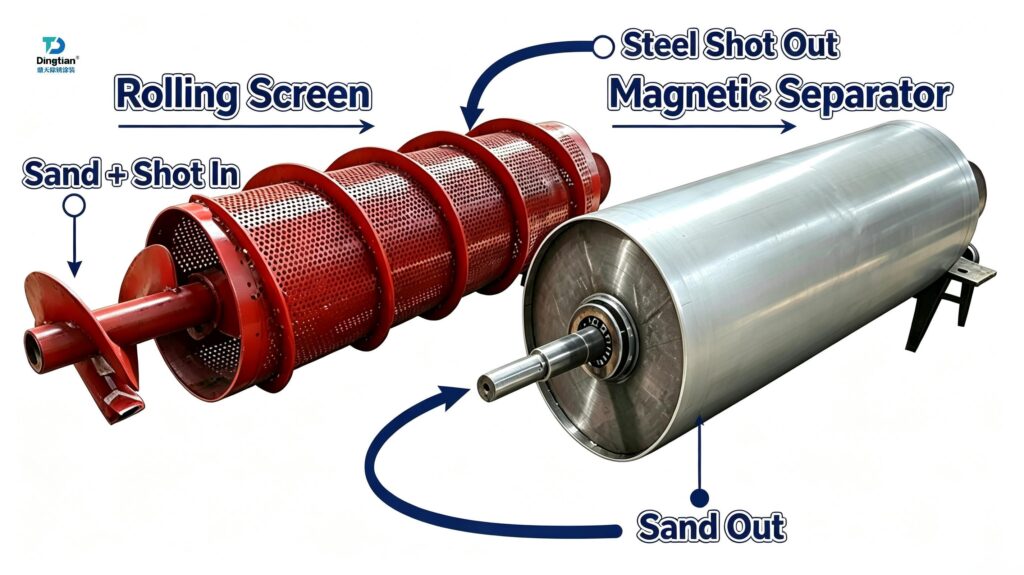
In short: moulding sand and slag left on castings act as an abrasive inside the blast machine, wearing blades, control cages and chamber liners far faster than steel work does. A rotary screen removes the coarse fraction and a magnetic separator removes the fine iron, keeping the abrasive loop clean and wear part life predictable.
Most foundries discover the problem through the maintenance bill rather than through the castings. The parts still come out clean. But shot blasting machine blades, control cages and chamber liners start needing replacement far sooner than the machine that runs welded steel in the next bay. Blade life that should run for months collapses into weeks, and nobody changed anything except the work.
The cause is what castings carry into the chamber. Moulding sand stays on the casting surface after shakeout, and once it enters the abrasive loop it stops being a contaminant and starts being a cutting tool.
What does moulding sand do to blast wheel wear parts?
Silica sand wears blast wheel parts by micro cutting, while steel shot wears them by impact fatigue. Cutting removes metal far faster than fatigue does, which is why foundry duty shortens wear part life so sharply.
Steel shot is spherical. It cleans by repeated impact, and the wear it causes is impact fatigue: the blade surface work hardens, micro cracks form, and material is lost slowly and evenly across the working face. That is a predictable curve, and it is the curve every blade life figure in a catalogue assumes.
Moulding sand is angular and hard. Quartz rates 7 on the Mohs hardness scale, which places it above the alloy steels used for blast wheel components, and it arrives with sharp fresh edges rather than rounded ones. Its wear mechanism is micro cutting. Each grain behaves as a small cutting edge that ploughs material off the surface it strikes. Cutting wear removes metal at a much higher rate than impact fatigue, and it removes it from the parts that cannot be allowed to lose section.
The difference between the two mechanisms is the reason a foundry shot blasting machine and a fabrication shop machine of identical build behave differently in service. The damage is not visible on the cleaned casting. It is visible in spare parts consumption.
| Property | Steel shot in the loop | Silica sand in the loop |
|---|---|---|
| Particle shape | Spherical or crushed but rounding in service | Angular with sharp fresh edges |
| Relative hardness | Matched to the wear parts by design | Quartz, Mohs 7, above blast wheel alloy steel |
| Wear mechanism | Impact fatigue | Micro cutting |
| Wear rate on blades | Slow and predictable | High and accelerating as sand accumulates |
| Effect on cleaning result | Consistent | Degrades across the shift as the mix dilutes |
| Effect on dust load | Normal | Rises, because sand is pulverised further each pass |
Three things normally arrive with the castings: moulding sand and core sand still adhering to the surface and released during the cycle; broken sand lumps, fused sand and slag from gates, risers and runners; and fines generated by the breakdown of all of the above.
The fines are the harder problem. Coarse lumps can be screened out at the first stage. Fine silica stays with the shot, is thrown by the blast wheels on every pass, and cuts the control cage, the blades and the blast chamber wear liners each time round. That is the loop a separation circuit exists to break.
Why is an air wash separator alone not enough for foundry duty?
An air wash separator separates on density, and at fine particle sizes silica sand and steel shot behave too similarly in the air stream for it to give a clean cut.
The air wash separator is the right choice for most blast cleaning duty and is fitted as standard on machines that handle rust, mill scale and old paint on steel structures. A controlled air stream passes across a curtain of falling abrasive. Dust and light fines are carried away, reusable media falls through, and a sliding baffle lets the operator tune the flow across the full width of the separator.
Foundry contamination is a different material balance. A large share of what comes off a casting is mineral sand, and the finer the sand the closer its behaviour in the air stream gets to that of small or partially broken shot. Two errors appear at once. Some sand reports to the reusable stream, where it continues to cut. Some usable shot reports to the reject, where it is lost and has to be replaced.
Neither error is large on its own. But the circuit runs continuously, so the sand that gets through accumulates and the abrasive mix degrades across a shift instead of holding steady. That drift is what shows up as inconsistent cleaning at the end of the day and as wear parts failing early.
This is why machines specified for castings are built with mechanical screening and magnetic separation ahead of, or alongside, the air wash stage. The air wash still earns its place. It simply cannot carry the whole duty by itself.
What does a rotary screen remove from the abrasive loop?
A rotary screen removes the oversize fraction before it can reach the blast wheels: sand lumps, fused sand, slag, broken core material, flash and other coarse debris released from the castings.
The unit is a rotating perforated drum or cage installed in the abrasive recovery circuit, normally at the chamber discharge or ahead of the bucket elevator. Reusable abrasive passes through the screen openings and continues in the loop. Anything larger than the opening rides along inside the drum and is discharged to a waste container.
In North American trade material the same device is commonly called a scalping screen, because scalping means taking the oversize off the top of a material stream. Both names describe the same hardware.
The screen does three useful jobs in sequence.
- It protects the recovery circuit. Coarse debris that reaches the bucket elevator buckets jams them, overloads the drive and causes spillage at the head. Screening first keeps the elevator running on abrasive rather than on lumps.
- It protects the magnetic separator. A magnetic drum works best on a controlled, evenly fed stream. A lump of fused sand with metal trapped inside it is the worst possible feed, because it either gets carried into the clean stream or drags good shot into the waste. Removing lumps mechanically first makes the magnetic stage accurate.
- It stops wasted wear. Oversize fragments thrown by the blast wheels do no useful cleaning work. They consume power, cause unnecessary impact wear and can mark finished surfaces.
Screen opening size is selected against the abrasive grading in use, so the working media is retained and the oversize solids are rejected. Specifying the opening as a number, matched to the shot size, is part of a proper foundry quotation.
What does a magnetic separator do in a shot blasting machine?
A magnetic separator uses the difference in magnetic response between ferrous shot and non magnetic silica sand, and removes the sand fraction that an air wash stage cannot reliably catch.
The screened mixture is fed across a magnetic drum or a magnetised belt. Ferromagnetic steel shot is held against the rotating surface and carried to a separate discharge point, where it drops into the clean abrasive stream returning to the blast wheels. Non magnetic quartz sand, dust agglomerates and other mineral contamination simply leave the magnetic field and are routed to waste.
This is a long-established principle in the foundry trade rather than a recent addition. Overbelt magnetic separation has been used to recover ferrous media from foundry sand since the 1950s, and magnetic drums are standard equipment in foundry sand reclamation lines. A blast machine reclaim circuit applies the same physics at smaller scale and higher cycle frequency.
Two build variants appear in practice, and the choice between them is a real specification decision.
| Type | How it works | Where it is used |
|---|---|---|
| Permanent magnet drum | Fixed field from permanent magnet blocks, no power draw on the magnetic circuit | Standard duty on most foundry blast machines, stable and maintenance light |
| Electromagnetic separator | Adjustable field strength from an energised coil | Heavy feed burden, demanding separation duty, or where field strength must be tuned to the media |
| Overbelt or overband magnet | Suspended magnetised belt above a conveyor, lifts ferrous material out of the stream | Recovery of ferrous media from sand streams, common in sand reclamation plants |
The point a buyer should take from this is that magnetic separation is a designed stage with a stated capacity, not a bolt-on accessory. Its capacity has to match the abrasive flow rate of the machine, or sand will pass simply because the drum is undersized for the volume moving over it.
Why must the screen and the magnetic separator work together?
Each unit removes a different size class and neither can do the other’s job. The screen handles oversize, the magnet handles fine and medium mineral contamination, and only the pair keeps the loop clean through a full shift.
Running the sequence properly gives a circuit that holds its condition rather than degrading across the day.
| Stage | Equipment | What it removes | What passes on |
|---|---|---|---|
| 1. Recovery | Screw conveyor under the chamber | Nothing, collects everything | Spent abrasive, sand, slag and fines |
| 2. Coarse separation | Rotary screen or scalping screen | Sand lumps, fused sand, slag, core fragments, flash | Abrasive within the working grading |
| 3. Magnetic separation | Magnetic drum or electromagnetic separator | Non magnetic silica sand and mineral contamination | Ferrous reusable shot |
| 4. Air wash | Air wash separator | Dust, fines and light broken media | Clean working abrasive to the store |
| 5. Dust collection | Cartridge or bag filter with fan | Airborne dust from the whole circuit | Filtered discharge within site limits |
With the sequence complete, three things follow. Blast wheel wear parts run to their expected life, because the cutting agent has been taken out of the loop. The abrasive mix holds its grading, so cleaning results stay consistent from the first part of the shift to the last. And the dust collector filter cartridge load falls, because sand that would otherwise be pulverised repeatedly and end up in the filters has already been rejected as solids.
That last point is often missed. A contaminated loop does not only wear the wheels. It moves the contamination into the dust collection system, which then carries the extra load in filter consumption and fan power.
Which machine types need this combination?
Any machine whose workpiece arrives with moulding sand on it. That is hanger type and tumble belt machines first, because they carry the bulk of foundry cleaning duty.
| Machine type | Typical foundry workpiece | Why contamination is high | Screen | Magnetic separator |
|---|---|---|---|---|
| Hanger type shot blasting machine | Heavy castings, mould boxes, machine beds, large irregular components | Castings arrive off the shakeout line with sand adhering, and the hook rotation releases it inside the chamber | Yes | Yes |
| Rubber belt tumble shot blasting machine | Small and medium castings, forgings, heat treated parts in batch | Tumbling is aggressive on media and parts release sand continuously while the drum rotates | Yes | Yes |
| Inclined drum shot blasting machine | Higher volume batch castings and forgings | Same contamination problem as tumble, at higher throughput | Yes | Yes |
| Overhead chain or monorail blast machine on foundry work | Castings and cast assemblies on continuous or step conveyors | Sand release is continuous along the line, so the loop needs constant cleaning | Yes | Yes |
| Roller conveyor machine on structural steel | Plate, profiles, welded sections | No mineral contamination, rust and mill scale only | Optional | Normally not required |
The last row matters as much as the others. A machine that only handles welded steel structures, plate, profiles or already cleaned components does not need magnetic separation. An air wash separator is sufficient, and adding a magnetic stage to a circuit that never sees mineral contamination buys capacity nobody uses.
The machines that genuinely need the pair are the ones taking castings straight from shakeout rather than castings that have been pre cleaned elsewhere. Wheelabrator publishes magnetic separation as a reclaim option for foundry duty, Pangborn class foundry machines are specified with the same circuit, and Sintokogio foundry systems use air wash separation as the final polishing stage after mechanical and magnetic cleaning.
What do buyers call these components in different countries?
The hardware is the same everywhere, but the names differ by market. Using the local term in an enquiry is what stops a specification being misread.
| Market | Magnetic unit | Screening unit |
|---|---|---|
| North America | magnetic separator, magnetic drum separator, ferrous separator | scalping screen, sizing screen |
| Germany and Austria | magnetic separator, drum magnet, as used on German manufacturers’ export pages | screen or sizer, described in English on export material |
| United Kingdom and Ireland | magnetic separator, drum magnet, overband magnet | screener, scalping screen |
| Italy and Southern Europe | magnetic separator, magnetic drum | rotary screen, screening unit |
| India and South Asia | magnetic separator, shot sand separator, the dominant trade terms in foundry listings | rotary screen |
| Turkey | manyetik separator, written with diacritics in Turkish trade material | rotary screen, referred to as a drum screen |
| Russia and CIS | magnetic separator, widely used in English on import enquiries | rotary screen |
| Southeast Asia and the Middle East | magnetic separator, abrasive reclamation system | rotary screen, scalping screen |
System and model codes buyers search
Enquiries also arrive under system-level names rather than component names. The common ones are full flow magnetic separator, magnetic abrasive separator, shot and sand separator, abrasive recovery and reclamation system, upper reclaim system and abrasive cleaning system. All of them describe the same circuit described above, and all of them are legitimate ways for a plant to ask for it.
If a supplier answers your enquiry with a different component name but the same separation sequence, they are describing the same machine. If they answer with the same name but cannot state where in the loop the screen and the magnet sit, they have not designed it.
How do you tell that the abrasive loop is contaminated?
Five indicators a plant can check without instruments, all of them visible in normal production.
| Indicator | What it means | What to check first |
|---|---|---|
| Wear part life has shortened since foundry castings started running | Cutting wear from silica, the earliest and clearest sign | Blade and control cage condition, then abrasive sample |
| Cleaning results drift across the shift | Abrasive mix degrading, not an operator problem | Separator adjustment and sand carryover |
| Reject stream contains usable shot | Over rejection, raising media cost | Air wash setting and magnetic drum feed rate |
| Dust collector loading rises with no change in production | Fine sand passing the separator, being pulverised and reaching the filters | Screen integrity and magnetic stage performance |
| Abrasive from the store feels gritty and looks dull | Sand present in the working mix | Take a sample and sieve it against the shot grading |
Any one of these on a foundry machine is a reason to check the separation circuit before ordering more wear parts. Replacing blades into a contaminated loop is the most common way a foundry turns a separation problem into a permanent spare parts cost. A shot blasting machine maintenance checklist that includes a monthly abrasive sample is what catches it early.
What does contaminated abrasive cost a foundry?
The cost lands in four places at once: wear parts, abrasive top-up, filter elements and unplanned downtime. None of them appear as a sand problem on the invoice, which is why the total is usually underestimated.
Wear parts are the largest single line. Cutting wear consumes blades, control cages, impellers and liners faster than impact wear, and these are the highest-turnover items on any blast machine. Shot blasting machine wear parts are cheap individually and expensive continuously.
Abrasive top-up is the second. Over rejection sends usable shot to waste, and diluted mix reduces cleaning efficiency, which extends cycle time and pushes more abrasive through the same circuit per part. Both effects raise media consumption for the same output.
Filter elements are the third. Fine silica reaching the dust collector loads the cartridges and shortens their service interval. Fan power also rises as the circuit works harder to hold extraction across dirtying elements.
Downtime is the fourth and the least predictable. Blade failure during a shift stops production, and the cost is measured in missed output rather than in parts. This is where how to reduce abrasive consumption in shot blasting stops being a maintenance topic and becomes a production planning one.
The separation circuit is inexpensive relative to these four lines combined. That is the entire commercial argument for specifying it on foundry duty.
When is a magnetic separator the wrong answer?
Three situations need a different solution, and specifying magnetic separation in them wastes money.
- Weakly magnetic sands. Chromite sand and some zircon sands respond weakly to a standard magnetic field. Foundry sand reclamation plants that must separate chromite from silica use high intensity rare earth magnetic separators rather than a standard drum. State the sand system at enquiry stage.
- Non ferrous castings. Aluminium, brass and bronze castings produce a non magnetic contamination load, and a magnetic separator has nothing to hold. Those machines need effective screening and air wash separation, and often a dedicated abrasive circuit so that iron pickup does not stain the casting surface later.
- Non ferromagnetic media. Where the process calls for stainless shot, ceramic media, glass bead or plastic media, magnetic separation does not apply. The circuit is built around screening and air wash instead.
Being told this before the order is placed saves a retrofit afterwards. A supplier who specifies a magnetic drum for an aluminium foundry has not understood the process, regardless of how competitive the price looks.
What should a foundry specify in the quotation?
Six points separate a foundry duty machine from a general purpose one. All six should be answered in writing.
- Screen opening size matched to the abrasive grading in use, stated as a number rather than as a description.
- Magnetic separator type, permanent drum or electromagnetic, and its stated capacity against the machine’s abrasive flow rate.
- Position in the circuit, whether screening happens before or after magnetic separation, and where the air wash stage sits.
- Reject handling, how sand, slag and oversize are collected, and whether a waste container or a screw discharge is included.
- Wear part materials on the blades, control cages, liners and screen, stated by grade rather than by a generic description such as wear resistant steel.
- Dust collector capacity matched to the foundry dust load, which runs higher than a steel fabrication duty on the same machine size.
Ask for the abrasive flow diagram with the offer. A supplier who can show the loop as a drawing, stage by stage, has designed it. A supplier who cannot has quoted a catalogue machine and will discover the foundry duty later, at your cost.
Once the machine is running, the same six points become the maintenance baseline. Common problems of shot blasting machine and solutions in a foundry almost always trace back to one of them drifting out of specification, and a shot blasting machine troubleshooting guide built around the separation circuit is more useful than one built around the blast wheels.
What information should be sent in a first enquiry?
Five items, and a configuration comes back with the offer rather than a price for a machine that may not suit.
- The casting material and the sand system in use, including whether chromite or zircon sand is involved.
- The heaviest part and its largest dimension.
- Whether castings arrive straight from shakeout or pre cleaned elsewhere.
- The required cleaning grade against ISO 8501-1, and any surface profile requirement.
- Shifts per day, with available plant power and clear height.
Those five answers determine machine type, chamber size, abrasive flow rate, screen opening, magnetic separator capacity and dust collector sizing. Nothing else is needed to produce a specification.
Jiangsu Dingtian Rust Removal and Coating Equipment Co., Ltd. builds hanger type, tumble belt, inclined drum, rotary table, bogie hearth and overhead chain shot blasting machines for foundries, fabricators and coating plants outside China, with abrasive recovery circuits specified against the contamination load of the actual process rather than against a standard catalogue configuration.
Email: dtcx@dt-shotblasting.com
WhatsApp / WeChat: +86 15895165618
Website: https://dt-shotblasting.com/
Frequently asked questions about foundry abrasive separation
Do I need a magnetic separator if my machine already has an air wash separator?
For foundry castings, yes. An air wash separator separates on density and cannot reliably remove fine silica sand from steel shot. The magnetic stage removes what the air wash passes, and the air wash then polishes the mix. On machines that only blast welded steel, plate or profiles, the air wash alone is sufficient.
What is the difference between a rotary screen and a scalping screen?
None in function. Both terms describe a screen that removes the oversize fraction from the abrasive stream. Rotary screen is the common general term and scalping screen is the North American trade term, taken from scalping, which means removing oversize material from the top of a stream.
How often should the screen and magnetic separator be inspected?
As part of the weekly round on foundry duty, with the screen drum checked for screen blinding and damage and the magnetic drum checked for material build-up. Both are quick visual checks. Screen blinding is the most common cause of oversize material reaching the blast wheels.
Can a magnetic separator remove aluminium or brass contamination?
No. Magnetic separation only acts on ferromagnetic material. Non ferrous contamination must be removed by screening and air wash, or by an eddy current separator where the process justifies one. This is one reason aluminium foundries are specified differently from iron and steel foundries.
Does magnetic separation work with stainless steel shot?
Only partially. Austenitic stainless grades are only weakly magnetic, so a standard drum will not hold them reliably. Where stainless or other non ferromagnetic media is used, the circuit is built around screening and air wash separation instead of magnetic separation.
What happens to the separated sand and slag?
It is discharged to a waste container or a screw conveyor, and from there to the plant’s foundry waste stream. Reject handling should be included in the specification, because a circuit that separates well but has nowhere to put the reject will back up and stop cleaning effectively.
Will a separation circuit reduce my abrasive consumption?
Yes, in two ways. It stops usable shot being rejected along with the sand, and it keeps the working mix at the correct grading so that each part needs a shorter cycle. Both effects reduce media used per part cleaned.
Why do my blades wear faster on castings than on welded steel?
Because moulding sand cuts rather than fatigues the blade surface. Quartz is harder than blast wheel alloy steel and arrives with sharp edges, so it removes material by micro cutting at a far higher rate than spherical shot does by impact. The cure is removing the sand from the loop, not buying harder blades.
Can these units be added to a machine already in service?
Often yes, but it depends on the existing recovery circuit layout, the headroom above the separator and the abrasive flow rate. A retrofit needs the flow rate measured first, because an undersized magnetic drum will not perform regardless of how well it is installed. Send the machine model and the abrasive flow rate for an assessment.
Is magnetic separation needed for green sand, resin sand and shell moulding alike?
All three leave silica based sand on the casting, so all three create the same cutting wear problem. Resin coated sand can be more tenacious on the surface and releases more fines during blasting, which raises the load on the dust collection stage. State the sand system at enquiry so the circuit is sized for it.
What cleaning grade can a foundry blast machine hold consistently?
Typically Sa 2.5 to Sa 3 against ISO 8501-1, confirmed on reference photographs for the grade specified. Holding the grade consistently across a shift is what a properly separated abrasive loop makes possible, because a degrading mix cannot hold any grade reliably.
Which machine type should a foundry choose, hanger or tumble belt?
Hanger type for heavy, large or delicate castings that cannot be tumbled, and for parts with machined faces that must not be struck. Tumble belt for small and medium castings, forgings and heat treated parts processed in batch. Both need the screening and magnetic separation circuit described here, because both receive castings carrying moulding sand.
Wheelabrator, Pangborn, Sintokogio (Sinto), Rosler and DISA are trademarks of their respective holders. They are named here only to explain how the same machine types and reclaim components are described in different markets, and no affiliation or endorsement is implied.
Watch our machines at work
More live footage from our factory:


