
Engineered by Dingtian
Stone Shot Blasting Machine | Marble & Granite Texturing
A stone shot blasting machine uses centrifuga…
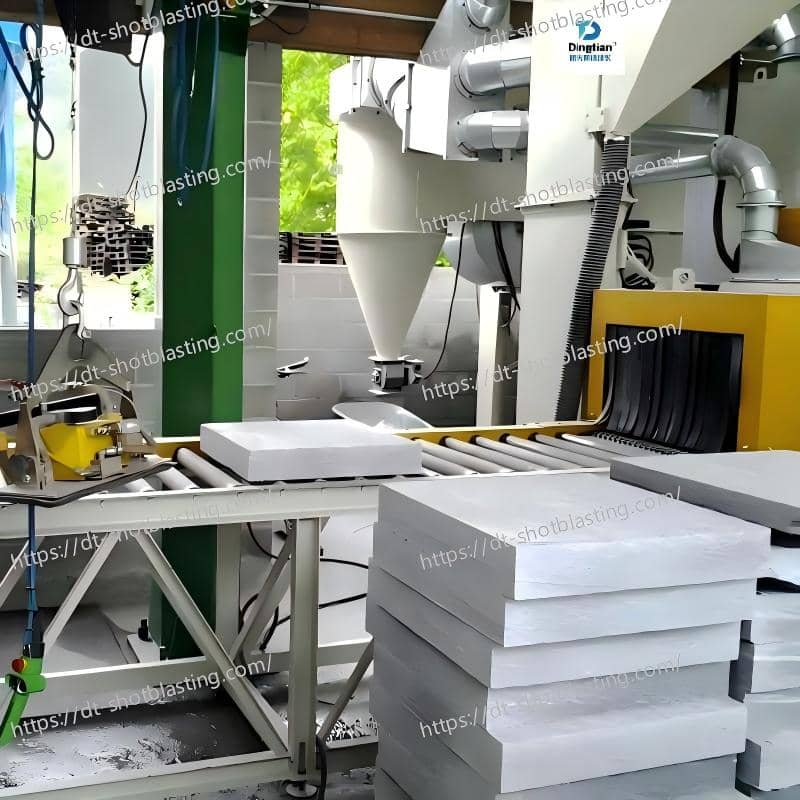
Request a QuoteA stone shot blasting machine uses centrifugal blast wheels to propel steel shot at stone slabs, tiles and pavers, producing uniform anti-slip textures at production speed. One machine delivers six distinct finishes: bush hammered finish, antique finish, flaming alternative, lychee face, leather finish and matte finish. Jiangsu Dingtian engineers each granite slab shot blasting machine around your stone type, slab dimensions and target output.
Natural stone processing has traditionally relied on manual bush hammering, open-flame flaming and hand antiquing. These methods are slow, inconsistent and labour-intensive. A stone shot blasting machine, also known in the industry as a stone surface shot blaster, replaces all of them with a single automated process that delivers repeatable results at 600 to 1,000 square metres per shift. The machine produces a durable non-slip surface for stone slabs and tiles without the variability inherent in manual methods. The sealed chamber contains dust, the closed-loop abrasive circuit minimises consumable cost and the variable-frequency controls allow instant switching between finish specifications.
How the Stone Shot Blasting Process Works
Slabs enter the sealed chamber on a roller conveyor. Centrifugal blast wheels mounted above and below the conveyor throw steel shot at the stone surface. Wheel speed, feed rate and shot size determine the texture depth. Spent shot falls through the conveyor into a screw conveyor, which feeds a bucket elevator and air wash separator. Clean shot returns to the wheels; fines and dust are captured by the cartridge dust collector. The chamber operates under negative pressure to contain all particulate.
| Parameter | Specification |
|---|---|
| Feed speed | 1 to 3 m/min, variable-frequency controlled |
| Output per shift | 600 to 1000 m2 on standard configurations |
| Processing cost, marble | RMB 0.4 to 0.65 per m2, about USD 0.06 to 0.09 |
| Abrasive | Steel shot, recirculated through screw conveyor, elevator and separator |
| Dust control | Sealed chamber under negative pressure, with integrated dust collection |
| Speed control | Variable-frequency drives for blast wheel speed and feed rate |
| Surface result | Adjustable, from fine matte to deep bush hammered texture |
The key advantage over manual methods is consistency. Every slab in a batch receives identical treatment because wheel speed and feed rate are locked by the PLC recipe. Manual bush hammering produces variable pit depth depending on operator fatigue and tool wear. Flaming creates colour variation and micro-cracking that weakens the stone. Shot blasting eliminates both problems while operating at a fraction of the per-square-metre cost.
Six Finishes From One Machine
| Finish buyers search for | What shot blasting produces |
|---|---|
| bush hammered finish | Deep pitted anti-slip texture. Shot blasting replaces pneumatic bush hammering with no tool wear and no operator fatigue |
| antique finish / antiquing | Uniform matte aged appearance, repeatable across a whole batch, unlike hand antiquing |
| flaming alternative / flamed look | A flamed appearance without colour variation, micro-cracking or open flame. Essential for marble, which cannot be flamed |
| lychee face / litchi surface | The Asian trade name for the same pitted anti-slip finish; identical result to bush hammered |
| leather finish / honed anti-slip | A finer textured matte surface at lower blast intensity and faster feed |
| matte finish | Low-gloss uniform surface for curtain wall and interior cladding |
All six finishes come from the same stone shot blasting machine. The operator adjusts wheel speed, feed rate and shot size to switch between textures. No tool changes or consumable replacements are needed. This flexibility lets stone processors serve multiple market segments from a single production line. Recipe storage on the PLC touch screen saves validated settings for each stone type and finish combination, ensuring repeatability across production runs separated by weeks or months.
Shot Blasting vs Compressed-Air Abrasive Blasting for Stone
| Item | Shot blasting | Compressed-air abrasive blasting |
|---|---|---|
| Power source | Centrifugal blast wheels throw shot | Compressed air propels grit |
| Throughput | High, continuous pass-through | Low, mostly manual nozzle work |
| Dust | Sealed chamber plus dust collector, chamber held under negative pressure | Open process, heavy airborne dust |
| Media | Steel shot recirculated through screw conveyor, elevator and separator | Quartz sand or grit consumed |
| Best suited to | Full-size slabs, tiles and pavers at production volume | Engraving, lettering, deep relief, site repair work |
| Finish consistency | Repeatable across a batch | Depends on operator skill and stand-off distance |
A stone shot blasting machine excels at high-volume surface texturing of full-size slabs and tiles. Compressed-air abrasive blasting remains the right choice for engraving, lettering, deep relief carving and on-site repair work where portability matters. Many stone processing plants use both: shot blasting for production texturing and compressed air for custom detailing. The two processes complement each other rather than competing.
Cost comparison strongly favours shot blasting for production volumes. Steel shot recirculates hundreds of times before replacement, while quartz sand is consumed in a single pass. Sealed chamber operation eliminates dust suppression costs and health monitoring requirements associated with open-air blasting. Processing cost for marble ranges from RMB 0.4 to 0.65 per square metre, making shot blasting economically superior to any manual alternative.
Which Stones and Materials Are Suitable
| Material | What it needs |
|---|---|
| Granite | High impact power. Hard stone needs higher wheel speed and coarser shot to open the surface |
| Quartzite and sandstone | Hard, abrasive-resistant stone; same high-power duty as granite |
| Marble | Gentle variable-frequency blasting. Soft stone chips at unsupported edges under concentrated impact, so lower wheel speed and finer shot |
| Travertine and limestone | Low-intensity texturing and antiquing; open pore structure needs care to avoid over-cutting |
| Engineered stone and quartz surfaces | Uniform matte or anti-slip texture for worktops, cladding and floor tiles |
| Concrete pavers and kerbstones | A concrete paver shot blasting machine removes surface laitance and exposes the aggregate for a decorative, slip-resistant finish |
| Stone that cannot be flamed | Marble and some limestones cannot tolerate open flame. Shot blasting is the standard replacement process |
Each stone type requires validated operating parameters. Granite tolerates aggressive blasting with coarse shot at high wheel speeds. Marble demands gentler treatment with finer shot and reduced wheel RPM to prevent edge damage and surface spalling. Travertine and limestone have open pore structures that can be over-cut if blast intensity is too high. Engineered stone and quartz surfaces respond well to moderate settings that produce uniform matte textures without exposing resin binder.
Concrete products represent a growing application segment. Precast pavers, kerbstones and architectural blocks benefit from surface laitance removal and aggregate exposure. The resulting textured surface provides slip resistance and visual appeal. Feed speed and wheel power are adjusted for concrete density, which varies significantly between mix designs.
Machine Configuration
| Item | Standard build | Configurable |
|---|---|---|
| Blast wheels | Centrifugal wheels in an angled array | Wheel count and motor power per stone hardness |
| Chamber lining | Wear-resistant liner plates in the blast zone | Liner grade per abrasive aggressiveness |
| Conveying | Roller conveyor, inverter driven | Roller spacing and width per slab size |
| Sealing | Rubber sealing curtains at entry and exit | Curtain length and chamber pressure per dust target |
| Abrasive circuit | Screw conveyor, bucket elevator, air wash separator | Separator capacity per wheel count |
| Dust collection | Cartridge dust collector, chamber under negative pressure | Collector airflow per chamber volume |
| Controls | PLC with touch screen, variable-frequency drives | Recipe storage per stone type and finish |
| Line integration | Standalone infeed and outfeed | Links into slab cutting, polishing and coating lines |
Engineered Stone-Line Configuration
| Parameter | Engineered Stone-Line Configuration |
|---|---|
| Materials | Granite, marble and concrete bricks |
| Surface result | Uniform anti-slip texture |
| Feed type | Continuous roller conveyor |
| Abrasive system | Closed-loop recovery and separation |
| Dust control | Integrated dust collection |
How It Compares With Imported Brands
We are an independent manufacturer; brand names are used only to identify compatible wear parts and reference equivalents, not to imply endorsement or origin.
| Item | Our machine | Why it matters |
|---|---|---|
| Wear part lead time | Days, not weeks | Made and stocked in our own plant; no import routing, no OEM allocation queue |
| Abrasive consumption | Lower | Air wash separator removes fractured media before it recirculates |
| Local serviceability | Open part numbers | Motors, gearboxes, bearings, PLC and inverters use common international specifications, so your own maintenance team can service them |
For facilities operating Wheelabrator or Pangborn stone processing equipment, we supply compatible wear parts and consumables. See our Wheelabrator and compatible wear parts pages for cross-reference details.
Commercial and Delivery Terms
| Term | Value |
|---|---|
| Delivery lead time | 30 to 120 days, depending on configuration and order scope |
| Port of loading | Shanghai, China, UN/LOCODE CNSHA |
| Price basis | Quoted per configuration once stone type, slab size, target finish and daily volume are confirmed |
| Customisation | OEM and ODM, built to customer drawing and plant layout |
| After-sales support | Installation manual, video guidance, remote online support, spare parts supply |
| Pre-shipment testing | Run test and blast test; texture report on customer sample slabs on request |
Maintenance Guidelines
Daily tasks include inspecting blast wheel blades for wear, checking roller conveyor alignment and emptying the dust collector hopper. Weekly checks cover verifying separator cut points, testing sealing curtains for gaps and cleaning lighting fixtures. Monthly maintenance includes replacing worn wheel blades, calibrating variable-frequency drives and inspecting chamber liner plates.
Keep spare blast wheel blades, sealing curtains and filter cartridges on hand. Recipe settings for each stone type should be documented and backed up. For general guidance, see our preventive maintenance checklist and maintenance troubleshooting guide.
Blast wheel blade wear directly affects texture consistency. Worn blades reduce shot velocity and change the impact angle, producing shallower or uneven textures. Replace blades when thickness reduction exceeds 20 percent of original specification. Document cumulative operating hours for each wheel set to establish a predictable replacement schedule. Roller conveyor bearings should be greased monthly and inspected quarterly for play or noise.
Environmental and Safety Advantages
The sealed chamber design eliminates uncontrolled dust emissions that plague open-air stone processing. Negative pressure containment ensures all particulate passes through the cartridge dust collector before atmospheric release. This protects worker health, meets environmental regulations and prevents dust deposition on neighbouring properties. Many municipalities now restrict open-air stone processing within industrial zones, making enclosed shot blasting the only compliant option.
Steel shot recirculation dramatically reduces solid waste compared to consumed abrasive media. A typical stone shot blasting machine generates less than 5 percent media waste per shift, versus 100 percent consumption for single-pass sand blasting. Spent steel shot is recyclable as scrap metal. Dust collector fines can be disposed of as inert industrial waste or used as construction fill material depending on local regulations.
Noise levels inside the sealed chamber are contained by rubber-lined walls and sealing curtains. External noise emissions typically fall below 85 dB(A) at one metre from the enclosure, meeting most industrial zone boundary limits without additional acoustic treatment. Operator exposure is further reduced because the blast process runs automatically with minimal manual intervention near the chamber.
Return on Investment and Operating Economics
Processing cost analysis shows shot blasting delivers the lowest cost per square metre among mechanised texturing methods. At RMB 0.4 to 0.65 per square metre for marble, operating costs are a fraction of manual bush hammering labour rates. Steel shot consumption averages less than 0.5 kg per 100 square metres due to closed-loop recovery. Electrical consumption for blast wheels and conveyors is offset by eliminating compressed air costs associated with pneumatic alternatives.
Payback period depends on current processing method and volume. Facilities replacing manual bush hammering typically recover equipment investment within 12-18 months based on labour savings alone. Additional benefits include reduced rework from inconsistent finishes, lower warranty claims from surface defects and expanded product range capability. The ability to offer six finishes from one machine opens revenue streams that justify the capital expenditure independently of cost savings.
When Is a Stone Shot Blasting Machine the Wrong Choice
Shot blasting is not suitable for detailed engraving, lettering or deep relief carving. Those applications require compressed-air abrasive blasting with manual or CNC-controlled nozzles. Shot blasting also does not suit irregular three-dimensional sculptures or monuments where flat conveyor feeding is impossible. On-site restoration work typically uses portable compressed-air equipment rather than fixed installations.
Very soft stones like soapstone and alabaster may be too fragile for centrifugal blasting even at minimum settings. Test samples confirm suitability before committing to production. If your stone type is not listed in our materials table, send us sample slabs for evaluation. We run blast tests at our facility and return textured samples with a full parameter report.
How a Chinese Factory Matches Imported Brands at About 40% of the Price
Norican, the parent company of Wheelabrator, has manufactured in Changzhou since 1997. Sintokogio has produced equipment in China through its Qingdao Xindong joint venture since 1996. Beyond these two cases, a substantial share of the world’s shot blasting equipment is manufactured in China, including contract production for Western and Japanese brand owners. Our machines use the same supply chain and the same component standards.
Buyers specifying the same cleanliness grade, wheel count and wear-part alloy typically pay around 40% of an imported brand’s price factory-direct. There is no distributor margin, no component round-trip freight, and no brand premium.
We do not chase the lowest bid. Price pressure is what forces thinner plate, second-grade wheels and skipped testing — the very things that destroy equivalence. Same specification, same testing, wear parts made in-house.
Stone Shot Blasting Machine FAQ
Can shot blasting produce a bush hammered or antique finish?
Yes. A stone shot blasting machine produces both bush hammered finish and antique finish on the same equipment. Higher wheel speed and coarser shot create deep pitted textures. Lower speed and finer shot produce uniform matte antiquing. Both finishes are repeatable across entire batches.
Can shot blasting replace a flamed finish?
Yes. Shot blasting produces a flaming alternative that matches the visual appearance of flame-textured granite without colour variation, micro-cracking or open flame risk. This is essential for marble, which cannot tolerate flaming. The result is consistent and safe for indoor applications.
Do granite and marble use the same machine?
Yes. The same stone shot blasting machine processes both materials. Granite requires higher wheel speed and coarser shot. Marble needs gentler variable-frequency blasting with finer shot to prevent edge chipping. The operator stores separate recipes for each stone type on the PLC touch screen.
Is the surface roughness adjustable?
Yes. Surface roughness is controlled by three variables: blast wheel speed, feed rate and shot size. Variable-frequency drives allow precise adjustment of both wheel speed and conveyor speed. Operators store validated recipes for each finish specification, ensuring repeatability across production runs.
What output can we expect per shift?
Standard configurations deliver 600 to 1,000 square metres per shift. Actual output depends on stone hardness, target texture depth and feed speed. Granite at deep bush hammered finish runs slower than marble at light matte finish. We calculate exact throughput during the engineering phase based on your specific requirements.
Can I customize the stone shot blasting machine according to my workshop size?
Yes. Roller width, chamber length, infeed and outfeed conveyors are all configurable. We also offer line integration with existing slab cutting, polishing and coating equipment. Provide your workshop layout and we will propose a machine arrangement that fits your space.
What kind of workpieces are suitable for this machine?
The machine handles granite slabs, marble tiles, engineered stone panels, concrete pavers, kerbstones, travertine boards and quartzite surfaces. Any flat or slightly curved stone product that fits within the conveyor width can be processed. Maximum slab thickness is typically 100 mm on standard configurations.
Do you provide after-sales support and installation instructions?
Yes. Every machine ships with an installation manual, wiring diagrams and video guidance. Remote online support covers mechanical assembly and electrical checkout. Spare parts are available with short lead times. Pre-shipment testing includes run tests and blast tests on customer sample slabs when requested.
What is the delivery time, and which port do you ship from?
Delivery ranges from 30 to 120 days depending on configuration and order scope. All shipments depart from Shanghai port (UN/LOCODE CNSHA). We provide complete export documentation and container loading plans.
What abrasive does a stone shot blasting machine use?
The machine uses steel shot recirculated through a closed-loop recovery system. Shot size ranges from S170 to S460 depending on the target finish. Finer shot produces smoother textures; coarser shot creates deeper profiles. The air wash separator removes fractured media before it recirculates, keeping consumption low.
Does shot blasting damage the stone surface?
No, when parameters are correctly set. Each stone type has a validated operating window. Marble and soft limestone require lower wheel speeds and finer shot to prevent edge chipping. Granite and quartzite tolerate higher energy. Recipe storage ensures operators always run within safe parameters.
Can it process concrete pavers and kerbstones?
Yes. A concrete paver shot blasting machine configuration removes surface laitance and exposes aggregate for a decorative, slip-resistant finish. Feed speed and wheel power are adjusted for concrete density. This is widely used by precast plants and block manufacturers.
What information do you need to quote this machine?
We need your stone type, maximum slab dimensions, target finish, daily output volume and any line integration requirements. Sample slabs help us validate texture settings before quotation. Contact us through our contact page with these details for a tailored proposal.
Line Integration and Plant Layout
A stone shot blasting machine integrates into existing stone processing plants at multiple points. Upstream of polishing lines, it textures slabs before honing to create leather or matte finishes. Downstream of cutting lines, it processes trimmed slabs and tiles for anti-slip treatment. Standalone placement suits job shops that texture customer-supplied material without owning upstream cutting equipment.
Infeed and outfeed conveyors link the blast machine to adjacent equipment. Roller tables with powered transfer stations move slabs between processes without manual handling. Automated stacking systems at the outfeed end organise textured slabs by finish type for downstream packaging or shipment. PLC integration with plant-wide control systems enables centralised production scheduling and inventory tracking.
Plant layout must account for dust collector placement, abrasive storage and maintenance access. The dust collector typically sits outside the building with ductwork penetrating the wall. Abrasive bulk storage bins feed the machine hopper via pneumatic conveying or bucket elevator. Maintenance platforms around blast wheels and elevator heads allow safe access for blade replacement and bearing inspection without scaffolding.
Jiangsu Dingtian Derusting & Painting Equipment Co., Ltd. builds every stone shot blasting machine to your exact stone type and production requirements. Share your specifications through our contact page to start your project discussion. Explore our roller conveyor shot blasting machine category for complementary metal surface preparation solutions or read our guide to choosing the right shot blasting machine.
More Technical Resources
For more technical blog posts, equipment technology articles and machine working videos, visit:
Model Comparison
Compare available models and technical parameters.
| Parameter | Engineered Stone-Line Configuration |
|---|---|
| Materials | Granite, marble and concrete bricks |
| Surface result | Uniform anti-slip texture |
| Feed type | Continuous roller conveyor |
| Abrasive system | Closed-loop recovery and separation |
| Dust control | Integrated dust collection |
Reviews
Customer reviews & ratings
Product inquiry
Reviews
There are no reviews yet.