
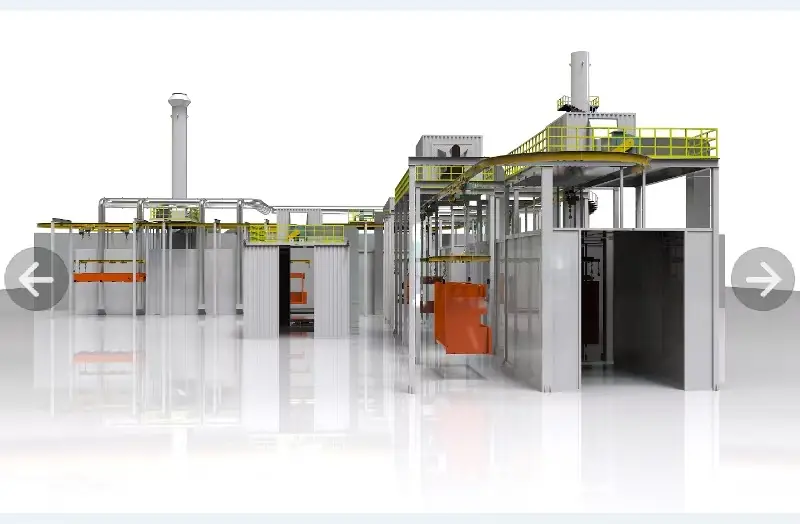
Engineered by Dingtian
Industrial Powder Coating and Painting Line
An industrial powder coating line applies dry…
Request a QuoteAn industrial powder coating line is a fully integrated finishing system that applies dry electrostatic powder to metal workpieces and cures the coating in a controlled oven. Unlike liquid painting, a powder coating production line emits zero VOCs and recovers overspray for reuse. Jiangsu Dingtian engineers each automatic powder coating line around your workpiece geometry, throughput target and coating specification. Whether you need a stand-alone electrostatic powder coating line or a complete pretreatment-to-curing system, our team designs the conveyor layout, spray booth, flash-off zone and curing oven as one coordinated unit.
The global shift toward solvent-free finishing has made powder coating line installations the default choice for new metal fabrication plants. Regulatory pressure on VOC emissions, rising solvent costs and customer demand for durable finishes all drive this transition. A properly engineered line delivers consistent film thickness, minimal waste and fast colour changeover while meeting environmental compliance without additional exhaust treatment infrastructure.
How an Electrostatic Powder Coating Line Works
A powder coating conveyor system carries workpieces through four sequential stages. First, pretreatment removes oil, rust and scale by chemical wash or abrasive blasting. This stage is critical because any residual contamination prevents powder adhesion and causes premature coating failure. Chemical pretreatment typically includes alkaline cleaning, rinsing, phosphate or zirconium conversion coating and a final deionised water rinse. For heavy rust or mill scale, abrasive blasting before chemical wash improves surface anchor profile.
Second, the spray booth applies charged powder particles that adhere to the grounded workpiece surface. Electrostatic guns charge each particle to between 60 and 100 kV. The grounded workpiece attracts the charged powder uniformly, including into recesses and Faraday cage areas when using tribo-charging or advanced corona guns. Automatic reciprocators or robots ensure even coverage across complex geometries. Manual touch-up stations address shadowed areas that automatic guns cannot reach.
Third, a flash-off zone allows any residual moisture to evaporate before the part enters the oven. This zone typically runs at ambient temperature with forced air circulation. Skipping the flash-off stage causes pinholes and blisters as trapped moisture expands during curing. Fourth, the curing oven heats the coated part to 180-200 degrees C for a specified dwell time so the powder melts, flows and cross-links into a continuous film. Oven temperature uniformity across every rack position is essential for consistent gloss and mechanical properties.
The powder coating system recovers overspray powder through cartridge filters or cyclone separators. Recovered powder passes through a sieve and returns to the feed hopper. This closed-loop recovery keeps material waste below five percent and eliminates solvent emissions entirely. A properly designed powder coat conveyor line maintains uniform temperature profiles across every rack position, ensuring consistent film thickness from first part to last.
Workpieces and Industries Served
An industrial painting line handles a wide range of metal products. Common applications include aluminium extrusions for window frames and curtain walls, steel shelving and racking components, automotive chassis parts and brackets, electrical enclosure panels, agricultural equipment frames, appliance housings and HVAC ductwork. Each product category demands specific conveyor spacing, hook design and oven zoning.
Heavy-duty sectors such as structural steel fabrication, wind tower manufacturing and offshore platform construction require larger booth openings and higher-capacity ovens. Light-gauge consumer goods run at faster line speeds with tighter temperature tolerances. Our complete powder coating systems for automated processes scale from small batch operations to continuous high-volume lines exceeding 2,000 square metres per shift.
Aluminium profile manufacturers represent one of the largest user groups. Extruded profiles for architectural applications require uniform coating on all faces, including deep channels and internal corners. Vertical conveyor lines with rotating hooks achieve full coverage on profiles up to seven metres long. Appliance manufacturers use horizontal conveyors for flat panels and cabinet housings where appearance quality is paramount. Automotive suppliers coat suspension components, brake calipers and engine brackets where corrosion resistance and chemical durability are the primary requirements.
For facilities that also need abrasive surface preparation before coating, our roller conveyor shot blasting machine integrates directly upstream of the coating line. This combination ensures Sa 2.5 cleanliness and proper anchor profile before powder application, maximising coating adhesion and service life.
Powder Coating vs Liquid Painting
| Comparison item | Powder coating | Liquid painting |
|---|---|---|
| Coating form | Solid powder, solvent-free | Liquid, solvent-borne or water-borne |
| Film thickness | 50-150 um in a single pass | 15-40 um per coat, built up in layers |
| Environmental impact | Zero VOC emission; overspray powder is recovered and reused | VOC emission; requires exhaust treatment |
| Appearance quality | Thicker film; can build up on sharp edges | Thinner, finer finish; better levelling |
| Suitable workpieces | Metal parts that withstand 180-220 degrees C | Complex shapes, precision appearance parts, heat-sensitive parts, oversized on-site structures |
| Colour changeover | Requires booth cleaning; slower | Fast; suits multi-colour short runs |
The choice between powder and liquid depends on your product mix, volume and regulatory environment. Powder coating wins on environmental compliance, single-pass film thickness and material utilisation. Liquid painting wins on fine appearance, low-temperature substrates and rapid colour change. Many manufacturers operate both systems: powder for structural and functional parts, liquid for cosmetic and heat-sensitive components.
VOCs Exhaust Treatment System
| Exhaust condition | Recommended process | Purification efficiency |
|---|---|---|
| Medium to low concentration | Activated carbon adsorption + catalytic oxidation (CO / RCO) | 95% or above |
| High volume, low concentration | Zeolite rotor concentrator + regenerative thermal oxidizer (RTO) | 99% or above, heat recovery 95% or above |
Powder coating lines themselves generate no VOCs. However, if your facility also operates liquid paint booths or pretreatment wash stages with solvent-based cleaners, exhaust treatment may be required. Activated carbon adsorption combined with catalytic oxidation suits medium-concentration streams. For high-volume low-concentration exhaust from large spray booths, a zeolite rotor concentrator paired with a regenerative thermal oxidizer achieves near-complete destruction with excellent heat recovery.
Engineered Coating-Line Configuration
| Parameter | Engineered Coating-Line Configuration |
|---|---|
| Process stages | Conveying, spraying, flash-off and drying |
| Paint application | Automatic or manual; selected for the coating system |
| Environmental systems | Ventilation, filtration and optional VOC treatment |
| Integration | Stand-alone booth or complete pretreatment and coating line |
| Configuration | Customized to workpiece, throughput and coating specification |
Four Steps of the Coating Line Process Flow
Step one is conveying. The powder coating conveyor system moves workpieces through each process zone at a constant speed. Overhead conveyors suit lighter parts hung from hooks or racks. Floor track conveyors handle heavier assemblies. Power-and-free conveyors allow accumulation and selective routing for mixed-product lines. Conveyor speed determines line throughput and must be matched to oven dwell time.
Step two is spraying. Automatic reciprocators or robots apply powder in the spray booth. Gun positioning, voltage settings and powder feed rate are programmed for each part number. Manual touch-up stations follow the automatic zone for recessed areas. Booth airflow captures overspray and directs it to the recovery system. Positive ionisation bars neutralise static charge on exiting parts to prevent dust attraction.
Step three is flash-off. Parts pass through an ambient or slightly heated zone to release any absorbed moisture. This step prevents defects during curing. Flash-off duration depends on part mass and pretreatment rinse water retention. Forced air circulation accelerates drying without adding significant floor space.
Step four is curing. The oven brings every part to the required peak metal temperature and holds it for the specified time. Typical cure schedules range from ten to twenty minutes at 180-200 degrees C for standard polyester and epoxy powders. UV-curable powders cure in seconds under ultraviolet lamps, enabling coating of heat-sensitive substrates like MDF and plastic. Oven zoning allows different temperature profiles for mixed-product lines.
How to Select the Right Powder Coating Line
Selecting the correct powder coating production line starts with three inputs: maximum workpiece dimensions, required hourly output and target film thickness. These determine conveyor speed, booth length, nozzle count and oven zone count. For facilities that run multiple colours, plan for dedicated colour-change stations or dual-booth layouts to minimise downtime.
Consider whether a semi-automatic powder coating line suits your current volume. Semi-automatic lines use manual loading and unloading with automated spray and cure stages, reducing capital cost while preserving finish consistency. Full automation adds automatic loading, robotic spraying and real-time film-thickness monitoring for high-volume plants. We also offer steel plate pretreatment and painting lines for heavy steel structures that need primer before topcoat.
Energy efficiency deserves attention during selection. Gas-fired ovens with recuperative burners reduce fuel consumption by 15-25 percent compared to basic direct-fire designs. Electric infrared preheating zones cut gel times and shorten oven length. Heat recovery from exhaust air preheats incoming make-up air. These options add upfront cost but deliver measurable operating savings over the line lifetime.
Brand Compatibility and Reference Equivalents
We are an independent manufacturer; brand names are used only to identify compatible wear parts and reference equivalents, not to imply endorsement or origin. Many global finishing plants operate equipment from Wagner, Gema or Nordson. Our industrial powder coating line uses internationally sourced spray guns, pumps and controllers that share consumable specifications with these platforms. When your existing line needs replacement nozzles, electrodes or fluidising plates, we supply compatible components without OEM allocation queues. For spare parts across multiple blast and coating brands, see our compatible wear parts catalogue.
Maintenance and Uptime
A well-maintained powder coating conveyor system delivers years of reliable service. Daily tasks include purging spray lines during colour changes, inspecting booth filters for powder buildup and verifying oven temperature uniformity with a datalogger. Weekly checks cover conveyor chain tension, hook grounding contacts and fan belt alignment. Monthly maintenance includes replacing worn nozzles, cleaning cyclone internals and calibrating film-thickness gauges.
Keep critical spares on hand: spray gun tips, venturi tubes, filter cartridges and thermocouples. Our after-sales team provides remote diagnostics via video call and ships replacement parts within days. For facilities running two or more shifts, we recommend a preventive maintenance schedule aligned with your production calendar. See our preventive maintenance checklist for general guidance applicable to coating lines.
Oven calibration deserves special attention. Temperature uniformity surveys should be performed quarterly using a multi-channel datalogger traversing the full oven length. Any zone deviating more than five degrees C from setpoint requires burner adjustment or element replacement. Conveyor speed verification with a tachometer ensures actual dwell time matches the programmed value. These checks prevent under-cure failures that may not appear until field exposure.
Powder Types and Their Applications
Thermoset powders dominate industrial applications. Epoxy powders provide excellent chemical resistance and adhesion for functional parts like electrical enclosures and pipe fittings. Polyester powders offer superior UV stability and colour retention for architectural aluminium and outdoor furniture. Epoxy-polyester hybrids balance mechanical properties with appearance for general-purpose use on shelving, racking and appliance components.
Thermoplastic powders including nylon, polyethylene and PVC serve niche applications requiring thick films or specific chemical resistance. Nylon coatings on dishwasher racks and shopping trolley baskets resist detergent attack and mechanical abrasion. Polyethylene linings protect water tanks and chemical containers from corrosion. Each powder type has a specific cure temperature window that the oven must accommodate.
Specialty powders expand the application range further. Anti-microbial powders for hospital and food processing equipment incorporate silver-ion or zinc-based additives. Conductive powders for electronic enclosures prevent electrostatic discharge. Heat-resistant silicone-modified powders withstand continuous service above 250 degrees C for exhaust components and heating elements. Our engineering team selects the appropriate powder chemistry based on your end-use environment and performance requirements.
Quality Control and Testing Protocols
Incoming powder inspection verifies particle size distribution, gel time and flow characteristics against the supplier certificate of analysis. Deviations in any parameter affect film appearance and mechanical properties. Storage conditions matter: powder absorbs moisture above 60 percent relative humidity, causing orange peel and pinholes during cure. Climate-controlled storage at 20-25 degrees C with desiccant maintains powder quality.
In-process monitoring includes film thickness checks every 30 minutes using magnetic or eddy-current gauges. Adhesion spot tests by cross-hatch method verify pretreatment effectiveness. Gloss readings confirm cure completeness and oven uniformity. Colour comparison against approved master samples under standardised D65 illumination detects batch-to-batch variation. All test results are logged for traceability and trend analysis.
Final acceptance testing follows the specification agreed with the customer. Salt spray testing per ASTM B117 validates corrosion protection for coated steel parts. Humidity resistance testing confirms performance in tropical climates. Impact testing and bend testing verify film flexibility for formed parts. Chemical resistance testing with MEK, acetone or household cleaners validates suitability for the intended service environment.
How a Chinese Factory Matches Imported Brands at About 40% of the Price
Norican, the parent company of Wheelabrator, has manufactured in Changzhou since 1997. Sintokogio has produced equipment in China through its Qingdao Xindong joint venture since 1996. Beyond these two cases, a substantial share of the world’s shot blasting equipment is manufactured in China, including contract production for Western and Japanese brand owners. Our machines use the same supply chain and the same component standards.
Buyers specifying the same cleanliness grade, wheel count and wear-part alloy typically pay around 40% of an imported brand’s price factory-direct. There is no distributor margin, no component round-trip freight, and no brand premium.
We do not chase the lowest bid. Price pressure is what forces thinner plate, second-grade wheels and skipped testing — the very things that destroy equivalence. Same specification, same testing, wear parts made in-house.
Powder Coating Line FAQ
What is the best powder coating line for small parts?
Small parts benefit from a compact electrostatic powder coating line with tight conveyor loops and lower oven volumes. Batch ovens suit very low volumes, while a mini continuous line handles 50-200 parts per hour. The key is matching conveyor speed to oven dwell time so every part reaches full cure.
How much does a powder coating production line cost?
Cost depends on line length, automation level, oven fuel type and environmental controls. A basic semi-automatic powder coating line starts at a fraction of a fully automated system. We quote each line after confirming your workpiece size, daily output and local emission requirements. Contact us for a configuration-specific estimate.
Batch vs continuous: what is the right powder coating workflow?
Batch processing suits job shops with frequent colour changes and varied part sizes. Continuous lines maximise throughput for dedicated products. A hybrid approach uses batch ovens with a powered conveyor for medium volumes. Your choice depends on product mix, shift pattern and floor space.
What is the production capacity of a typical powder coating line?
Capacity ranges from 100 square metres per shift for small batch systems to over 2,000 square metres per shift for high-speed continuous lines. Throughput depends on conveyor speed, rack density and oven length. We calculate exact capacity during the engineering phase based on your specific workpiece and coating specification.
Which heating method should the curing oven use?
Natural gas offers the lowest operating cost in most regions. Electric heating suits smaller ovens or locations without gas infrastructure. Infrared preheating accelerates gel times for thick-film applications. We select the heating method based on your energy costs, oven size and local utility availability.
Should I choose an overhead conveyor or a floor track conveyor?
Overhead conveyors save floor space and suit lighter parts hung from hooks. Floor track conveyors handle heavier loads and larger assemblies that cannot be suspended. Some lines combine both: overhead for small parts and floor track for large weldments. Your workpiece weight and geometry determine the optimal choice.
Can the coating line be customized to my factory dimensions?
Yes. Every industrial painting line we build is engineered to your facility layout. We adjust booth width, oven length, conveyor path and utility connections to fit your available space. Provide your building drawings and we will propose a line arrangement that meets your throughput target within your footprint.
How is installation and commissioning handled for export projects?
We provide detailed installation manuals, wiring diagrams and video guidance. Remote online support covers mechanical assembly and electrical checkout. For complex lines, we can dispatch engineers to supervise installation and conduct on-site commissioning. Pre-shipment testing verifies all subsystems before container loading.
How is coating quality inspected and accepted?
Standard acceptance tests include film thickness measurement with a magnetic or eddy-current gauge, adhesion testing by cross-hatch method, gloss reading with a reflectometer and colour comparison against approved samples. Curing completeness is verified by MEK rub test or differential scanning calorimetry. We define acceptance criteria with you before production starts.
Is colour changeover difficult on a powder line?
Colour change requires purging the spray guns, cleaning the booth interior and replacing or cleaning the recovery system filters. With proper procedure, a trained operator completes a full change in 15-30 minutes. Dual-booth configurations eliminate changeover downtime entirely by dedicating one booth per colour family.
Energy Efficiency and Operating Cost Reduction
Modern powder coating line designs incorporate multiple energy-saving features that reduce operating costs without compromising finish quality. Recuperative burners in gas-fired ovens preheat combustion air using exhaust heat, improving thermal efficiency by 15-25 percent over basic direct-fire designs. Variable-frequency drives on conveyor motors and fan systems match power consumption to actual load rather than running at full speed continuously.
Oven insulation thickness directly affects fuel consumption. Standard 100 mm mineral wool insulation reduces heat loss to acceptable levels for most climates. Cold-climate installations benefit from 150 mm insulation with vapour barriers to prevent condensation within the wall cavity. Door seals and curtain strips at oven entry and exit points minimise convective heat loss during part transit.
Heat recovery from exhaust air streams preheats incoming make-up air, reducing the energy required to maintain oven temperature. Cross-flow heat exchangers transfer warmth from outgoing exhaust to incoming fresh air without mixing the two streams. In facilities with both pretreatment wash stages and curing ovens, waste heat from the oven can preheat rinse water, creating a synergistic energy loop that lowers total utility consumption.
Jiangsu Dingtian Derusting & Painting Equipment Co., Ltd. engineers every powder coating line to match your exact production requirements. Share your workpiece drawings, target output and coating specification, and our team will propose a complete system configuration with transparent pricing. Reach out through our contact page to start your project discussion. You can also explore our guide on how shot blasting improves coating adhesion or browse our full shot blasting equipment range for complementary surface preparation solutions.
More Technical Resources
For more technical blog posts, equipment technology articles and machine working videos, visit:
Model Comparison
Compare available models and technical parameters.
| Parameter | Engineered Coating-Line Configuration |
|---|---|
| Process stages | Conveying, spraying, flash-off and drying |
| Paint application | Automatic or manual; selected for the coating system |
| Environmental systems | Ventilation, filtration and optional VOC treatment |
| Integration | Stand-alone booth or complete pretreatment and coating line |
| Configuration | Customized to workpiece, throughput and coating specification |
Reviews
Customer reviews & ratings
Product inquiry
Reviews
There are no reviews yet.