
Tilting Drum Shot Blasting Machine: Working Principle, Suitable Workpieces & Selection Guide
The tilting drum shot blasting machine features an inclined, rotating barrel that gently tumbles workpieces, while multiple blast wheels hurl steel shots at high speed to remove rust, mill scale, burrs and molding sand in one cycle. Thanks to the inclined design, parts load and unload automatically — workpieces discharge by gravity without manual raking, making it an ideal surface cleaning solution for automated lines handling high-volume small-to-medium parts.
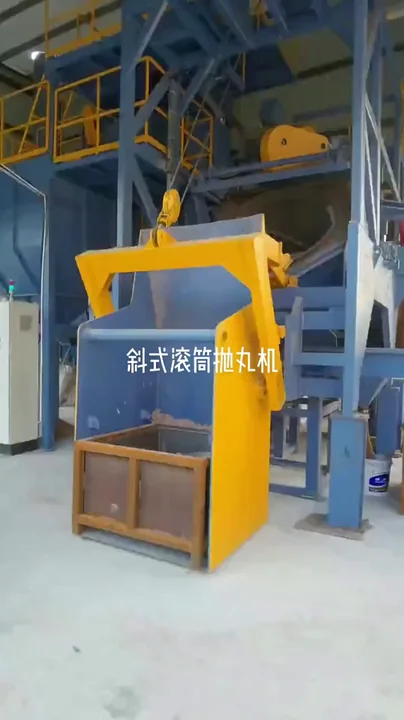
1. How the Tilting Drum Shot Blasting Machine Works
The tilting drum shot blasting machine adopts an inclined, rotatable drum structure. Workpieces are loaded into the drum and tumbled gently as it rotates slowly; meanwhile, multiple blast wheels directionally hurl steel shots at high speed, and the shots keep striking the tumbling workpiece surfaces, quickly removing rust, mill scale, burrs and molding sand to restore a clean surface.
Steel shots together with rust debris and molding sand fall to the bottom of the drum. A screw conveyor and bucket elevator feed them to an air-wash separator: reusable steel shots are separated and recycled for the next cycle, while waste is discharged. Dust generated during cleaning is sent to the dust collector for centralized filtration, keeping the workshop environment clean.
Working Process of the Tilting Drum Shot Blasting Machine
Three Core Advantages of the Inclined Design
- Automatic loading: The inclined drum structure makes it easy to configure automatic loading equipment, so workpieces enter the drum automatically and manual handling is reduced.
- Automatic unloading: With the rotating drum and inclined angle working together, workpieces discharge by gravity after cleaning — no manual raking needed.
- Automation-friendly: Loading and unloading require far less labor and can be linked with upstream and downstream processes for continuous, automated production.
2. Factories That Use the Tilting Drum Shot Blasting Machine
The tilting drum shot blasting machine is especially suited to high-volume surface cleaning of small-to-medium workpieces. Typical applications include:
- Foundries: cleaning molding sand from small and medium castings and removing riser flash, with uniform cleaning achieved by drum tumbling plus shot blasting.
- Forging & stamping plants: removing rust and mill scale from forgings to restore the metal surface.
- Fastener, spring & small hardware workshops: batch cleaning of small parts with high efficiency and low running cost.
- Heat treatment shops: removing mill scale generated during heat treatment and preparing parts for downstream processes.
- Small auto parts factories: derusting and strengthening small auto components for better surface quality and consistency.
Selection tip: for larger workpieces that need suspended cleaning, consider a hook type shot blasting machine; for long workpieces such as pipes and profiles in high-volume production, choose a through type shot blasting machine; batch cleaning of forgings and stampings can also use a crawler type shot blasting machine. Pick the cleaning method that best fits your workpiece shape.
3. FAQ – Suitable & Unsuitable Workpieces
To help you select quickly, here are the most common questions about suitable and unsuitable workpieces for the tilting drum shot blasting machine.
- Small and medium cast iron / cast steel castings and other small castings;
- Forgings, small stamping parts, nuts, bolts and standard fasteners;
- Small springs and small hardware die castings (parts that tolerate mild impact);
- Small parts that need mill scale removal after heat treatment;
- Small engineering machinery parts, valve parts and similar.
- Thin-wall parts and sheet parts: tumbling impact can cause deformation and dents;
- Precision-machined parts and appearance parts: parts striking each other can cause pits and scratches;
- Large and heavy parts: the drum capacity is limited, and excessive weight can damage the drum body;
- Easily breakable fragile parts.
4. More Machines – Live Working Videos
Watch more shot blasting machines working live on our social media channels:
5. More Shot Blasting Machines & Surface Cleaning Equipment
We offer a full range of shot blasting equipment covering different workpiece shapes and capacity needs:
Sourcing Notes for International Buyers
When you request a shot blasting machine price from any manufacturer or supplier, compare more than the initial quotation: blast wheel quantity and power, abrasive recovery system, dust collector capacity and the cost of wear parts over the first years of operation. Jiangsu Dingtian Rust Removal and Coating Equipment Co., Ltd. is a China source factory with shot blasting manufacturing experience since 1998, quoting factory-direct and supporting OEM / ODM customization of the tilting drum shot blasting machine to your workpiece mix.
For an accurate quotation on the tilting drum shot blasting machine, send your workpiece drawings or photos, the target cleanliness grade (for example Sa2.5 per ISO 8501-1) and your daily throughput; our engineers will recommend the model, blast wheel layout and environmental configuration, together with a wear-parts list. Contact us by email or WhatsApp for a tailored proposal.
{“questions”: [{“id”: “faq-q1914-0”, “question”: “How does a tilting drum shot blasting machine work?”, “jsonQuestion”: “How does a tilting drum shot blasting machine work?”, “answer”: “The drum tilts to accept a batch of small castings, then rotates while blast wheels clean the tumbling load from multiple angles, giving uniform coverage without manual turning.”, “jsonAnswer”: “The drum tilts to accept a batch of small castings, then rotates while blast wheels clean the tumbling load from multiple angles, giving uniform coverage without manual turning.”}, {“id”: “faq-q1914-1”, “question”: “Which workpieces suit the tilting drum machine?”, “jsonQuestion”: “Which workpieces suit the tilting drum machine?”, “answer”: “Small to medium castings and forgings that can tumble freely without damage, such as brackets, flanges, gears and hardware parts processed in batches.”, “jsonAnswer”: “Small to medium castings and forgings that can tumble freely without damage, such as brackets, flanges, gears and hardware parts processed in batches.”}, {“id”: “faq-q1914-2”, “question”: “Which workpieces should NOT go into a tilting drum?”, “jsonQuestion”: “Which workpieces should NOT go into a tilting drum?”, “answer”: “Thin-walled, precision or collision-sensitive parts, and long or heavy workpieces; these are better handled by mesh belt, hook type or roller conveyor machines.”, “jsonAnswer”: “Thin-walled, precision or collision-sensitive parts, and long or heavy workpieces; these are better handled by mesh belt, hook type or roller conveyor machines.”}, {“id”: “faq-q1914-3”, “question”: “How is capacity selected for a foundry?”, “jsonQuestion”: “How is capacity selected for a foundry?”, “answer”: “Match the drum volume and blast wheel power to your batch weight and cycle time; the selection section above lists the criteria buyers should compare.”, “jsonAnswer”: “Match the drum volume and blast wheel power to your batch weight and cycle time; the selection section above lists the criteria buyers should compare.”}]}