
Engineered by Dingtian
Wind Turbine Tower Shot Blasting Machine | Internal & External Wall Rust Removal
The wind turbine tower shot blasting machine …
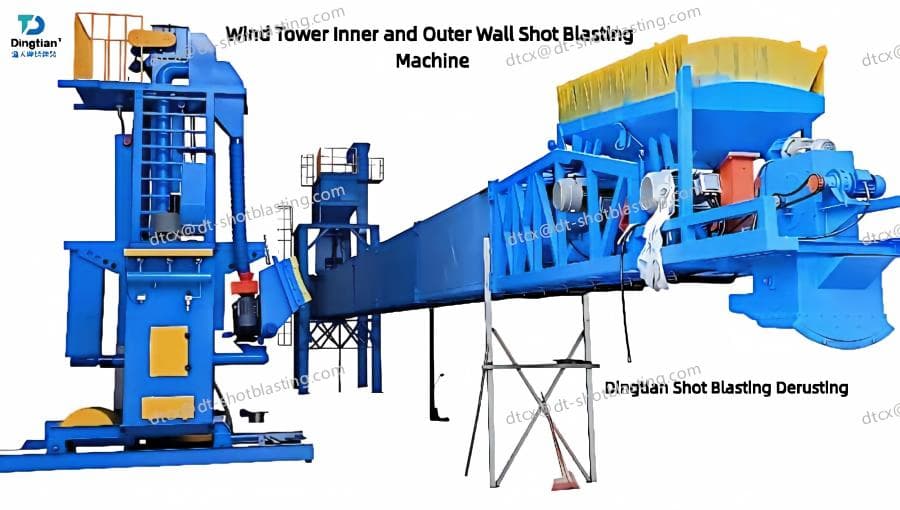
Request a QuoteThe wind turbine tower shot blasting machine from Jiangsu Dingtian Derusting & Painting Equipment Co., Ltd. is engineered for one demanding job: preparing large-diameter cylindrical steel sections to a paint-ready surface. Our wind tower shot blasting machine inner and outer wall systems remove mill scale, rust, old coating and welding residue in a single automated pass. Every installation is built around high-velocity centrifugal impeller wheel blasting technology, delivering abrasive at 60-100 m/s for consistent SA 2.5-SA 3 to ISO 8501-1 cleanliness. Whether you fabricate onshore tower segments or offshore wind tower monopiles. This machine class gives your coating line the surface profile it needs for a 20-year anti-corrosion life.
This page explains how the machine works, which workpieces it handles, the verbatim technical configuration, how to choose between internal and external wall setups, and How our wind tower shot blasting equipment compares with imported brands. We also cover tower segment blasting machine 50 ton capacity heavy duty requirements, wear part maintenance, and the most common buyer questions.
Working Principle of the Wind Turbine Tower Shot Blasting Machine
The core of our wind turbine tower shot blasting machine is the centrifugal blast wheel. An electric motor spins a turbine impeller at high speed. Steel abrasive is fed into the center of the wheel and accelerated outward by centrifugal force. The abrasive leaves the wheel at 60-100 m/s and strikes the tower surface. This impact removes rust and scale and creates an anchor profile for paint adhesion.
The process runs in four coordinated stages:
Stage 1 – Material handling. The tower section rides on an automated roller conveyor. Variable-frequency drives let the operator match conveyor speed to the required cleanliness grade. Heavier contamination runs slower; lightly rusted sections run faster. Roller spacing and load ratings are engineered for large diameter tube shot blasting machine cantilever boom style loading of long, heavy cylinders.
Stage 2 – Outer wall blasting. For the external surface, multiple blast wheels are arranged around the passage. Wheel angles are calculated so the entire circumference receives uniform impact, including the weld seams of the tower section. This is the classic wind tower external wall shot blasting machine configuration.
Stage 3 – Inner wall blasting. The internal surface is the hardest part of the job. Our wind tower inner surface shot blasting machine design uses a cantilever boom that carries a rotating blast head into the cylinder. The head moves along the tower axis while the abrasive stream sweeps the full inner circumference. This is how the machine cleans the inside of a wind tower without manual labor inside a confined space. The result is a true wind turbine tower inner and outer wall shot blasting machine: both walls treated in one machine, which is the defining feature of this equipment class.
Stage 4 – Abrasive recovery and environmental control. Spent abrasive, dust and detached scale fall into a recovery system. An elevator carries the abrasive to a separator that removes dust and broken media. Clean abrasive returns to the blast wheels. A cartridge dust collector keeps the plant air clean. This closed-loop recovery and filtration approach is what enables eco-friendly shot blasting in tower production: abrasive is continuously recycled rather than discarded, and particulate emissions stay within regulatory limits. The result is a complete wind tower blast and paint facility front end rather than a standalone blaster.
Important process distinction: centrifugal wheels versus robotic abrasive blast robots. Buyers often compare our machine with robotic blast cleaning systems such as Blastman-type automatic blast cleaning robot equipment used for blast cleaning of exterior surface of wind turbine towers. These are two different technologies, and each suits different tower sections:
- Robotic abrasive blast cleaning robots use compressed air and a nozzle-carrying robot that crawls on the tower wall. They excel at spot repair, touch-up of weld zones, and blasting erected towers in the field or in very large blast rooms where the section cannot be conveyed. They are flexible but slower per square meter, consume more energy per ton of abrasive, and depend on compressed air capacity.
- Our centrifugal impeller wheel blasting machine uses motor-driven turbines. It is the right choice for serial production of tower sections in the factory, where throughput, abrasive cost per square meter, and consistent Sa 2.5 results matter most. For a wind turbine tower production facility processing section after section, wheel blasting is dramatically more economical than any robotic blast cleaning for wind power nozzle system.
In short: if you blast dozens of identical tower segments per month, choose the wheel machine. If you repair erected towers or handle one-off geometry, a robotic air-blast system may fit better. Many plants run both, with our wind tower shot blasting equipment semi-automatic airless wheel line doing the bulk production work.
Applicable Workpieces and Industries
The wind turbine tower shot blasting machine is a key piece of renewable energy manufacturing equipment, but it is not limited to wind energy. Any large cylindrical or heavy structural workpiece that fits the roller conveyor can be processed. The same machine class handles monopile shot blasting, pipe spools and heavy weldments. Below is the verbatim applicability data from our engineering documentation:
| Category | Typical buyers and workpieces |
|---|---|
| Wind power | New energy and wind power equipment makers: tower sections, frames, hubs, flanges |
| Pipes | Pipe makers — doubles as a steel pipe shot blasting machine for oil casing and boiler tubing |
| Structures | Steel-structure fabricators: H-beam, I-beam, steel plate, box girders, pressure vessels |
| Marine & offshore | Shipyards: hull sections, platforms, monopile shot blasting, tank shells |
For wind power customers, the typical workpieces are tower sections of 20-60 tons, transition pieces, hub castings and flange rings. Wind tower section shot blasting per segment is the standard production rhythm, because towers ship in sections and are bolted together on site. For offshore projects, monopile shot blasting / pipe and spool blast wheel machine duty is common: the same wheel arrangement that strips a tower exterior also prepares monopiles and jacket legs before anti-corrosion coating.
Because the machine doubles as structural steel equipment, many fabricators pair it with a roller conveyor shot blasting machine for steel plate and H beam line, or use a hook type shot blasting machine for hubs, flanges and irregular castings that cannot roll on a conveyor. Smaller components such as bolts. Brackets and fittings are often processed on a rubber belt tumble blast machine or a turntable shot blasting machine in the same plant.
Technical Parameters
The following configuration table is copied verbatim from our product documentation. Actual dimensions, wheel power and conveyor load are customized per project; contact our engineers for a drawing-based proposal.
| Parameter | Engineered Wind-Tower Configuration |
|---|---|
| Workpieces | Wind-turbine towers, large pipes and tanks |
| Treatment surfaces | Inner and outer walls |
| Material handling | Automated roller conveyor |
| Process result | Rust, scale and coating removal; paint-ready profile |
| Environmental control | Abrasive recycling and dust collection |
Key performance figures for the standard wind tower shot blasting machine platform:
- Abrasive velocity: 60-100 m/s at the wheel outlet
- Surface cleanliness: SA 2.5-SA 3 to ISO 8501-1, with a controlled anchor profile for epoxy and polyurethane coating systems
- Internal blasting: robotic internal blast head on a cantilever boom, programmable for different tower diameters
- Related model codes in our catalog: Q32, Q35, Q37, Q69 series cover complementary workpieces, while the wind tower line is engineered to order
- Offshore duty: offshore tower ready construction for marine-grade coating schedules
If your plant also runs plate and profile work, see our steel plate pretreatment and painting line for the shop-primer side of wind tower manufacturing, or the steel pipe inner and outer wall shot blasting machine when your diameter range leans toward pipe and casing rather than tower sections.
How to Choose the Right Wind Tower Shot Blasting Configuration
Choosing a wind turbine tower shot blasting machine starts with honest answers to five questions. First: which walls must be treated? An outer-wall-only line costs far less than a full wind tower inner and outer wall shot blasting machine, but Internal corrosion protection is mandatory for most modern towers, so wind turbine tower internal blasting coating life requirements usually decide this for you. Second: what are your section diameters and weights? A tower segment blasting machine 50 ton capacity heavy duty roller bed, reinforced frames and larger drive motors are needed for offshore segments. Third: what cleanliness grade does your coating supplier require? Wind tower section shot blasting Sa 2.5 anti-corrosion is the industry baseline; Sa 3 demands more wheel power or slower conveyor speed. Fourth: what is your daily throughput? Wheel count and total installed power scale with sections per shift. Fifth: will the machine link to painting? Most buyers want a wind tower blast and paint facility layout where blasting, priming and topcoat flow in one line.
Terminology also matters when you search or specify. Different markets call this machine by different names. The table below is reproduced verbatim from our market research so you can match supplier language to your own specification:
| Term | Where it is used |
|---|---|
| Wind tower shot blasting machine | The general trade name used by Chinese exporters and B2B platforms |
| Wind turbine tower shot blasting machine | JX Abrasives, CNMFRS and technical articles; the most common long form |
| Wind turbine tower inner and outer wall shot blasting machine | The full functional name; both walls in one machine, which is the defining feature |
| Wind tower inner surface shot blasting machine | Reiking wording for internal-wall-only machines; RQ2000 is sold as a “wind tower wall shot blasting machine“ |
| Tower internal wall blasting machine | B2B encyclopaedia wording; also written as internal wall tower shot blasting machine |
| Wind tower external wall shot blasting machine | Outer-wall-only configuration, common on GoVeda patent listings |
| Generator tower shot blasting machine | Alternative wording for the turbine tower |
| Wind tower section shot blasting | Buyers specifying per-section processing rather than a whole tower |
| Wind tower blast and paint facility | Whole-plant wording — BlastOne Australia and Airblast UK sell complete facilities |
| Wind turbine tower production facility | Airblast UK wording for an integrated blast room line |
| Robotic blast cleaning for wind power | Blastman Robotics (Finland) wording for automated internal blasting |
| Monopile shot blasting / pipe and spool blast wheel machine | CYM and offshore buyers; the same machine class handles monopiles, pipes and spools |
A practical selection rule: if your sections are longer than the standard roller bed. Ask for a large diameter tube shot blasting machine cantilever boom layout with extended infeed and outfeed conveyors. If your mix includes small-diameter pipe. Request adjustable blast head tooling so one machine covers the full wind tower shot blasting machine inner and outer wall diameter range. Our engineering team also publishes practical guidance on our blog. Including how a wind turbine tower shot blasting machine works and shot blasting for wind tower inner and outer wall.
Comparison with Imported Brands
We are an independent manufacturer; brand names are used only to identify compatible wear parts and reference equivalents, not to imply endorsement or origin.
European and American brands established the wind tower blasting category, and their machines are well engineered. Wheelabrator offers wind energy surface preparation systems with strong global service networks. Pangborn is known for durable wheel technology in North American tower plants. Japanese Sintokogio equipment is respected for precision and longevity. So why do more and more tower fabricators specify Jiangsu Dingtian?
- Capital cost. A complete wind tower blast and paint facility front end from imported brands often costs two to three times more than an equivalent Dingtian line with the same wheel power and conveyor capacity.
- Lead time. Imported lines commonly quote 12-18 months. Our engineered-to-order tower lines ship in a fraction of that time, which matters when your tower contracts are already signed.
- Customization. We design around your actual section diameters, weights and factory bay layout instead of forcing your product into a fixed catalog machine.
- Wear parts and spares. Blades, liners, wheels and elevator buckets for imported machines carry long lead times and premium prices. We supply direct-fit replacements, including compatible wear parts for major brand machines, from stock-grade lead times.
- Process equivalence. Our centrifugal wheels reach the same 60-100 m/s abrasive velocity and the same SA 2.5-SA 3 to ISO 8501-1 result that coating warranties demand.
The honest summary: if budget is unlimited and you want a brand name on the nameplate, imported machines are fine equipment. If you want the same surface preparation result with faster payback, flexible engineering and affordable spares. The Dingtian wind turbine tower shot blasting machine is the stronger commercial choice. Many customers keep an older imported line running and buy Dingtian compatible wear parts for various shot blasting machine series to cut their operating cost immediately.
Maintenance and Wear Parts
A wind tower shot blasting machine works hard. Abrasive at 60-100 m/s wears everything it touches, so a disciplined wear parts program protects your uptime and your surface quality. The main consumables are:
- Blast wheel blades and impellers. Replace blades in matched sets to keep the wheel balanced. Inspect weekly under heavy duty.
- Control cage and wheel housing liners. A worn control cage shifts the abrasive pattern and leaves unblasted stripes on the tower wall.
- Chamber wear plates. Manganese steel or cast chromium liners protect the blast room shell. Check thickness at the hot spots opposite the wheels.
- Internal blast head wear parts. The cantilever boom head works inside the cylinder where inspection is harder. Schedule its liners and nozzles on a fixed hour basis.
- Elevator buckets, separator screens and conveyor rollers. These keep the abrasive loop running; a failed bucket stops the whole line.
- Dust collector cartridges. Replace on differential pressure, not on a calendar guess.
Practical maintenance tips from our field engineers: keep abrasive clean, because fine dust in the mix accelerates wear on every component; Check belt and coupling alignment monthly; log blast hours per wheel so replacements are planned, not emergency; and always stock one full blade set plus chamber liners before commissioning. We supply all of the above as genuine Dingtian parts and as compatible wear parts for other machine series. For background on consumable life, read our guide to shot blasting machine wear parts and our article on choosing steel shot and grit. Since correct abrasive sizing directly affects both finish quality and wear rate.
How a Chinese Factory Matches Imported Brands at About 40% of the Price
Norican, the parent company of Wheelabrator, has manufactured in Changzhou since 1997. Sintokogio has produced equipment in China through its Qingdao Xindong joint venture since 1996. Beyond these two cases, a substantial share of the world’s shot blasting equipment is manufactured in China, including contract production for Western and Japanese brand owners. Our machines use the same supply chain and the same component standards.
Buyers specifying the same cleanliness grade, wheel count and wear-part alloy typically pay around 40% of an imported brand’s price factory-direct. There is no distributor margin, no component round-trip freight, and no brand premium.
We do not chase the lowest bid. Price pressure is what forces thinner plate, second-grade wheels and skipped testing — the very things that destroy equivalence. Same specification, same testing, wear parts made in-house.
FAQ
What is a wind turbine tower shot blasting machine?
It is an automated abrasive blasting system built to prepare the inner and outer surfaces of wind tower steel sections before painting. High-speed centrifugal wheels throw steel abrasive at 60-100 m/s onto the tower wall, removing rust. mill scale and old coating to reach SA 2.5-SA 3 cleanliness per ISO 8501-1. The machine typically includes a roller conveyor, blast chamber, internal blast head on a cantilever boom, abrasive recovery system and dust collector.
What is the difference between an inner wall and an outer wall tower machine?
An outer wall machine places fixed blast wheels around the conveyor passage to treat the external circumference. An inner wall machine adds a rotating blast head that travels into the cylinder on a boom to treat the internal surface. A full wind turbine tower inner and outer wall shot blasting machine combines both, which is the defining feature of this equipment class, because modern towers require internal corrosion protection as well as external.
How does it clean the inside of a wind tower?
A cantilever boom carries a robotic internal blast head into the tower section. The head rotates while the boom feeds it along the cylinder axis, so the abrasive stream sweeps the entire inner circumference. The operator programs the diameter, travel speed and blast pattern from the control panel. No worker enters the confined space during blasting, which improves both safety and consistency.
Why is shot blasting necessary before painting a wind tower?
Paint bonds mechanically to a clean, profiled surface. Rust, mill scale and contaminants cause coating delamination, and a tower repaint in the field is enormously expensive. Shot blasting removes all contamination and creates a uniform anchor profile, which Is why coating manufacturers require Sa 2.5 or Sa 3 blasting before their warranty-grade epoxy systems are applied. Proper blasting directly determines the coating life of the tower.
Does shot blasting strengthen the tower steel?
Blasting produces compressive residual stress in the surface layer, which can be beneficial for fatigue behavior. However, the primary purpose on wind towers is surface preparation for coating, not a controlled strengthening process. The main measurable results are cleanliness grade and anchor profile, both verified against ISO 8501-1 comparison standards.
Is it suitable for offshore wind towers?
Yes. Offshore towers and monopiles face the most aggressive corrosion environment in the industry, so they demand the highest surface preparation standard. Our offshore tower ready configurations handle heavy sections, large diameters and the strict Sa 2.5 to Sa 3 grades required by marine coating systems. The same machine class also processes monopiles, transition pieces and jacket components.
Can it be linked to an existing painting line?
In most cases yes. The roller conveyor of the blasting machine can be aligned with the entry of a primer and topcoat line so sections flow directly from blasting to coating while the surface is still fresh. This is the standard wind tower blast and paint facility layout. We survey your existing paint line, oven and conveyor heights before finalizing the blast machine design.
What is the difference from a standard through-feed machine?
A standard through-feed roller conveyor machine treats only the external surfaces of a workpiece. A wind tower machine adds the internal blast head, heavier roller load capacity for tens of tons per section, and Wheel arrangements sized for large diameters. Structurally it is a through-feed machine, but functionally it is engineered specifically for long, heavy, large-diameter cylinders.
Can the same machine handle monopiles, pipes and steel structures?
Yes, within the diameter and weight envelope of the conveyor and blast chamber. The same wheel class is sold as a monopile shot blasting / pipe and spool blast wheel machine for offshore foundations. Oil casing and boiler tubing. Structural sections such as box girders can also pass through, although dedicated H-beam and plate lines are more efficient for high-volume structural work.
What determines the price of a wind tower shot blasting machine?
The main cost drivers are the maximum section diameter and weight, the number and power of blast wheels, whether internal wall blasting is included. The level of automation in the internal blast head, the capacity of the dust collection and abrasive recovery systems, and any integration with downstream painting equipment. Because every tower plant is different, we quote each project after reviewing your workpiece drawings and factory layout.
Discuss Your Wind Tower Blasting Project with Our Engineers
Jiangsu Dingtian Derusting & Painting Equipment Co., Ltd. builds engineered wind turbine tower shot blasting machine systems for tower fabricators, pipe mills and offshore foundation plants worldwide. Send us your section diameters, weights, cleanliness grade and daily throughput, and Our engineers will propose a complete wind tower inner and outer wall shot blasting machine layout with conveyor integration, abrasive recycling and dust control. We also supply OEM and ODM services, fast delivery of wear parts, and compatible spares for major imported brands. Explore related equipment such as our trolley type shot blasting machine for oversized components, or browse the full shot blasting machine catalog, and Request a quotation today to get a drawing-based proposal for your tower line.
More Technical Resources
For more technical blog posts, equipment technology articles and machine working videos, visit:
Model Comparison
Compare available models and technical parameters.
| Parameter | Engineered Wind-Tower Configuration |
|---|---|
| Workpieces | Wind-turbine towers, large pipes and tanks |
| Treatment surfaces | Inner and outer walls |
| Material handling | Automated roller conveyor |
| Process result | Rust, scale and coating removal; paint-ready profile |
| Environmental control | Abrasive recycling and dust collection |
Reviews
Customer reviews & ratings
Product inquiry
Reviews
There are no reviews yet.