
Engineered by Dingtian
CNC Automated Blasting Machine
A CNC abrasive blasting machine combines serv…
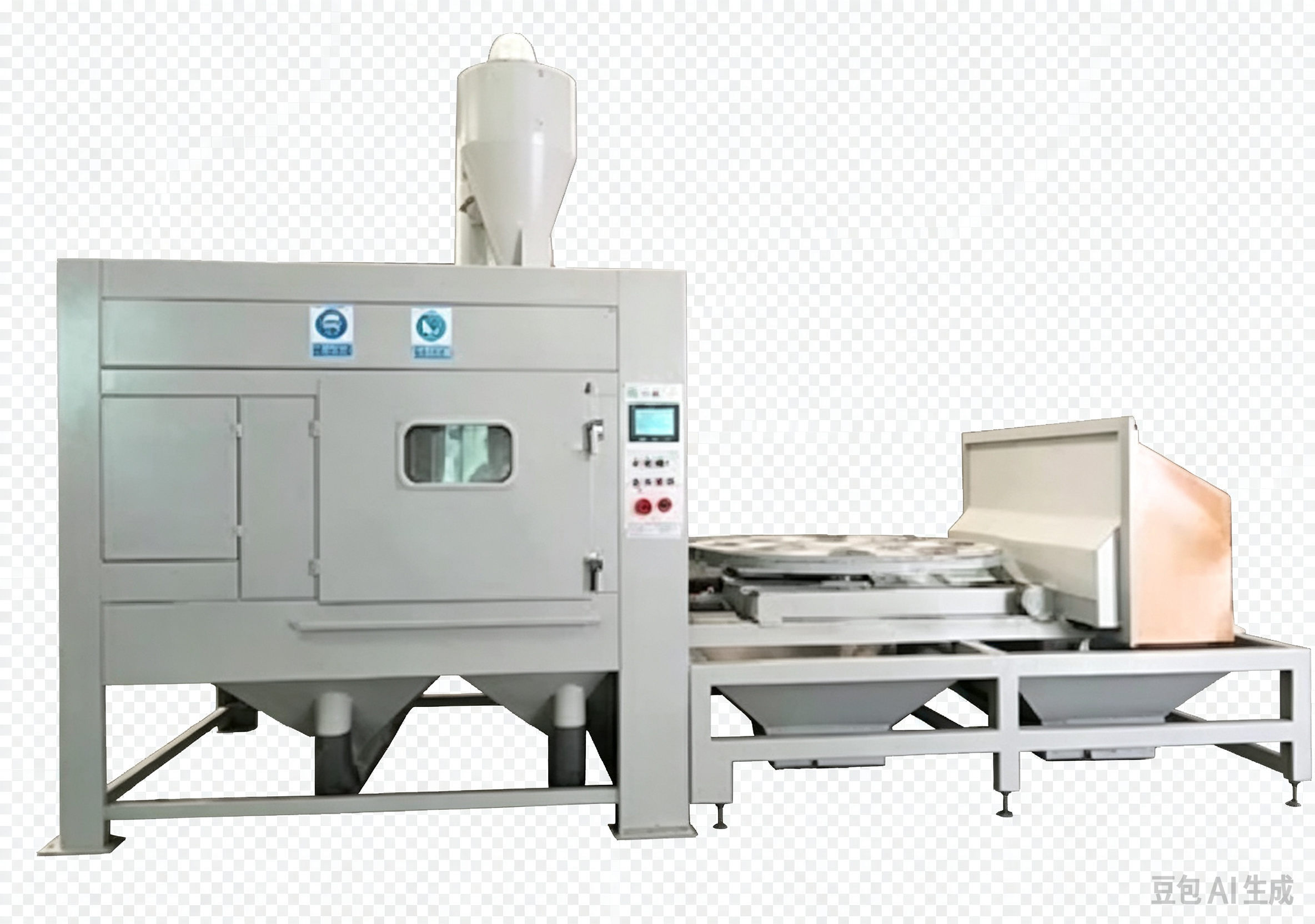
Request a QuoteA CNC abrasive blasting machine combines servo-controlled nozzle motion with recipe-based programming to deliver repeatable surface finishes on precision workpieces. Unlike manual blast cabinets, this automated blast cabinet stores process parameters for each part number, eliminating operator variation and ensuring every cycle matches the validated specification. Jiangsu Dingtian builds each CNC automated blasting machine around your workpiece envelope, surface requirement and production rate.
Precision manufacturing demands surface finishes that manual processes cannot guarantee. Gear tooth roots, turbine blade platforms, medical implant surfaces and aerospace fastener bores all require controlled profiles within tight tolerances. A CNC abrasive blasting machine achieves this by replacing human judgment with programmed motion paths, regulated pressure and timed exposure. The result is documented repeatability that supports quality audits and regulatory compliance.
How a CNC Abrasive Blasting Machine Works
The workpiece sits on a rotary indexing table inside a sealed blast cabinet. Overhead nozzle manifolds traverse across the part at programmed speeds and stroke lengths. The servo system indexes the table to precise angular positions while the nozzles follow stored paths. A closed-loop abrasive recovery circuit with cyclone separation returns usable grain to the blast nozzles and rejects fines to the dust collector. Cartridge-type dust collection maintains negative pressure inside the cabinet for clear visibility and containment.
All motion parameters are stored as recipes on the HMI touch screen. An operator selects the part number and presses start. The machine executes the full cycle automatically, including table rotation, nozzle traverse, blast duration and media flow. This recipe-based control is what distinguishes a robotic abrasive blasting cell from a conventional manual cabinet. In the trade, this type of equipment is also referred to as a programmable blast cabinet, emphasising the stored-process capability that separates it from standard single-cycle machines. Each recipe records nozzle speed, stand-off distance, blast pressure, media type and cycle time, creating a complete process record for traceability.
The sealed cabinet design prevents abrasive escape and protects surrounding equipment. Rubber-lined walls resist wear from reflected media. Viewing windows with internal air curtains stay clear during operation. Safety interlocks prevent door opening while blast pressure is active. The entire system integrates into existing production cells with standard electrical and compressed-air connections.
Workpieces and Industries
A CNC abrasive blasting machine serves industries that demand consistent, documented surface finishes. Typical workpieces include precision gears and shafts, turbine blades and discs, medical implant components, aerospace fasteners and fittings, automotive transmission parts, hydraulic valve bodies and semiconductor tooling. Each application requires specific media selection, pressure settings and coverage targets.
The machine handles deburring, surface profiling, coating removal and cosmetic finishing. For gear manufacturers, it produces uniform root fillet profiles before heat treatment. For aerospace suppliers, it achieves controlled surface roughness per ISO 8503-2 specifications. For medical device makers, it creates matte finishes that meet biocompatibility surface requirements. Automotive plants use it for brake disc surface preparation and engine block cleaning where dimensional tolerance must be preserved.
Semiconductor equipment manufacturers rely on automated abrasive blast systems for chamber component refurbishment. Used wafer handling parts arrive with deposited films and particle contamination. The CNC machine strips coatings uniformly without altering base dimensions, then applies a controlled anchor profile for re-coating. Recipe storage ensures identical results across successive refurbishment cycles.
Technical Specifications
| Parameter | Typical value | Remark |
|---|---|---|
| Table load | Per workpiece | Determined by the workpiece; quoted per application |
| Table diameter | Per workpiece | Determined by the workpiece and fixture envelope; quoted per application |
| Nozzle count | Per workpiece | Sized to the area and geometry to be covered; quoted per application |
| Cycle time | Per workpiece | Depends on surface requirement, pressure, feed rate, passes and masking; quoted per application |
| Power supply | Per workpiece | Sized to the installed load; quoted per application |
| Compressed-air consumption | Per workpiece | Sized to nozzle count and blast pressure; quoted per application |
| Cabinet type | Sealed blast cabinet | Works on the same principle as an automated blast cabinet or blast cell |
| Table motion | Rotary indexing | Rotation speed and indexing positions set in the recipe |
| Nozzle motion | Overhead manifold traverse | Traverse speed and stroke set in the recipe |
| Control | Servo-controlled, recipe-based | Part number selected on the HMI touch screen |
| Abrasive recovery | Closed-loop with cyclone separation | Returns usable grain and rejects fines |
| Dust collection | Cartridge type | Maintains negative pressure and clear windows |
| Media | Angular aluminium oxide; spherical glass beads; ceramic beads; plastic media; sodium bicarbonate | Selected for the required cut, finish or peening result |
| Reference standards | ISO 8501-1; ISO 8503-2; SAE J442; SAE J443 | Used as applicable to cleanliness, profile and peening specification |
Abrasive Media and the Finish Each Produces
Media selection determines both the cutting rate and the final surface character. Angular aluminium oxide provides aggressive cutting for scale removal and deep profiling. Spherical glass beads produce uniform matte or satin finishes without embedding. Ceramic beads offer durability between glass and oxide, suitable for peening and light profiling. Plastic media strips coatings gently without damaging soft substrates. Sodium bicarbonate cleans delicate surfaces without dimensional change.
Each media type has a finite useful life. Fractured particles lose cutting efficiency and can embed in soft substrates. The closed-loop cyclone separator continuously removes fines and undersized particles, extending media life and maintaining consistent finish quality. Media replenishment rates depend on workload intensity and separator efficiency. Our systems typically achieve media recirculation rates above 90 percent.
How Repeatability Is Guaranteed
Repeatability comes from three layers of control. First, servo motors position nozzles and table with sub-millimetre accuracy on every cycle. Second, pressure regulators maintain constant blast pressure regardless of compressor load fluctuations. Third, timed exposure ensures every surface receives identical media impact energy. Together, these controls eliminate the three main sources of variation in manual blasting: inconsistent stand-off distance, variable sweep speed and uneven dwell time.
Data logging captures every cycle parameter for post-process verification. If a quality audit reveals an out-of-specification reading, the logged data identifies whether the deviation originated from machine settings, media condition or workpiece positioning. This traceability is essential for aerospace, medical and automotive suppliers operating under quality management systems.
When This Machine Is the Wrong Choice
A CNC abrasive blasting machine excels at precision work on fixtured parts. It is not the right choice for very large structures that exceed cabinet dimensions. For those applications, consider our blast room systems. It also does not suit high-volume continuous processing of simple shapes where a conveyor-fed machine offers better economics. For flat parts in series production, our roller conveyor shot blasting machine may be more appropriate.
How to Specify a CNC Abrasive Blasting Machine
To size a CNC automated blasting machine correctly, provide the following inputs:
- Workpiece dimensions, weight and material grade
- Target surface cleanliness per ISO 8501-1 or customer drawing note
- Required surface profile range per ISO 8503-2
- Annual volume and shift pattern
- Any masking or fixturing requirements
- Media preference or existing specification per SAE J442 / SAE J443
With these inputs, our engineering team proposes table diameter, nozzle count, servo axis configuration and cycle time. We also recommend whether a standalone cabinet or an inline cell integrated with your existing conveyor suits your workflow better.
Brand Compatibility and Reference Equivalents
We are an independent manufacturer; brand names are used only to identify compatible wear parts and reference equivalents, not to imply endorsement or origin. Facilities operating Wheelabrator, Pangborn or Sintokogio equipment can source compatible nozzles, liners and seals from our inventory. Our CNC abrasive blasting machine uses standard international components for motors, PLCs and inverters, so your maintenance team can service them locally. See our Wheelabrator and Pangborn compatible parts pages for cross-reference details.
Maintenance Guidelines
Daily maintenance includes inspecting nozzle wear, checking air pressure regulators and emptying the dust collector hopper. Weekly tasks cover verifying servo axis home positions, cleaning cyclone internals and testing safety interlocks. Monthly checks include replacing worn nozzle liners, calibrating pressure gauges and inspecting rotary table bearings.
Keep a spare set of nozzles, seals and filter cartridges on hand. Recipe backups should be stored off-machine to allow quick recovery after controller replacement. For detailed guidance, refer to our maintenance troubleshooting guide and preventive maintenance checklist. Nozzle wear directly affects finish consistency, so document cumulative hours and replace on schedule rather than waiting for visible degradation.
Integration With Production Workflows
A CNC abrasive blasting machine integrates into existing production cells in several configurations. Standalone placement suits job shops where parts arrive from multiple upstream processes. Inline placement between machining and inspection stations creates a continuous flow cell with minimal work-in-progress inventory. Pallet system integration allows the blast cabinet to accept standardised fixturing from your existing automation infrastructure.
Communication with factory MES or SCADA systems enables real-time production tracking. The PLC exports cycle completion signals, parameter logs and alarm states via OPC-UA or Modbus TCP. This connectivity supports Industry 4.0 initiatives by making surface finishing data available for statistical process control and predictive maintenance analytics.
How a Chinese Factory Matches Imported Brands at About 40% of the Price
Norican, the parent company of Wheelabrator, has manufactured in Changzhou since 1997. Sintokogio has produced equipment in China through its Qingdao Xindong joint venture since 1996. Beyond these two cases, a substantial share of the world’s shot blasting equipment is manufactured in China, including contract production for Western and Japanese brand owners. Our machines use the same supply chain and the same component standards.
Buyers specifying the same cleanliness grade, wheel count and wear-part alloy typically pay around 40% of an imported brand’s price factory-direct. There is no distributor margin, no component round-trip freight, and no brand premium.
We do not chase the lowest bid. Price pressure is what forces thinner plate, second-grade wheels and skipped testing — the very things that destroy equivalence. Same specification, same testing, wear parts made in-house.
CNC Abrasive Blasting Machine FAQ
What is bead blasting finish in CNC?
Bead blasting uses spherical glass beads propelled by compressed air to produce a uniform matte or satin finish. In a CNC abrasive blasting machine, the nozzle path and pressure are programmed, so every part receives identical coverage. Bead blasting is common for cosmetic surfaces on aluminium and stainless steel components.
Automated vs manual blasting: which is more efficient?
Automated blasting eliminates operator fatigue and variation. Cycle times are shorter because servo motion follows optimised paths without pauses. More importantly, repeatability improves quality yield and reduces rework. Manual blasting still suits one-off repairs and field work, but production environments benefit from automation.
How does robotic abrasive blasting improve productivity?
A robotic abrasive blasting cell runs unattended once the recipe is validated. One operator can manage multiple cells simultaneously. Productivity gains come from faster cycle times, zero setup variation and reduced inspection rejects. Data logging also supports traceability for regulated industries.
What media types does this machine support?
The machine supports angular aluminium oxide for aggressive cutting, spherical glass beads for matte finishes, ceramic beads for durable peening, plastic media for gentle stripping and sodium bicarbonate for non-damaging cleaning. Media selection depends on the substrate hardness, target profile and finish specification.
Can this machine handle shot peening applications?
Yes. When configured with appropriate media and pressure settings, the machine can perform controlled peening per SAE J442 and SAE J443. For dedicated high-intensity peening of gears and shafts, see our CNC shot peening machine page for specialised configurations.
What standards apply to surface cleanliness and profile?
ISO 8501-1 defines visual cleanliness grades. ISO 8503-2 specifies surface profile measurement methods. SAE J442 covers cast steel shot and grit specifications. SAE J443 defines procedures for measuring Almen intensity in peening. Our machines are configured to meet any combination of these standards.
Jiangsu Dingtian Derusting & Painting Equipment Co., Ltd. engineers each CNC abrasive blasting machine to your exact workpiece and surface specification. Send us your part drawings and requirements through our contact page for a tailored proposal. Browse our CNC automated blasting machines category for additional configurations or read our guide to choosing the right shot blasting machine.
More Technical Resources
For more technical blog posts, equipment technology articles and machine working videos, visit:
Reviews
Customer reviews & ratings
Product inquiry
Reviews
There are no reviews yet.