
Engineered by Dingtian
Automatic Abrasive Blasting Room for Large Workpieces
A blast room is an enclosed industrial enclos…
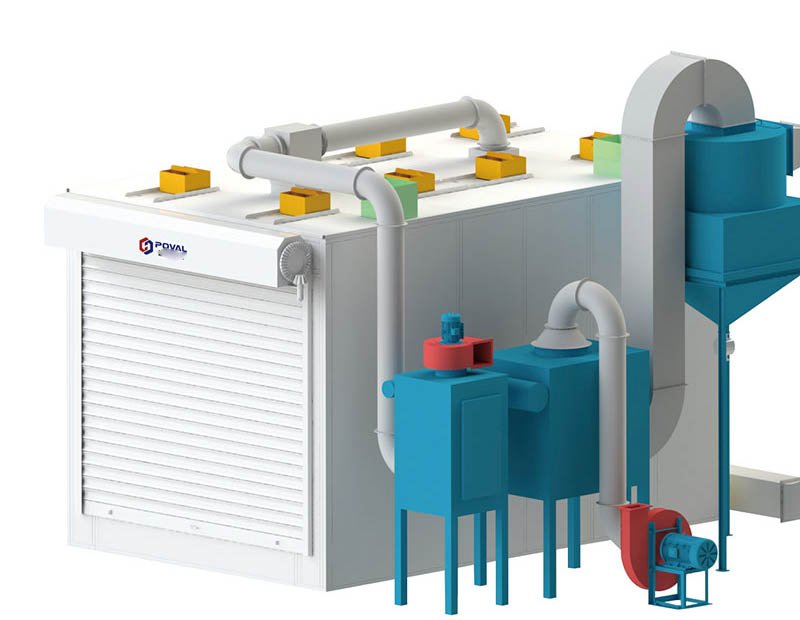
Request a QuoteA blast room is an enclosed industrial enclosure where operators perform abrasive blasting on large workpieces that cannot fit inside a standard blast cabinet. Also known as a blast booth, this facility integrates sealed chamber walls, abrasive recovery systems, ventilation and dust collection into one engineered unit. Jiangsu Dingtian designs each abrasive blasting room around your maximum workpiece dimensions, daily throughput and environmental compliance requirements.
Large-scale surface preparation demands a controlled environment. Open-air blasting wastes abrasive, creates uncontrolled dust emissions and exposes workers to hazardous particulate. A properly designed blast room solves all three problems by containing the process, recovering spent media for reuse and filtering exhaust air to regulatory standards. The result is lower operating cost, better working conditions and documented environmental compliance.
How an Abrasive Blasting Room Works
An operator wearing protective equipment enters the blast room and directs a compressed-air nozzle at the workpiece surface. Spent abrasive falls to the floor, where a recovery system collects and transports it to a separator. The separator removes fines and contaminants, returning clean abrasive to the blast pot for reuse. A dust extraction system maintains negative pressure inside the chamber, capturing airborne particles through cartridge or bag filters before exhausting clean air.
The entire cycle is continuous: blast, recover, separate, recycle. This closed-loop design reduces abrasive consumption by up to 90 percent compared to open-air blasting and keeps emissions within regulatory limits. A properly designed sandblasting room also provides uniform lighting, safe access doors and emergency ventilation to protect the operator. Lighting levels typically exceed 500 lux at the work surface to ensure visibility of surface defects and coverage progress.
Ventilation design follows a cross-flow or downdraft pattern depending on room geometry and workpiece type. Cross-flow suits long narrow rooms where airflow moves horizontally from inlet to exhaust. Downdraft suits tall rooms where gravity assists particle capture. Air change rates are calculated to maintain visibility and keep respirable dust below occupational exposure limits. Filter selection matches the dust characteristics: cartridge filters for fine steel shot dust, bag filters for coarse mineral abrasives.
Workpieces and Industries
A blast room handles workpieces too large or heavy for automated machines. Common applications include ship hull sections and offshore platform modules, wind turbine tower segments, large steel castings and forgings, bridge girders and structural weldments, pressure vessels and storage tanks, railway bogies and locomotive frames, and mining equipment assemblies.
Industries that rely on blast booth facilities include shipbuilding and marine repair, heavy equipment manufacturing, structural steel fabrication, power generation, rail transport and oil and gas infrastructure. Each sector has specific cleanliness targets, typically Sa 2.5 per ISO 8501-1, and surface profile ranges matched to the coating system. For wind tower inner wall blasting, see our dedicated wind tower blasting guide.
Ship repair yards use blast rooms for hull section refurbishment during dry dock periods. The room accommodates curved hull plates and complex stiffener arrangements that automated conveyors cannot handle. Offshore fabricators blast monopile sections and transition pieces before applying multi-layer corrosion protection systems. Structural steel plants blast welded assemblies after fabrication to remove weld slag, spatter and mill scale before painting. Each application drives specific room dimensions, door sizes and crane capacity requirements.
The 4 Abrasive Recovery Systems – Comparison Table
| Recovery system | Working principle | Foundation pit required? | Best suited for |
|---|---|---|---|
| Mechanical screw (auger) recovery | Rotating helical blades push abrasive to a collection point, then a bucket elevator lifts it to the separator | Yes – typically a 2.5-3.5 m deep pit | High-volume continuous production; large conveying capacity and high efficiency |
| Belt conveyor recovery | A belt conveyor transports abrasive to a central point, then a bucket elevator lifts it for separation | Yes – pit or raised foundation needed | Medium and large blast rooms; simple, reliable structure with low blockage risk |
| Scraper (drag conveyor) recovery | Mechanical scrapers on the floor push abrasive to the collection point, then a bucket elevator lifts it to the separator | No deep pit – shallow foundation only (0.5-2.5 m) | Heavy oversized workpieces, steel bridge structures; durable, efficient and tolerant of foreign objects |
| Pneumatic recovery (honeycomb floor) | Fan vacuum pulls abrasive through a honeycomb floor and conveys it pneumatically to the grit-dust separator | No – or an extremely shallow foundation only | Small and medium blast rooms; very low failure rate and minimal maintenance, but higher energy consumption |
Engineered Abrasive Blasting Room Configuration
| Parameter | Engineered Abrasive Blasting Room Configuration |
|---|---|
| Applications | Large castings, forgings, welded structures and marine components |
| Process | Scale and rust removal; surface strengthening |
| Core systems | Blast chamber, abrasive recovery, ventilation and dust collection |
| Controls | Integrated lighting and electrical control |
| Configuration | Customized to workpiece size, handling and throughput |
How to Choose the Right Recovery System
Your choice of recovery system depends on four factors: workpiece weight, foundation constraints, production volume and maintenance tolerance. If your facility cannot accommodate a deep pit, pneumatic honeycomb or scraper recovery eliminates that requirement. For high-volume continuous operations where uptime is critical, mechanical screw recovery offers the highest conveying capacity. Belt conveyor recovery provides a middle ground with simple mechanics and moderate pit depth.
We also consider abrasive type when selecting the recovery system. Steel shot and grit flow easily through all four systems. Softer media like aluminium oxide or garnet may require wider auger flights or larger scraper blades to prevent degradation. Foundation costs can represent a significant portion of total project cost, so choosing a shallow-pit or no-pit system may reduce overall capital expenditure even if the recovery equipment itself costs more.
For automated alternatives to manual blasting in a room, see our CNC abrasive blasting machine and roller conveyor shot blasting machine. These systems suit repeatable production workpieces that fit within their processing envelopes. Many facilities operate both automated machines for series production and a blast room for oversized or irregular items.
Blast Room Design Considerations
Room dimensions must accommodate your largest workpiece with adequate clearance for operator movement and nozzle access. Minimum clearance of 1.5 metres on each side and 2 metres above the workpiece ensures safe operation. Door width should exceed your widest workpiece by at least 0.5 metres. Roll-up doors, sliding doors and bi-fold doors each have different space and sealing characteristics.
Internal lining protects steel walls from abrasive wear. Rubber lining suits steel shot and grit applications. Ceramic tile or hardened steel plates suit aggressive mineral abrasives. Liner thickness and attachment method depend on expected service life and replacement accessibility. Floor grating above the recovery system allows abrasive to fall through while supporting operator weight and workpiece loads. Grating bar spacing matches the abrasive size to prevent plugging.
Electrical systems must be rated for dusty environments. Explosion-proof lighting and switches are required when using aluminium or magnesium abrasives. Standard industrial fixtures suffice for steel shot and inert mineral media. Emergency stop buttons at each door and inside the room provide immediate shutdown capability. Interlocked doors prevent blasting when doors are open.
Brand Compatibility and Reference Equivalents
We are an independent manufacturer; brand names are used only to identify compatible wear parts and reference equivalents, not to imply endorsement or origin. Facilities operating Wheelabrator or Pangborn blast rooms can source compatible liners, nozzles, filter cartridges and elevator buckets from our inventory. Our blast room systems use standard international components for fans, motors and PLCs. See our Wheelabrator and Pangborn compatible parts pages for cross-reference details.
Maintenance and Operating Costs
Daily maintenance includes inspecting nozzle wear, checking floor recovery mechanisms for blockages and emptying the dust collector hopper. Weekly tasks cover verifying separator cut points, testing door seals and cleaning lighting fixtures. Monthly checks include replacing worn elevator buckets, calibrating airflow gauges and inspecting chamber liner plates for breakthrough.
Operating costs depend primarily on abrasive consumption, compressed air usage and filter replacement frequency. A well-designed recovery system keeps abrasive recirculation rates above 95 percent, minimising new media purchases. Cartridge filters typically last 2,000-4,000 hours depending on dust loading. Compressed air represents the largest ongoing energy cost. Variable-speed compressors and receiver tanks sized to peak demand reduce electricity consumption. For detailed guidance, see our preventive maintenance checklist and maintenance troubleshooting guide.
Nozzle wear directly affects productivity and finish quality. A worn nozzle increases air consumption without increasing blast area coverage. Replace nozzles when bore diameter exceeds the original specification by more than 10 percent. Tungsten carbide nozzles last significantly longer than ceramic ones in steel shot service. Budget nozzle replacement as a predictable consumable cost rather than an unexpected failure.
Dust Collection and Environmental Compliance
Dust collection is the most critical subsystem for regulatory compliance and operator safety. The collector must handle the peak dust generation rate during active blasting while maintaining sufficient airflow to keep the chamber under negative pressure. Undersized collectors cause visibility loss, dust escape through door seals and potential exposure limit violations.
Cartridge filters suit fine steel shot dust with high filtration efficiency and compact footprint. Pulse-jet cleaning maintains airflow without interrupting operation. Bag filters handle larger volumes of coarse mineral abrasive dust with lower pressure drop. Pre-filters extend main filter life by capturing heavy particles before they reach the primary media. Differential pressure monitoring across the filter bank signals when cleaning or replacement is needed.
Exhaust air quality must meet local emission standards. Typical limits range from 5 to 30 mg per cubic metre depending on jurisdiction. HEPA final filters achieve sub-micron capture for facilities near residential areas or with strict environmental permits. Silencers on exhaust fans reduce noise emissions below site boundary limits. Stack height and discharge velocity are calculated to prevent ground-level dust deposition in surrounding areas.
Safety Systems and Operator Protection
Operator safety drives every design decision in a blast room. Personal protective equipment includes supplied-air respirators, blast suits, gloves and hearing protection. The room itself provides secondary protection through containment, ventilation and lighting. Emergency stop buttons at every entry point allow immediate shutdown if an operator is injured or equipment malfunctions.
Door interlocks prevent blast activation when doors are open. Interior lighting uses sealed fixtures rated for dusty environments with explosion-proof ratings where required. Anti-fatigue floor grating reduces operator strain during extended shifts. Communication systems allow operators to signal for assistance without removing respiratory protection. First aid stations and eyewash units are positioned outside each room entrance.
Training covers safe operating procedures, equipment inspection protocols and emergency response. Operators learn to recognise signs of equipment wear that could cause unsafe conditions. Regular safety audits verify compliance with documented procedures. Our installation packages include operator training materials and safety signage templates matched to your local regulatory language requirements.
Foundation and Structural Requirements
Foundation design depends on the recovery system selected and the maximum workpiece weight. Mechanical screw and belt conveyor systems require reinforced concrete pits with waterproof membranes to prevent groundwater infiltration. Pit walls must resist lateral earth pressure and dynamic loads from elevator mounting. Drainage sumps collect any water ingress for pumping to prevent corrosion of submerged components.
Scraper and pneumatic recovery systems minimise or eliminate pit depth, reducing foundation cost and construction time. However, they may require raised floor platforms or shallow trenches for ductwork routing. Structural steel framing supports the chamber walls, roof and crane runway beams. Column spacing matches the modular panel width for efficient enclosure assembly.
We provide complete foundation drawings with reinforcement schedules, anchor bolt layouts and load tables for your civil engineer to review and stamp. Soil bearing capacity assumptions are noted on the drawings so your geotechnical consultant can verify adequacy. For sites with poor soil conditions, we adjust the foundation design to distribute loads appropriately. Pile foundations or ground improvement may be required for soft clay or fill sites. Our structural team coordinates with your local engineer to ensure compliance with regional building codes and seismic requirements where applicable.
How a Chinese Factory Matches Imported Brands at About 40% of the Price
Norican, the parent company of Wheelabrator, has manufactured in Changzhou since 1997. Sintokogio has produced equipment in China through its Qingdao Xindong joint venture since 1996. Beyond these two cases, a substantial share of the world’s shot blasting equipment is manufactured in China, including contract production for Western and Japanese brand owners. Our machines use the same supply chain and the same component standards.
Buyers specifying the same cleanliness grade, wheel count and wear-part alloy typically pay around 40% of an imported brand’s price factory-direct. There is no distributor margin, no component round-trip freight, and no brand premium.
We do not chase the lowest bid. Price pressure is what forces thinner plate, second-grade wheels and skipped testing — the very things that destroy equivalence. Same specification, same testing, wear parts made in-house.
Blast Room FAQ
What is the difference between an abrasive blasting room and a shot blasting machine?
A blast room is a walk-in enclosure where an operator manually directs the blast nozzle. A shot blasting machine is an automated system where centrifugal wheels or fixed nozzles process workpieces on a conveyor. Rooms suit large, irregular or low-volume workpieces. Machines suit high-volume repeatable production. Many facilities use both.
How deep a pit does an abrasive blasting room need?
Pit depth depends on the recovery system. Mechanical screw recovery requires 2.5-3.5 m. Belt conveyor needs a pit or raised foundation. Scraper recovery works with 0.5-2.5 m. Pneumatic honeycomb recovery needs no pit or an extremely shallow one. Your site conditions determine which system fits.
Which abrasive recovery system has the lowest failure rate?
Pneumatic honeycomb recovery has the fewest moving parts and the lowest mechanical failure rate. However, it consumes more energy than mechanical systems. Scraper recovery offers a good balance of reliability and energy efficiency for heavy workpiece environments.
What abrasive media is used in an abrasive blasting room?
Common media include steel shot, steel grit, aluminium oxide, garnet and glass beads. Steel shot and grit are most common for rust and scale removal because they recirculate hundreds of times. Garnet and aluminium oxide suit non-ferrous workpieces where iron contamination must be avoided.
What blast cleanliness grade can an abrasive blasting room achieve?
A properly operated blast room achieves Sa 2.5 (near-white metal) per ISO 8501-1, which is the standard requirement for most protective coating systems. Sa 3 (white metal) is achievable with additional passes and finer media. Surface profile is controlled by media size and blast pressure.
What affects abrasive blasting room price?
Key cost drivers are room dimensions, recovery system type, dust collector capacity, foundation work and automation level. Pneumatic recovery costs more upfront but saves on foundation excavation. Larger rooms need more powerful ventilation and lighting. We quote each room after confirming your specifications.
Do you supply abrasive blasting rooms for export with installation support?
Yes. We provide complete engineering packages including structural drawings, foundation plans, electrical schematics and installation manuals. Remote video support covers assembly and commissioning. For complex projects, we dispatch engineers for on-site supervision. All components are containerised for standard shipping from Shanghai port.
Meeting OSHA standards with a properly designed blast room?
OSHA-compliant design includes adequate ventilation to maintain visibility and respirable dust below exposure limits, proper lighting levels, safe entry and exit points, emergency stop systems and personal protective equipment stations. Our blast booth designs incorporate these features as standard. Local regulations may add specific requirements that we address during engineering.
How much does it cost to build a large sand blasting room?
Building a large sand blasting room is a construction project, not a single equipment purchase, so the total investment covers civil works, enclosure, recovery plant and commissioning together. Beyond the equipment price covered above, room dimensions and structural steel framing determine the enclosure cost. The abrasive recovery system type — mechanical screw, belt conveyor, scraper or pneumatic honeycomb — drives both equipment price and foundation depth, which can represent a significant portion of project expenditure. Dust collection and ventilation capacity must be sized to the room volume and blasting intensity. Electrical and control systems vary based on automation level and local code requirements. Foundation work, site preparation, shipping and local installation labour all add to the final investment. We provide custom quotations based on your maximum workpiece size, daily throughput target and site conditions rather than publishing generic pricing. Share your project parameters through our contact page for an accurate proposal tailored to your application.
Mobile and Container Blast Booth Options
Not every project justifies a permanent blast room installation. Mobile blast booths housed in standard 20-foot or 40-foot shipping containers provide temporary surface preparation capacity for ship repair yards, bridge maintenance projects and remote construction sites. The containerised unit includes blast chamber, recovery system, dust collector and lighting in a self-contained package that connects to site power and compressed air.
Container blast booths deploy within days of delivery. Foundation requirements are minimal: level compacted ground with drainage suffices for pneumatic recovery configurations. When the project completes, the unit disconnects and relocates to the next site. This flexibility eliminates the capital commitment of permanent infrastructure while maintaining controlled blasting conditions and environmental compliance.
We offer both new-build container booths and conversion of customer-supplied containers. Interior lining, recovery system selection and dust collector sizing follow the same engineering standards as permanent rooms. Rental and lease options are available for short-term projects where outright purchase is not economical. Container booths also serve as pilot installations for facilities evaluating blast room technology before committing to a permanent build. Performance data collected during the rental period informs the specification of the eventual permanent installation.
Project Planning and Timeline
A typical blast room project follows a structured timeline from initial enquiry to commissioning. The engineering phase takes two to four weeks after receipt of workpiece specifications and site conditions. Manufacturing lead time ranges from 30 to 90 days depending on room size and configuration complexity. Shipping adds two to six weeks depending on destination port. On-site assembly and commissioning typically requires one to three weeks with our supervision.
Early engagement accelerates the overall schedule. Providing workpiece drawings, production targets and site survey data at the enquiry stage allows parallel engineering while commercial terms are finalised. Foundation work can proceed during manufacturing if drawings are released early. Pre-shipment factory testing identifies and resolves integration issues before container loading, reducing on-site commissioning time. We maintain standard component inventory to shorten lead times for common configurations. Custom features such as oversized doors, special crane capacities or non-standard recovery layouts add manufacturing time but are accommodated within our standard production workflow.
Jiangsu Dingtian Derusting & Painting Equipment Co., Ltd. engineers every blast room to your exact workpiece and facility requirements. Share your dimensions, throughput target and site conditions through our contact page for a tailored proposal. You can also read our offshore monopile shot blasting guide or explore our full shot blasting equipment range for complementary solutions.
More Technical Resources
For more technical blog posts, equipment technology articles and machine working videos, visit:
Model Comparison
Compare available models and technical parameters.
| Parameter | Engineered Abrasive Blasting Room Configuration |
|---|---|
| Applications | Large castings, forgings, welded structures and marine components |
| Process | Scale and rust removal; surface strengthening |
| Core systems | Blast chamber, abrasive recovery, ventilation and dust collection |
| Controls | Integrated lighting and electrical control |
| Configuration | Customized to workpiece size, handling and throughput |
Reviews
Customer reviews & ratings
Product inquiry
Reviews
There are no reviews yet.